





The global restaurant industry is experiencing one of its biggest operational transformations in decades. Rising labor costs, increasing customer expectations, digital ordering habits, and the demand for faster service have accelerated the adoption of self-ordering kiosks across quick-service restaurants (QSRs), fast-casual chains, cafés, food courts, and even full-service restaurants.
Once considered a premium technology, self-ordering kiosks have become a mainstream investment for restaurant operators worldwide. Today, they are no longer simply replacing cash registers—they are reshaping customer experiences, improving operational efficiency, increasing average order values, and enabling restaurants to build truly omnichannel digital ecosystems.
This article explores how self-ordering kiosks are transforming the restaurant industry, the technologies driving adoption, regional market trends, business benefits, implementation challenges, and what restaurants should expect over the next five years.
Why Restaurants Are Accelerating Digital Ordering
Restaurants today face several structural challenges:
- Labor shortages
- Rising wages
- High employee turnover
- Longer customer wait times
- Increasing demand for personalization
- Growth of mobile ordering and digital payments
Self-ordering kiosks address many of these challenges simultaneously.
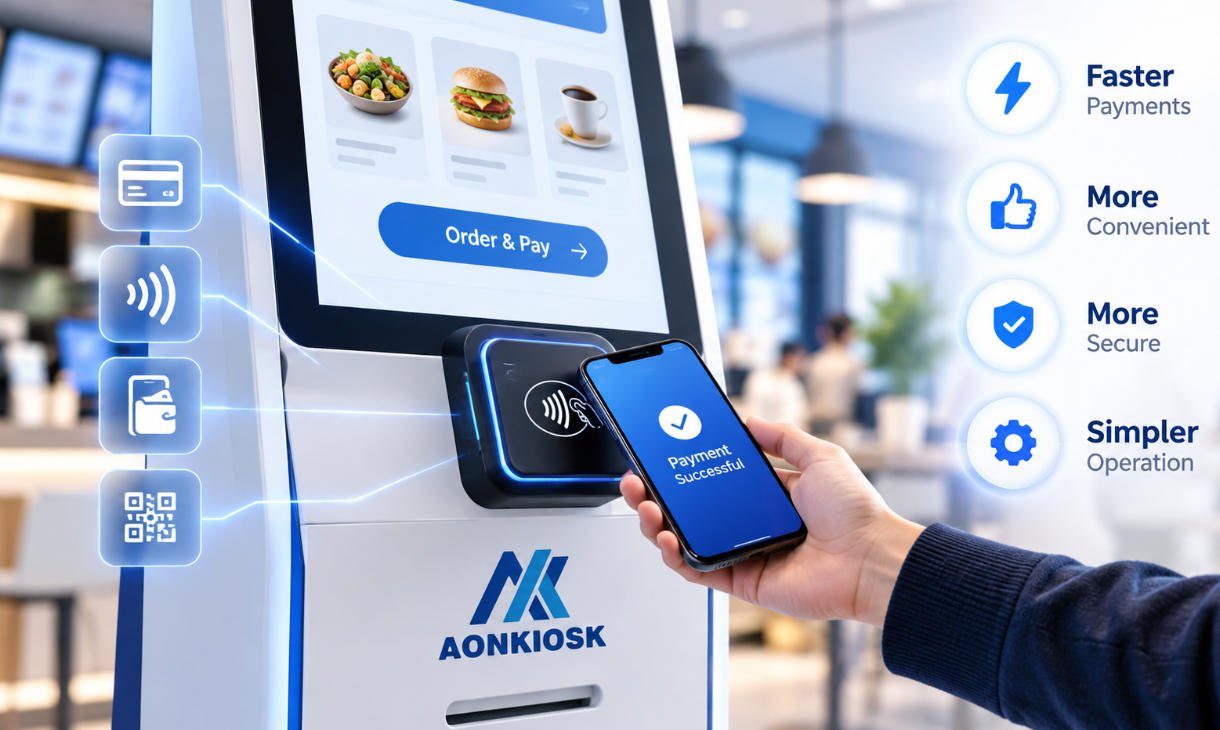
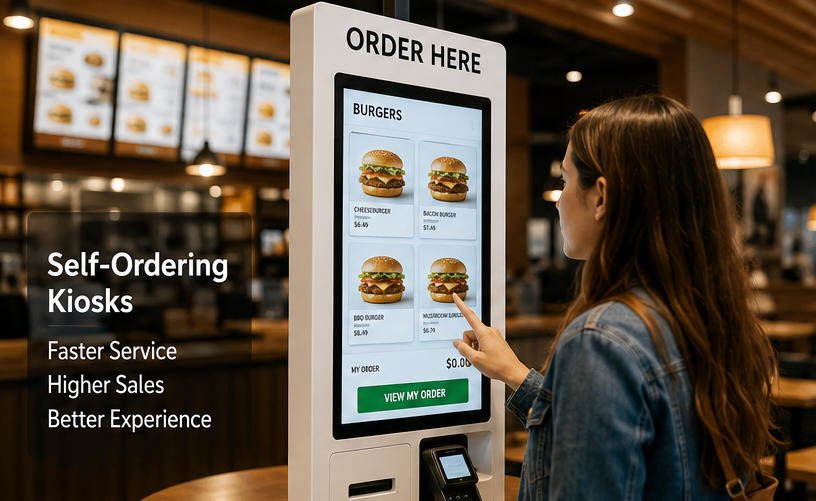
Unlike traditional POS ordering, kiosks allow customers to browse menus at their own pace, customize meals visually, complete secure payments, and transmit orders directly to the kitchen—without requiring cashier interaction.
For operators, this reduces front-counter congestion while allowing employees to focus on food preparation and hospitality.
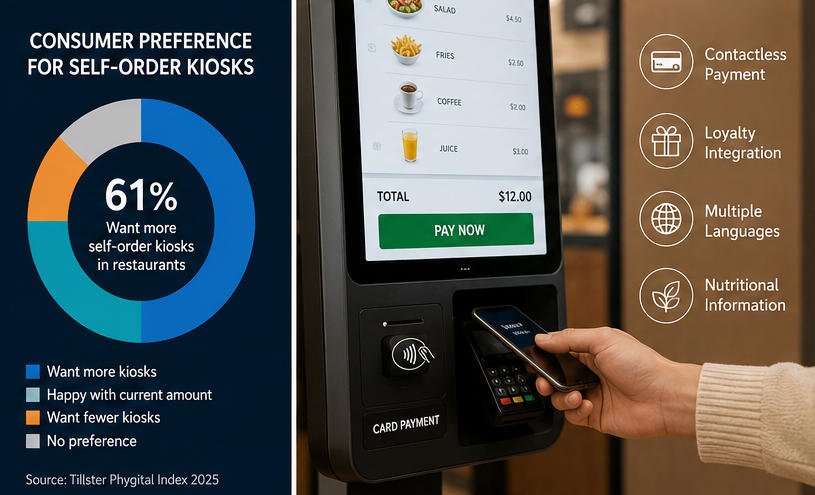
According to Tillster’s 2025 Phygital Index, 61% of consumers want more self-order kiosks in restaurants, compared with just 36% two years earlier. The same survey found that 42% of kiosk users now place kiosk orders at least once every week.
The Global Self-Service Kiosk Market Continues to Expand
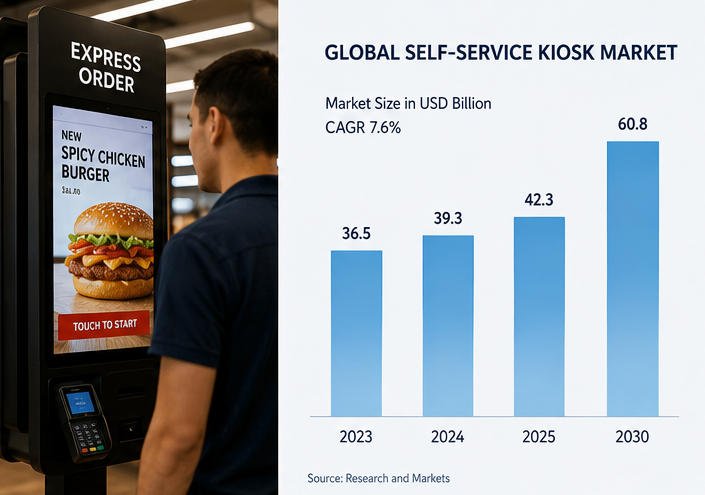
The rapid adoption of restaurant kiosks reflects the broader growth of the self-service technology industry.
Multiple market research firms estimate that the global self-service kiosk market exceeded USD 40 billion in 2025 and is expected to continue growing steadily through 2030, driven primarily by retail, healthcare, transportation, hospitality, and foodservice applications.
Within foodservice specifically:
- Restaurant kiosk installations have increased rapidly since the pandemic.
- Industry analysts estimate that global restaurant self-order kiosks nearly reached 350,000 installed units by 2023.
- Installations are projected to roughly double before the end of this decade.
The strongest growth markets include:
- United States
- Canada
- United Kingdom
- Germany
- Australia
- China
- Japan
- South Korea
- Singapore
- Middle East (UAE & Saudi Arabia)
How Self-Ordering Kiosks Improve Restaurant Operations
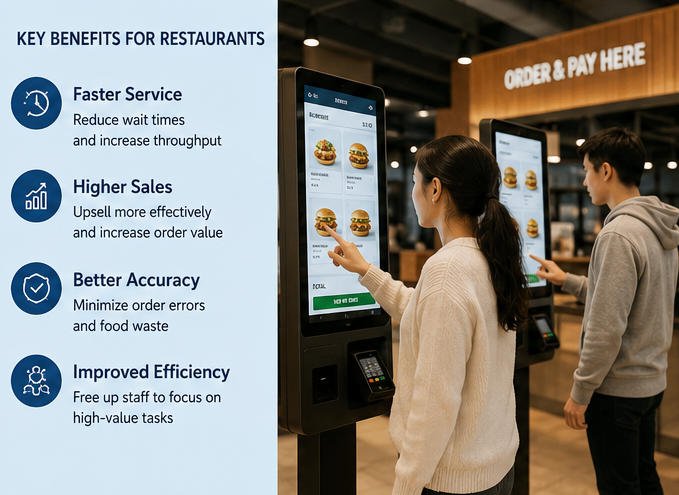
1. Faster Service
Traditional cashier ordering often creates bottlenecks during peak meal periods.
Self-order kiosks allow multiple customers to browse menus simultaneously, reducing queue times and increasing throughput.
Orders are transmitted directly to the kitchen display system (KDS), eliminating manual order entry.
Restaurants commonly experience:
- Faster ordering
- Reduced waiting time
- Higher customer throughput
- Better peak-hour efficiency
2. Higher Average Order Value
Perhaps the biggest financial advantage of kiosks is their ability to consistently upsell.
Unlike cashiers, kiosks never forget to recommend:
- Larger meal sizes
- Side dishes
- Desserts
- Premium toppings
- Limited-time offers
- Beverage upgrades
Industry research indicates kiosk transactions often generate larger average tickets than cashier-assisted orders because digital interfaces present visual recommendations and personalized promotions throughout the ordering process.
3. Improved Order Accuracy
Manual ordering errors remain one of the most common operational issues in restaurants.
Self-ordering kiosks reduce mistakes because customers directly select:
- Ingredients
- Portion sizes
- Allergens
- Cooking preferences
- Drink options
Orders reach the kitchen exactly as entered, minimizing communication errors and reducing food waste.
4. Better Labor Allocation
Contrary to popular belief, most restaurants do not deploy kiosks simply to eliminate staff.
Instead, employees are reassigned to higher-value tasks such as:
- Guest assistance
- Food preparation
- Table service
- Delivery management
- Order fulfillment
- Restaurant cleanliness
Major restaurant brands consistently position kiosks as tools that improve productivity rather than replace hospitality.
Customer Experience Has Become More Personalized
Modern kiosks offer significantly more functionality than early touchscreen ordering systems.
Today’s platforms often include:
- Loyalty program integration
- AI-powered product recommendations
- Multiple language options
- Contactless payment
- Mobile wallet support
- QR code ordering
- Digital receipts
- Accessibility features
- Nutritional information
- Ingredient filtering
Customers can browse menus without feeling rushed, customize meals visually, and review every item before confirming payment.
For international travelers, multilingual interfaces also reduce communication barriers.
Global Restaurant Chains Leading Adoption
Many of the world’s largest restaurant brands now consider kiosks a core component of their digital strategy.
Examples include:
- McDonald’s
- Burger King
- KFC
- Wendy’s
- Panera Bread
- Shake Shack
- Taco Bell
- Five Guys
- Chipotle
- Subway
McDonald’s remains one of the industry’s most influential adopters. The company continues expanding digital ordering across restaurants while integrating kiosks with its mobile app, loyalty program, and delivery ecosystem. Digital sales have become an increasingly important share of the company’s overall business.
Other chains have similarly expanded kiosk deployments after reporting improvements in service speed, order accuracy, and average check size.
AI Is Making Restaurant Kiosks Smarter
Artificial intelligence is becoming the next major innovation in self-ordering technology.
Modern kiosk software increasingly supports:
Personalized Recommendations
AI analyzes previous purchases, loyalty history, time of day, and seasonal trends to recommend menu items.
Dynamic Digital Menus
Restaurants can automatically promote:
- High-margin products
- Limited-time offers
- Low-inventory items
- Breakfast or dinner menus based on time
Predictive Upselling
Machine learning improves upselling strategies by identifying combinations customers are most likely to purchase.
Voice Ordering
Some next-generation kiosks now incorporate conversational AI, enabling customers to place orders using natural language.
Integration Across Restaurant Digital Ecosystems
Today’s kiosk is no longer an isolated ordering terminal.
Instead, it connects with:
- POS systems
- Kitchen Display Systems (KDS)
- Inventory management
- CRM platforms
- Loyalty programs
- Mobile applications
- Online ordering
- Digital menu boards
- Cloud analytics
This creates a seamless omnichannel experience where customers can begin an order on a mobile app, modify it at a kiosk, earn loyalty rewards, and receive personalized promotions across multiple channels.
Challenges Restaurants Must Consider
Despite clear advantages, kiosk deployment requires careful planning.
Common implementation challenges include:
Initial Investment
Hardware, software licensing, installation, and integration require upfront capital.
However, many operators achieve positive ROI through increased sales and labor efficiency over time.
User Adoption
While younger customers readily embrace self-service technology, some elderly or first-time users may require staff assistance.
Restaurants should continue offering alternative ordering methods to ensure accessibility.
Maintenance
Touchscreens require regular cleaning, software updates, payment security compliance, and technical support.
Reliable hardware significantly reduces downtime and operating costs.
Cybersecurity
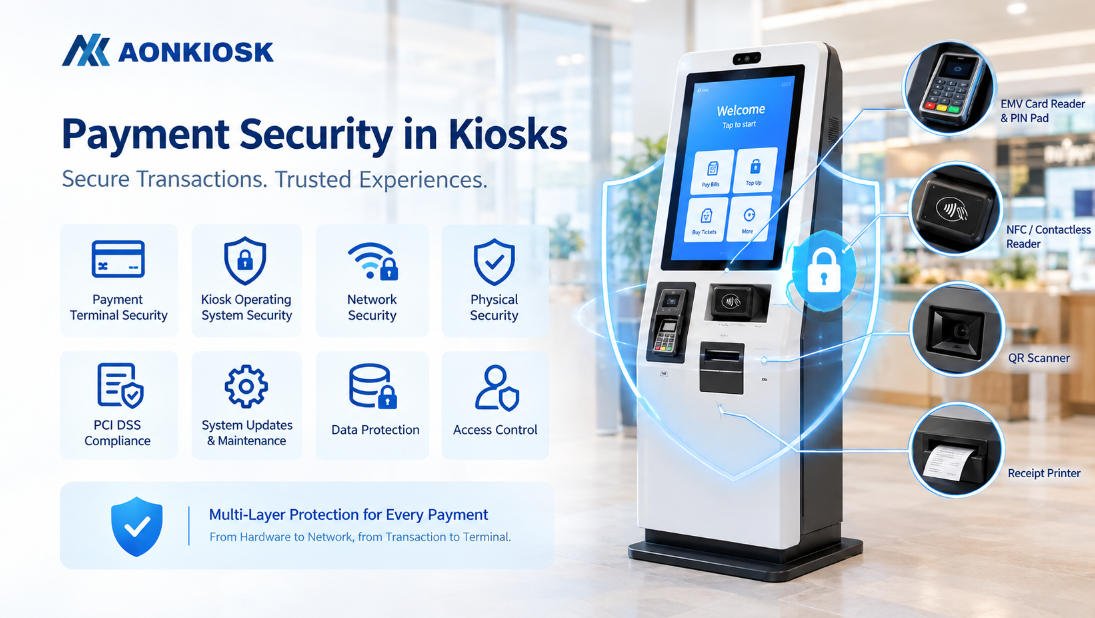
Because kiosks process payment information and customer data, restaurants must implement secure payment gateways, encrypted communications, and regular software updates to protect against cyber threats.
Regional Market Trends
North America
North America remains the largest restaurant kiosk market, driven by labor shortages, rising wages, and widespread consumer acceptance of digital ordering.
Europe
European restaurants increasingly adopt kiosks alongside cashless payment systems, particularly in quick-service chains and transportation hubs.
Asia-Pacific
Asia-Pacific is experiencing the fastest growth.
Countries including China, Japan, South Korea, Singapore, and India are rapidly expanding kiosk deployments due to urbanization, smartphone adoption, and government support for digital transformation.
Middle East
Restaurants across the UAE and Saudi Arabia are investing heavily in self-service technologies as part of broader smart city and hospitality modernization initiatives.
The Future of Restaurant Self-Ordering
Over the next five years, restaurant kiosks are expected to evolve beyond simple ordering terminals.
Emerging innovations include:
- AI-powered voice assistants
- Facial recognition for loyalty identification (where legally permitted)
- Computer vision for personalized recommendations
- Real-time inventory synchronization
- Fully cloud-managed kiosk fleets
- Predictive maintenance
- Remote device management
- Integration with robotic food preparation
- Advanced customer analytics
Rather than replacing employees, kiosks will increasingly automate repetitive tasks while allowing staff to focus on customer engagement and operational excellence.
Conclusion
Self-ordering kiosks have become a strategic investment rather than a technology experiment.
For restaurant operators, they offer measurable improvements in operational efficiency, order accuracy, customer satisfaction, and revenue generation. For consumers, they deliver greater convenience, personalization, and faster service.
As artificial intelligence, cloud computing, and digital payments continue to advance, self-ordering kiosks will play an even more central role in shaping the future of restaurants worldwide. Businesses that invest in scalable, integrated, and user-friendly kiosk solutions today will be better positioned to compete in an increasingly digital foodservice landscape.
References
- Tillster, 2025 Phygital Index – Restaurant Consumer Trends: https://www.restaurantdive.com/news/tillster-phygital-report-2025-kiosks-preference-increasing-us-consumers/745162/
- Restroworks, Self-Ordering Kiosk Restaurant Statistics 2025: https://www.restroworks.com/blog/self-ordering-kiosk-restaurant-statistics/
- Research and Markets, Global Self-Service Kiosk Market Forecast: https://www.researchandmarkets.com/reports/6113839/self-service-kiosk-market-forecasts
- Technavio, Self-Service Kiosk Market Forecast 2025–2029: https://finance.yahoo.com/news/self-kiosk-market-grow-usd-024500695.html
- Investopedia, Why Ordering Food at a Kiosk Can Be More Expensive: https://www.investopedia.com/why-ordering-food-at-a-kiosk-can-be-smooth-easy-and-more-expensive-than-you-realize-11716597
- Wavetec, McDonald’s Self-Ordering Kiosk Strategy: https://www.wavetec.com/blog/mcdonalds-leveraging-self-service-technologies/