





Introduction: Self-Service Kiosks Enter a Data-First Era
The self-service kiosk industry is undergoing a significant transformation driven by big data analytics, AI integration, and digital consumer behavior shifts. What was once a simple automation tool for ordering or ticketing has evolved into a core infrastructure component across retail, hospitality, healthcare, transportation, and government services.
For global manufacturers—especially Chinese kiosk manufacturers—this shift presents a major opportunity to move from hardware suppliers to intelligent solution providers.
Today, self-service kiosks are no longer just “machines”; they are data collection and customer interaction endpoints in a rapidly expanding digital ecosystem.
Global Market Overview: Strong Expansion Driven by Automation Demand
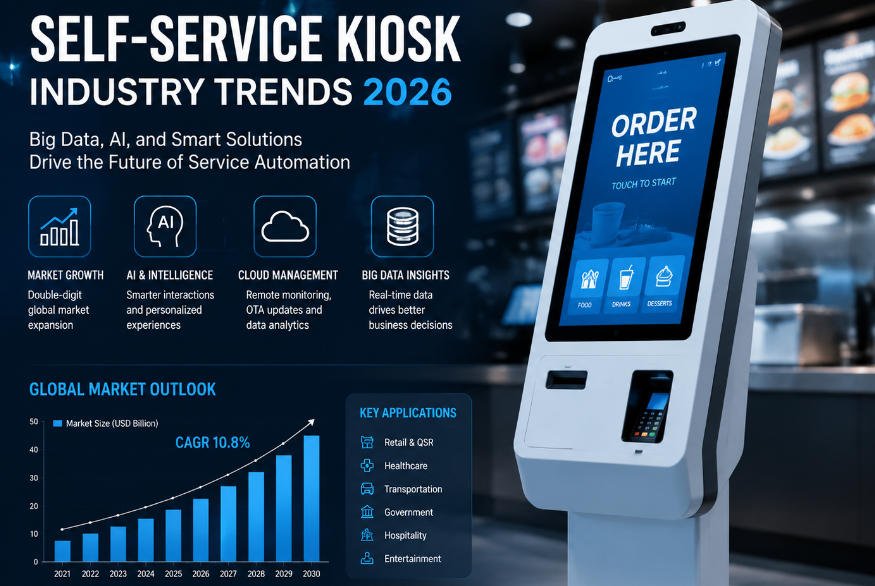
Industry research consistently shows that the self-service kiosk market is experiencing steady double-digit growth, driven by labor cost pressures, digital transformation strategies, and consumer preference for fast, contactless services.
Key macro trends shaping the market:
- Rising adoption of contactless payment systems
- Increasing demand for labor-saving automation in retail and QSR (Quick Service Restaurants)
- Expansion of smart cities and digital public infrastructure
- Integration with cloud-based management platforms
- Growth of omnichannel retail ecosystems
From a big data perspective, kiosks are becoming critical nodes in real-time customer analytics networks, capturing behavioral data such as:
- Purchase patterns
- Peak usage time
- User journey mapping
- Payment preference distribution
- Queue and service efficiency metrics
This data is now a strategic asset for enterprises optimizing operations and customer experience.
Technology Evolution: From Standalone Devices to Intelligent Systems
Modern self-service kiosks are evolving into AI-powered interactive terminals connected to centralized cloud systems.
1. AI + Personalization
Kiosks now use machine learning to:
- Recommend products based on purchase history
- Adjust UI based on user behavior
- Optimize upselling and cross-selling strategies
2. Cloud-Based Management
Operators can now manage thousands of kiosks remotely:
- Real-time status monitoring
- Software updates via OTA (Over-The-Air)
- Performance analytics dashboards
3. Big Data Integration
Kiosks feed structured and unstructured data into enterprise systems:
- CRM (Customer Relationship Management)
- ERP (Enterprise Resource Planning)
- Marketing automation platforms
This turns kiosks into frontline data engines rather than isolated hardware units.
Industry Applications: Expanding Use Cases Across Sectors
Retail & QSR (Quick Service Restaurants)
Self-ordering kiosks reduce waiting time and increase order accuracy while boosting average transaction value through AI-driven recommendations.
Transportation & Ticketing
Airports, metro systems, and bus terminals use kiosks for:
- Ticket issuance
- Check-in automation
- Identity verification
Healthcare
Hospitals deploy kiosks for:
- Patient registration
- Appointment scheduling
- Payment processing
Government & Public Services
Digital kiosks reduce administrative workload by enabling:
- Self-service document applications
- Tax and utility payments
- Information access services
Each of these sectors contributes to a growing ecosystem of data-rich service automation.
Big Data Insight: What Kiosks Reveal About Consumer Behavior
One of the most valuable aspects of self-service kiosks is their ability to generate real-world behavioral datasets at scale.
Key insights derived from kiosk data:
- Peak demand forecasting: identifying hourly and seasonal usage patterns
- Menu optimization: determining best-selling combinations in QSR environments
- Customer segmentation: grouping users by spending habits and interaction speed
- Operational efficiency: detecting bottlenecks in service workflows
For businesses, this enables data-driven decision-making in real time, significantly improving ROI.
Opportunity for Chinese Manufacturers: From OEM to Smart Solution Providers
China remains one of the world’s most important hubs for kiosk manufacturing due to its:
- Strong hardware supply chain
- Competitive production costs
- Rapid prototyping capabilities
- Mature industrial engineering ecosystem
However, the industry is shifting.
The New Competitive Advantage: Intelligence, Not Just Hardware
To stay competitive globally, Chinese kiosk manufacturers must evolve in three key directions:
1. Hardware + Software Integration
Moving beyond chassis and touchscreen production to:
- Embedded operating systems
- Cloud management platforms
- API-driven ecosystem integration
2. Data Capability Building
Manufacturers can no longer ignore data:
- Build analytics dashboards for clients
- Offer usage intelligence as a service
- Integrate AI-based recommendation engines
3. Industry-Specific Solutions
Instead of generic kiosks, demand is rising for:
- Retail-specific ordering systems
- Healthcare compliance kiosks
- Transportation-grade rugged terminals
This shift enables higher margins and long-term client relationships.
Challenges in the Industry
Despite strong growth, the sector faces several challenges:
- High integration complexity across software ecosystems
- Security risks in payment and personal data handling
- Rapid technological obsolescence cycles
- Increasing global competition from Korea, Europe, and the US
Manufacturers must invest heavily in R&D and software ecosystems to remain competitive.
Future Outlook: Smart, Connected, and Data-Centric Kiosks
The next phase of self-service kiosks will be defined by:
- Full AI-driven personalization
- Edge computing for real-time decision making
- Deep integration with IoT ecosystems
- Voice and facial recognition interfaces
- Predictive analytics for business optimization
In the long term, kiosks will act as distributed customer intelligence nodes within smart cities and digital commerce systems.
Conclusion
The self-service kiosk industry is entering a new era shaped by big data, AI, and cloud intelligence. For global players, especially Chinese manufacturers, the opportunity lies not only in producing reliable hardware but in delivering end-to-end intelligent service ecosystems.
Companies that successfully combine manufacturing strength with data-driven software capabilities will lead the next wave of global kiosk innovation.