





Adding a cash recycler to a self-service kiosk is not simply a matter of finding enough empty space inside the cabinet.
The recycler affects the kiosk’s internal structure, user interface, cash path, service doors, security, power distribution, software logic and even the way the machine is transported and installed.
This is why cash recycler integration should ideally begin before the kiosk enclosure is finalized.
A common mistake is to design the touchscreen, printer and payment area first, then try to fit the recycler into whatever space remains. It may work in CAD, but the resulting machine can be difficult to refill, awkward to repair, unnecessarily large, or impossible to service without removing other components.
For a commercial deployment, integration needs to answer a more practical question:
Can the cash recycler operate reliably inside this kiosk every day—and can technicians actually maintain it when something goes wrong?
This guide looks at the engineering decisions behind integrating a cash recycler into a self-service kiosk, from choosing the exact module and planning denomination capacity to mechanical mounting, software communication and prototype testing.
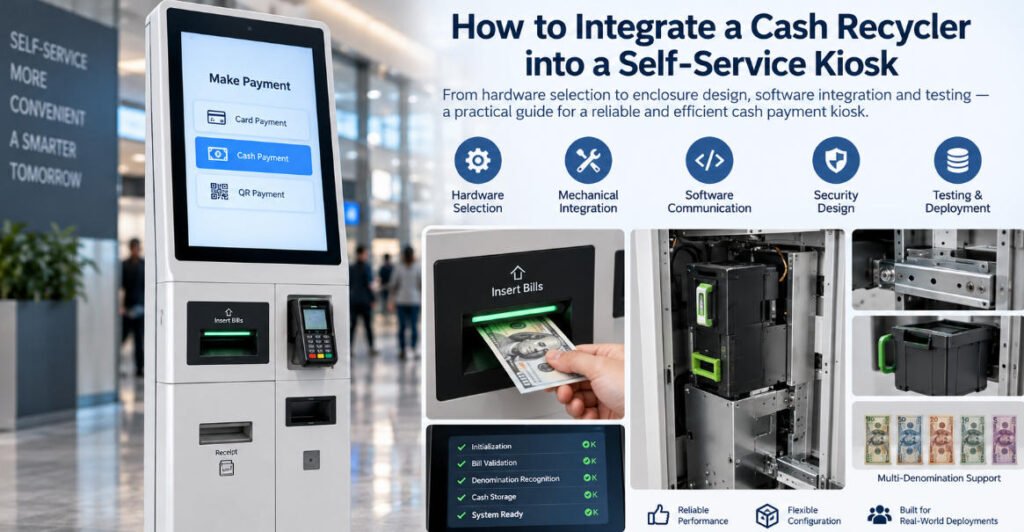
Start With the Transaction Model, Not the Recycler
Before selecting hardware, understand how cash will actually move through the kiosk.
Consider a payment kiosk that processes 600 transactions per day. If only 8% of customers use cash, it has a very different requirement from another kiosk where 60% of customers pay with banknotes and frequently need change.
Start by documenting:
- Expected transactions per day
- Percentage of cash transactions
- Average transaction value
- Currency
- Accepted denominations
- Typical banknotes inserted
- Expected change per transaction
- Required operating period between cash collections
- Peak-day transaction volume
These figures determine whether recycling is justified and what capacity is needed.
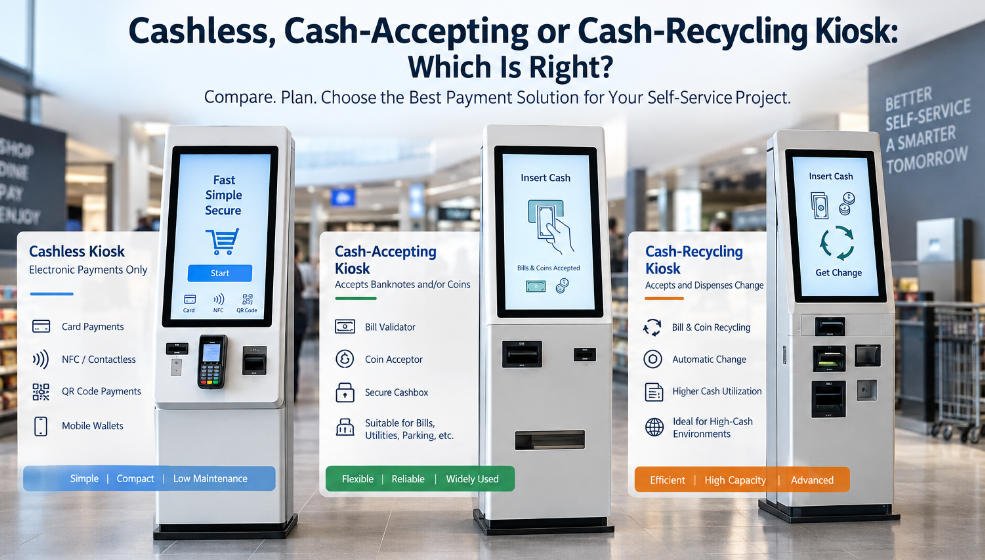
If your project is still deciding between electronic payment, basic cash acceptance and recycling, that architecture decision should be made before detailed cash recycler integration begins.
A recycler solves a particular operational problem: it allows suitable accepted cash to become available for later payouts. If the kiosk rarely returns change, a simpler bill validator and cashbox may be more economical and easier to maintain.
Freeze the Exact Cash Recycler Model Early
“Cash recycler” is not a mechanical specification.
Different models can vary considerably in dimensions, accepted currencies, denomination configuration, storage capacity, communication interface, power requirements, note insertion position and service procedure.
Before enclosure design is frozen, obtain the exact recycler’s:
- Product datasheet
- 2D mechanical drawing
- 3D CAD file, if available
- Installation manual
- Electrical requirements
- Interface documentation
- SDK/API documentation
- Recommended mounting orientation
- Required maintenance clearance
A physical sample is even better.
This is similar to integrating a card terminal. As discussed in AONKIOSK’s kiosk payment terminal integration guide, peripheral selection should ideally be confirmed before final sheet-metal drawings are approved.
Changing a recycler late in development can be considerably more disruptive than changing a small peripheral.
A 10 mm dimensional difference may affect a bracket. A different service direction may affect an entire door. A different note path may require the customer-facing insertion slot to move.
For this reason, the exact hardware model should be treated as part of the kiosk’s mechanical specification.
Understand the Cash Path Before Designing the Cabinet
A recycler has both a customer-facing cash path and an internal cash path.
From the customer’s perspective, the interaction may look simple:
Insert banknote → validation → transaction → receive change
Inside the machine, several things can happen.
The inserted banknote may be authenticated, identified by denomination, routed into a recycling cassette, sent to a storage cassette, rejected, or returned to the customer.
During payout, stored denominations must travel back through the dispensing mechanism to the customer.
The kiosk enclosure cannot obstruct any part of this process.
Pay particular attention to the relationship between:
Bezel → recycler inlet → transport mechanism → recycling/storage modules → service access
The front-panel opening must align accurately with the recycler’s input/output position. Poor alignment can create an awkward user experience and may make the kiosk appear poorly assembled even when the recycler itself works correctly.
The surrounding metalwork should also avoid creating unnecessary edges or gaps around the cash inlet.
Mechanical Mounting Must Support More Than Weight
Cash recyclers are generally larger and mechanically more complex than card readers or barcode scanners.
Their mounting system therefore needs to do more than simply hold the device.
A good structure should provide:
Rigid support. The recycler should not shift when users insert or retrieve banknotes.
Accurate alignment. The cash inlet needs to remain aligned with the external bezel.
Vibration resistance. Normal operation, transportation and repeated door opening should not gradually loosen the assembly.
Serviceability. The recycler should be removable without dismantling unrelated kiosk components.
Load distribution. Heavy modules should transfer their load into a suitable internal frame rather than relying on a thin decorative panel.
In some projects, a fixed mounting frame is appropriate.
In others, a sliding tray or removable module frame can significantly improve servicing.
The correct solution depends on recycler weight, enclosure dimensions, service direction and deployment environment.
This is one area where prototype testing is more valuable than making decisions from renderings alone.
Leave Real Service Clearance
A frequent kiosk design mistake is confusing installation space with service space.
Suppose a recycler is 400 mm deep and the cabinet provides 405 mm.
Technically, it fits.
But can a technician open the cassette?
Can the module be pulled out?
Can a jammed note be reached?
Can a connector be unplugged?
Can the recycler be replaced without removing the industrial PC, printer or power supply?
These questions often reveal that the kiosk needs considerably more internal space than the component dimensions suggest.
Before approving the enclosure, simulate common service procedures:
- Open the kiosk.
- Remove or replenish cash.
- Clear a banknote jam.
- Access connectors.
- Remove the recycler.
- Reinstall and align it.
If one of these procedures requires disassembling several unrelated components, reconsider the layout.
Good cash recycler integration is not only about fitting hardware into a cabinet. It is about making the hardware maintainable throughout the kiosk’s working life.
Design the Service Door Around Cash Operations
Cash access deserves special consideration because it combines maintenance and security.
Depending on the recycler, technicians may need access to recycling cassettes, overflow storage, transport paths and connectors.
The service door therefore needs sufficient opening angle and working clearance.
But making a large door is not automatically better.
Door dimensions influence enclosure stiffness, lock placement, hinge loading and unauthorized-access risk.
A practical design separates public interaction from technician interaction.
The customer should only reach the intended cash inlet/output area. Cash storage, mounting hardware and internal connections should remain behind controlled service access.
For higher-risk deployments, project teams may also need to consider reinforced doors, multiple locking points, internal cash compartments, anchoring and operational procedures for cash collection.
The enclosure and recycler should be considered one security system rather than two unrelated products.
Plan Banknote Capacity by Denomination
Recycler capacity is often discussed as a single number.
For example:
“The recycler can hold X notes.”
That number can be misleading.
A recycler does not simply need enough total capacity. It needs the right denomination distribution.
Imagine a kiosk that accepts $5, $10, $20 and $50 notes.
Customers may frequently insert $20 notes but receive $5 and $10 notes as change. The kiosk could therefore have plenty of total cash inside while still becoming unable to complete certain transactions because one payout denomination has been depleted.
This is why capacity planning should consider:
Cash demand by denomination, not only total banknote count.
A useful starting estimate is:
Daily notes handled = Daily transactions × Cash-payment rate × Average notes inserted per cash transaction
For example:
600 transactions/day × 40% cash × 1.5 notes = 360 incoming notes per day
But that still does not tell the whole story.
You also need to estimate the denomination mix, change payouts, peak-day variation and collection interval.
A sensible design normally includes additional capacity margin rather than sizing the system exactly to average daily demand.
Later in this content series, this subject can be developed further as a dedicated kiosk cash-capacity calculation guide.
Consider the Recycler’s Effect on Overall Kiosk Size
Cash-handling hardware can quickly dominate the internal architecture.
A cashless kiosk may fit inside a relatively slim cabinet because a payment terminal, scanner and receipt printer require limited space.
A recycler changes that equation.
It may require:
- Greater enclosure depth
- A wider lower cabinet
- Additional internal framing
- Larger service doors
- More floor footprint
- Increased shipping weight
- A stronger base
- Additional anti-tipping measures
This is particularly important when the kiosk also contains a coin system.
A machine combining a banknote recycler, coin recycler, receipt printer, card terminal, scanner, industrial PC and UPS can become crowded very quickly.
For this reason, AONKIOSK’s Retail & Payment Kiosks are better viewed as configurable hardware platforms rather than a fixed enclosure into which every possible payment component can simply be inserted.
The enclosure dimensions should follow the required hardware architecture.
Do Not Forget the Center of Gravity
Cash recycler placement can also affect kiosk stability.
A heavy module installed high inside a narrow enclosure may raise the center of gravity. A large service door can shift balance when opened. Pulling a heavy recycler forward on a sliding tray can change the load distribution again.
Floor-standing kiosks should therefore be evaluated in both operating and service conditions.
Depending on the project, designers may need to consider:
- Base dimensions
- Recycler mounting height
- Floor anchoring
- Wall anchoring
- Internal frame strength
- Service-tray extension
- Door weight
- Anti-tipping design
These considerations are especially important for public environments where users may lean on or push against the kiosk.
Power and Communication Need Their Own Plan
Cash recycler integration is both mechanical and electronic.
Depending on the selected hardware, the recycler may communicate with the host system through serial, USB or another manufacturer-supported interface.
Do not assume the interface from a generic product description.
Use the documentation for the exact model.
The electrical design should confirm:
- Required input voltage
- Peak and normal power consumption
- Power-supply capacity
- Communication interface
- Connector location
- Cable length
- Grounding requirements
- Power-up sequence where relevant
- Host computer compatibility
Cable routing deserves attention as well.
Recycler cables should not cross moving doors, sharp sheet-metal edges, printer service paths or areas where technicians routinely remove cash cassettes.
Leave appropriate service slack while preventing loose cables from entering mechanical areas.
Software Integration Goes Beyond “Accept Cash”
The software side is where recycling becomes substantially more complex than basic cash acceptance.
The kiosk application may need to receive information about:
- Inserted denomination
- Accepted or rejected banknote
- Current recycler inventory
- Available payout denominations
- Cashbox status
- Full or near-full conditions
- Jam conditions
- Module errors
- Dispensed amount
- Failed payout
- Returned banknote
The transaction logic must then decide what happens next.
Consider a simple example.
A customer needs to pay $12 and inserts $20.
Before accepting the transaction, should the application confirm that $8 of change is available?
What happens if the recycler can return only $5?
Should the $20 note be rejected immediately?
Should the transaction be cancelled?
Can another payment method be offered?
These decisions are not mechanical-enclosure questions. They belong to the software and payment workflow.
AONKIOSK focuses on kiosk hardware manufacturing and integration rather than developing the customer’s business software, so responsibilities between the recycler supplier, software developer, kiosk manufacturer and system integrator should be defined early in the project.
Build Error States Into the User Experience
A working recycler is only one operating condition.
Commercial kiosks also need to behave sensibly when something goes wrong.
Typical situations include:
- Banknote rejected
- Unsupported denomination
- Insufficient change
- Recycler cassette full
- Recycler cassette empty
- Banknote jam
- Communication lost
- Module unavailable
- Service door open
Each state should have a defined software response.
For example, if cash temporarily becomes unavailable but card payment remains operational, the kiosk might disable the cash option rather than taking the entire machine offline.
This is where modular payment architecture can improve uptime.
The objective is not to pretend failures will never happen. The objective is to make predictable failures manageable.
Think Carefully Before Adding Coin Recycling
Many projects use the phrase “cash recycler” to mean a complete banknote-and-coin system.
These are not necessarily one module.
Banknote recycling and coin recycling often involve separate hardware with different capacity, routing and maintenance requirements.
Coins introduce their own challenges:
- Weight
- Coin diameter and thickness
- Sorting
- Hoppers
- Overflow
- Foreign objects
- Dirt and debris
- Coin return paths
- Collection containers
If the kiosk needs to return both notes and coins, the enclosure layout becomes significantly more complicated.
Do not finalize the cabinet around the banknote recycler and assume the coin system can be “added later.”
Both cash paths should be designed together.
Separate Customer Access From Cash Collection Access
Another useful design principle is to distinguish three zones:
Customer zone: touchscreen, scanner, payment terminal, cash inlet/output and receipt outlet.
Service zone: printer paper, computer access, cable connections and replaceable peripherals.
Cash-security zone: recycler cassettes, overflow cashbox and other stored currency.
The exact architecture varies, but separating these functions can make servicing more organized and reduce unnecessary access to stored cash.
For example, staff replacing receipt paper should not necessarily need access to the cash storage area.
Likewise, cash-collection personnel may not need access to the kiosk’s industrial computer or network equipment.
These boundaries can be considered during the enclosure design rather than solved later with operational rules.
Prototype With the Real Recycler
A recycler integration should not go directly from CAD to batch production.
Build a physical prototype using the actual cash-handling hardware whenever possible.
At minimum, test:
Banknote insertion. Does the user naturally find and reach the inlet?
Banknote return. Can returned notes be retrieved easily?
Payout. Does dispensed cash remain accessible without falling or becoming trapped?
Repeated transactions. Does the mechanism remain stable during continuous use?
Cashbox access. Can authorized staff remove and reinstall storage modules comfortably?
Jam recovery. Can a technician reach the relevant cash path?
Module replacement. How long does recycler removal actually take?
Door operation. Do service doors, hinges or cables interfere with the module?
Thermal behavior. Does the complete kiosk remain within the operating requirements of its installed components?
Transport stability. Does the mounting remain secure after normal handling and shipping simulation?
AONKIOSK’s OEM & ODM kiosk manufacturing workflow covers mechanical engineering, peripheral integration, prototyping and production support, which is particularly relevant for projects where cash hardware determines much of the internal structure.
A prototype is where theoretical fit becomes practical validation.
Define Responsibility Between All Project Parties
Cash recycler projects often involve more companies than expected.
There may be:
- Kiosk manufacturer
- Cash recycler manufacturer
- Software company
- Payment solution provider
- System integrator
- Distributor
- End customer
- Local maintenance provider
Problems occur when everyone assumes another party is responsible for integration.
Before production, define who handles:
Mechanical integration
Who designs the brackets, openings and enclosure?
Electrical integration
Who specifies the power supply and communication wiring?
Driver/SDK integration
Who connects the recycler SDK to the kiosk application?
Transaction logic
Who determines change rules and error handling?
Testing
Who validates cash transactions with local currency?
Field maintenance
Who services the recycler after deployment?
A clear responsibility matrix can prevent significant delays during commissioning.
What to Send Your Kiosk Manufacturer
If you are requesting a custom kiosk with cash recycling, avoid sending only:
“We need cash payment.”
A much better RFQ package includes:
- Recycler manufacturer and model
- Currency
- Accepted denominations
- Required payout denominations
- Estimated daily transactions
- Expected cash-payment percentage
- Average transaction value
- Cash collection interval
- Recycler datasheet
- Mechanical drawings
- SDK/interface information
- Coin-handling requirements
- Other kiosk peripherals
- Installation environment
- Preferred kiosk dimensions
- Prototype quantity
- Expected production quantity
If the recycler model has not yet been selected, make that clear.
The manufacturer can then avoid designing critical structures around dimensions that may change later.
Final Thoughts: Integration Should Follow the Cash Workflow
Successful cash recycler integration is not defined by whether the recycler physically fits inside the kiosk.
It is defined by whether the complete system works as a commercial machine.
Customers need to insert and retrieve cash naturally. The software needs to understand available denominations. Technicians need to clear jams and remove cassettes without dismantling the kiosk. The enclosure needs to support and protect heavy cash hardware. And the system needs enough capacity to survive the intended service interval.
That requires cooperation between mechanical engineering, electrical integration, software development and field operations.
For custom projects, AONKIOSK can develop the kiosk enclosure and internal hardware architecture around customer-selected recyclers, payment terminals, printers, scanners and other commercial peripherals.
The earlier those components are defined, the easier it is to create a kiosk that is compact, serviceable and practical to manufacture at scale.
Frequently Asked Questions
What information is needed before integrating a cash recycler into a kiosk?
The most important information is the exact recycler model, currency, accepted and payout denominations, mechanical dimensions, power requirements, communication interface, expected cash volume and service-access requirements. Providing a physical sample during prototype development can also reduce integration risk.
Can a cash recycler be added to an existing kiosk design?
Sometimes, but it depends on available internal space, front-panel geometry, structural strength and service access. Adding a recycler to a cabinet originally designed for cashless payment may require substantial enclosure modifications.
How much space should be left around a cash recycler?
There is no universal clearance. Use the installation and maintenance requirements of the exact recycler model. In addition to the device dimensions, allow enough room for cassette removal, jam clearing, connectors and module replacement.
What is the difference between a bill validator and a cash recycler?
A bill validator primarily authenticates and accepts banknotes, typically routing them to a storage cashbox. A recycler can retain suitable denominations and make them available for later payout. That makes recycler integration more complex mechanically and at the software level.
Does a cash recycler require special kiosk software?
The kiosk application normally needs to communicate with the recycler through the hardware manufacturer’s supported interface or SDK. Software requirements can include denomination recognition, inventory monitoring, payout commands, error handling and transaction recovery.
Should banknote and coin recycling be designed together?
Yes, if both are required. Coin modules introduce additional space, weight, routing and maintenance requirements. Designing the banknote system first and adding coin recycling late can force major enclosure changes.
Can AONKIOSK integrate a customer-specified cash recycler?
For custom OEM/ODM projects, AONKIOSK can design kiosk hardware around specified third-party peripherals, subject to evaluation of the actual module, dimensions, interfaces and project requirements. Providing technical documentation and preferably a sample during development helps reduce integration uncertainty.