





Artificial intelligence (AI) is reshaping the way businesses interact with customers, and self-service kiosks have become one of the most visible examples of this transformation. Once limited to basic functions such as ticket printing or order placement, modern kiosks now leverage AI, computer vision, machine learning, natural language processing (NLP), and cloud connectivity to deliver faster, more personalized, and more intelligent customer experiences.
Across retail, healthcare, hospitality, banking, transportation, and quick-service restaurants (QSRs), AI-powered self-service kiosks are becoming strategic business assets rather than simple self-checkout machines. They help organizations reduce operating costs, improve service quality, increase revenue, and address ongoing labor shortages while meeting rising customer expectations for speed and convenience.
This article explores how AI-powered self-service kiosks work, the technologies behind them, real-world applications, measurable business benefits, current market trends, and the challenges organizations should consider before deployment.
What Are AI-Powered Self-Service Kiosks?
AI-powered self-service kiosks are interactive terminals equipped with artificial intelligence technologies that enable automated customer interactions with minimal human assistance.
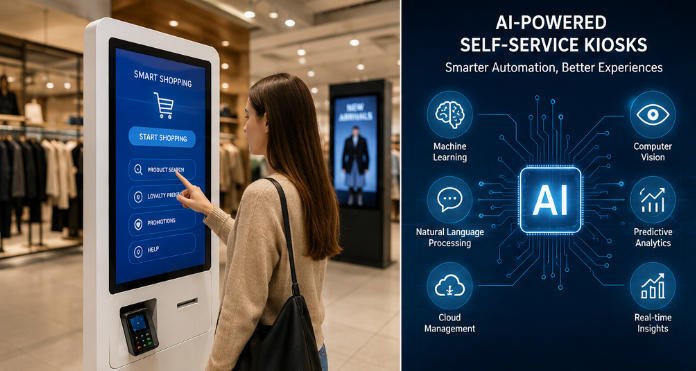
Unlike traditional kiosks that follow fixed workflows, AI-enabled kiosks continuously analyze user behavior, learn from data, and optimize interactions in real time. Depending on the application, they may include:
- Machine learning algorithms
- Computer vision cameras
- Voice recognition
- Natural language processing (NLP)
- Facial recognition (where legally permitted)
- Recommendation engines
- Predictive analytics
- Cloud-based management platforms
- IoT connectivity
These capabilities allow kiosks to provide personalized recommendations, detect customer intent, automate identity verification, optimize operations, and generate valuable business insights.
Why AI Is Changing Self-Service Technology
Customer expectations have changed dramatically over the past decade. According to PwC’s Global Consumer Insights Survey, speed, convenience, and personalized experiences have become key factors influencing purchasing decisions.
At the same time, businesses face increasing challenges:
- Rising labor costs
- Staff shortages
- Higher customer service expectations
- Growing demand for 24/7 services
- Digital transformation initiatives
AI bridges these gaps by allowing businesses to automate repetitive processes while maintaining high-quality customer interactions.
Instead of replacing employees entirely, AI-powered kiosks often handle routine tasks so staff can focus on higher-value customer engagement.
Core AI Technologies Behind Modern Kiosks
1. Machine Learning
Machine learning enables kiosks to improve recommendations over time by analyzing historical customer behavior.
For example:
- recommending additional menu items
- suggesting complementary retail products
- predicting customer preferences
- optimizing promotional offers
This creates experiences similar to online recommendation systems used by major e-commerce platforms.
2. Computer Vision
Computer vision allows kiosks to recognize objects, products, identification documents, or customer movement.
Applications include:
- age verification
- inventory recognition
- facial authentication (where permitted)
- queue monitoring
- gesture recognition
Retailers increasingly use computer vision to accelerate checkout processes while reducing fraud.
3. Natural Language Processing (NLP)
NLP allows customers to interact with kiosks using natural speech rather than navigating multiple touch-screen menus.
Modern conversational kiosks can:
- answer frequently asked questions
- guide users through transactions
- provide multilingual assistance
- understand conversational requests
This significantly improves accessibility for elderly users and international visitors.
4. Predictive Analytics
AI analyzes historical transaction data to predict customer behavior.
Businesses can:
- forecast demand
- optimize inventory
- personalize promotions
- reduce waiting times
- allocate staff more efficiently
5. Cloud-Based AI Management
Cloud platforms enable organizations to manage thousands of kiosks from a centralized dashboard.
Administrators can remotely:
- deploy software updates
- monitor device health
- collect analytics
- adjust pricing
- update digital signage
- manage AI models
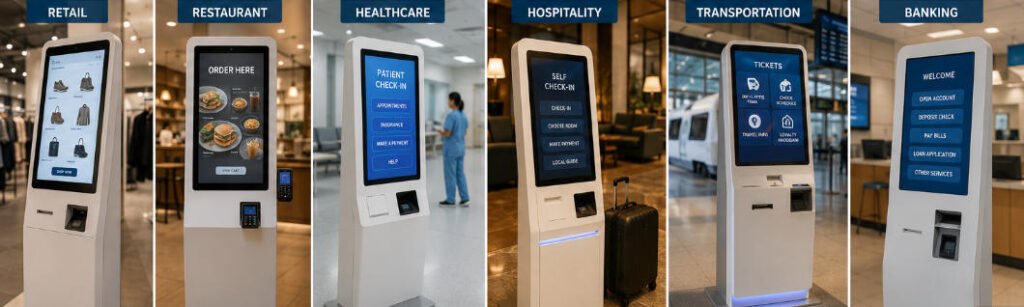
Industry Applications
Retail
Retail remains one of the largest adopters of AI-powered kiosks.
Common applications include:
- self-checkout
- endless aisle ordering
- product information
- loyalty enrollment
- personalized promotions
- returns processing
AI helps retailers analyze purchasing behavior and recommend products based on customer preferences, increasing basket size and customer satisfaction.
Quick-Service Restaurants (QSR)
Restaurants increasingly rely on AI ordering kiosks.
Benefits include:
- reduced ordering errors
- faster ordering
- personalized upselling
- dynamic menu recommendations
- multilingual ordering
Research has shown that digital ordering systems often encourage customers to purchase additional items because AI consistently suggests complementary products throughout the ordering process.
Healthcare
Healthcare providers use intelligent kiosks for:
- patient check-in
- appointment scheduling
- insurance verification
- identity confirmation
- symptom screening
- payment processing
These systems reduce administrative workloads while improving patient flow and reducing waiting times.
Hospitality
Hotels use AI-powered kiosks for:
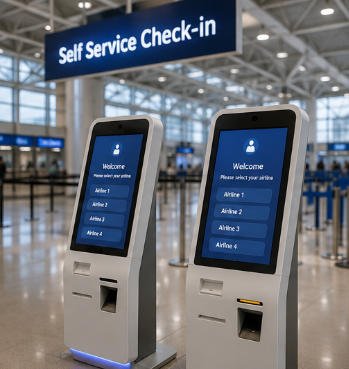
- self check-in
- digital room keys
- payment
- local recommendations
- concierge services
- express check-out
This improves guest satisfaction while allowing hotel staff to focus on personalized hospitality.
Transportation
Airports, railway stations, and public transportation operators use AI kiosks for:
- ticket purchasing
- baggage services
- passenger information
- identity verification
- boarding assistance
Many transportation hubs now combine AI with biometric technologies to accelerate passenger processing.
Banking and Financial Services
Banks deploy intelligent kiosks for:
- account opening
- identity verification
- loan applications
- cash deposits
- ATM services
- financial education
AI also assists in fraud detection and document validation during customer onboarding.
Business Benefits
Improved Operational Efficiency
Automating repetitive customer interactions allows businesses to serve more customers without proportional increases in staffing.
This reduces labor costs while improving service consistency.
Faster Customer Service
AI kiosks dramatically reduce queue times.
Customers appreciate shorter waiting periods, especially in airports, restaurants, and hospitals where time is critical.
Personalized Experiences
Unlike traditional kiosks, AI systems adapt recommendations based on:
- purchase history
- demographics
- browsing behavior
- seasonal trends
- loyalty programs
Personalization often leads to higher customer satisfaction and increased revenue.
Better Business Intelligence
Every interaction generates valuable data.
Organizations gain insights into:
- customer preferences
- peak traffic hours
- purchasing behavior
- product performance
- operational bottlenecks
These insights support better strategic decision-making.
Scalability
Cloud-connected AI kiosks can be deployed across hundreds or thousands of locations while maintaining centralized management.
This significantly reduces maintenance costs and improves operational consistency.
Challenges Businesses Should Consider
Although AI-powered kiosks offer substantial benefits, successful implementation requires careful planning.
Data Privacy
Businesses collecting biometric or behavioral data must comply with regulations such as:
- GDPR
- CCPA
- HIPAA (for healthcare)
Privacy-by-design principles should be integrated from the beginning.
Cybersecurity
Connected kiosks require robust protection against:
- malware
- ransomware
- unauthorized access
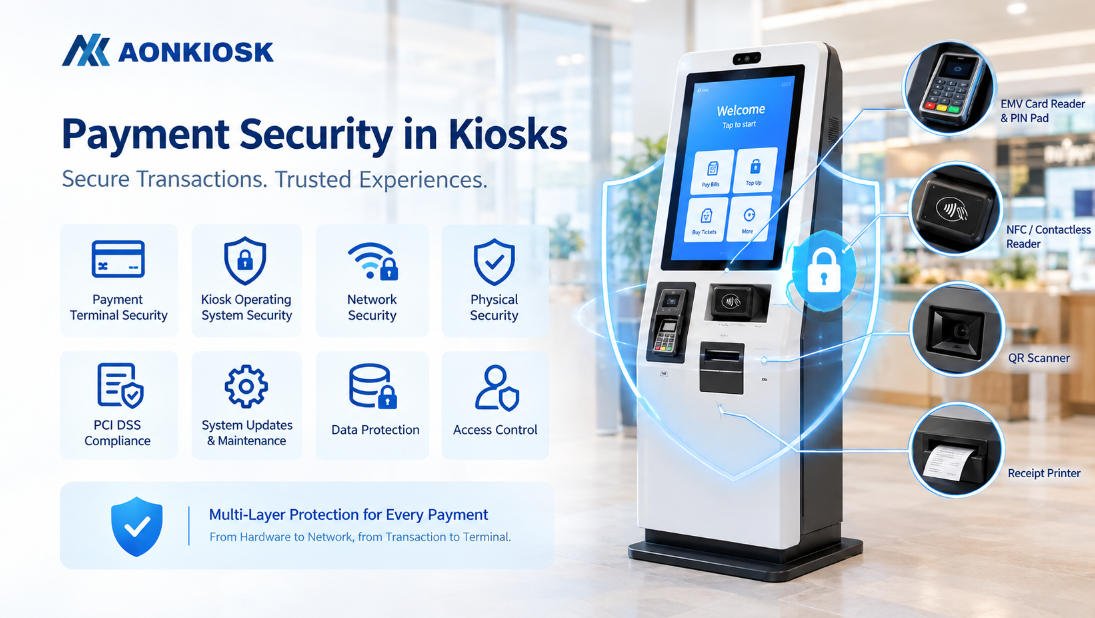
- payment fraud
- data breaches
Security updates and encryption are essential.
User Accessibility
Kiosks should comply with accessibility standards such as the Americans with Disabilities Act (ADA) and the Web Content Accessibility Guidelines (WCAG), ensuring that users with visual, hearing, or mobility impairments can interact with the system effectively.
Initial Investment
Although AI kiosks often reduce long-term operating costs, businesses must consider:
- hardware investment
- AI software licensing
- cloud infrastructure
- system integration
- employee training
- ongoing maintenance
A clear return-on-investment (ROI) analysis is recommended before deployment.
Future Trends
Several technologies will shape the next generation of intelligent kiosks:
- Generative AI assistants
- Emotion recognition (where legally appropriate)
- Digital human avatars
- Multimodal voice interaction
- Edge AI computing
- Autonomous retail stores
- Digital identity verification
- Hyper-personalized recommendations
- AI-powered predictive maintenance
As AI models continue improving, kiosks will evolve from transactional devices into intelligent digital service assistants capable of handling increasingly complex customer interactions.
Conclusion
AI-powered self-service kiosks have evolved far beyond simple touch-screen terminals. By integrating artificial intelligence, machine learning, cloud computing, and advanced analytics, they enable organizations to deliver faster, smarter, and more personalized services while improving operational efficiency and reducing costs.
From retail stores and hospitals to airports and hotels, intelligent kiosks are becoming an essential component of digital transformation strategies. Organizations that invest in secure, accessible, and customer-centric AI kiosk solutions today will be better positioned to meet tomorrow’s expectations for convenience, automation, and personalized experiences.
As AI technology continues to mature, self-service kiosks will play an increasingly important role in creating seamless, data-driven customer experiences across virtually every industry.
References
- McKinsey & Company — The State of AI
https://www.mckinsey.com/capabilities/quantumblack/our-insights/the-state-of-ai - Deloitte Insights — AI and Intelligent Automation
https://www2.deloitte.com/us/en/insights/focus/cognitive-technologies.html - PwC Global Consumer Insights Survey
https://www.pwc.com/gx/en/industries/consumer-markets/consumer-insights-survey.html - National Institute of Standards and Technology (NIST) — AI Risk Management Framework
https://www.nist.gov/itl/ai-risk-management-framework - U.S. Department of Justice — Americans with Disabilities Act (ADA)
https://www.ada.gov/ - World Economic Forum — Artificial Intelligence
https://www.weforum.org/topics/artificial-intelligence/ - MarketsandMarkets — Self-Service Kiosk Market Research
https://www.marketsandmarkets.com/ - Grand View Research — Self-Service Kiosk Market Size Report
https://www.grandviewresearch.com/industry-analysis/self-service-kiosk-market