





Contactless Payments Are Reshaping the Self-Service Experience
The global shift toward contactless payments has fundamentally changed how consumers interact with businesses. Whether ordering food at a quick-service restaurant, checking into a hotel, paying for parking, purchasing transit tickets, or completing a retail purchase, customers increasingly expect payment to be fast, secure, and touch-free.
Self-service payment kiosks have emerged as one of the most effective technologies enabling this transformation. By integrating contactless payment capabilities—including NFC cards, mobile wallets, QR code payments, and wearable devices—modern kiosks reduce transaction times while improving customer satisfaction and operational efficiency.
For businesses, contactless payment kiosks are no longer simply a convenience. They have become an essential part of digital transformation strategies, helping organizations reduce labor costs, increase transaction throughput, enhance payment security, and deliver seamless omnichannel experiences.
As a professional self-service kiosk manufacturer, AONKIOSK has witnessed growing demand from retail, hospitality, healthcare, transportation, and government sectors for intelligent payment kiosk solutions that support today’s digital payment ecosystem. Businesses implementing these systems are better positioned to meet evolving customer expectations while improving operational performance.
Learn more about AONKIOSK’s complete Self-Service Kiosk Solutions
The Rapid Growth of Contactless Payments Worldwide
Consumer behavior has shifted dramatically over the past several years. Digital wallets, tap-to-pay cards, and mobile payment applications have become mainstream across developed and emerging markets alike.
Several factors continue to accelerate adoption:
- Increased consumer preference for faster checkout experiences
- Growth of digital wallets such as Apple Pay, Google Pay, Samsung Wallet, and regional mobile payment platforms
- Expansion of EMV contactless card issuance by financial institutions
- Continued investment in cashless infrastructure
- Rising labor costs encouraging business automation
- Improved NFC security standards
According to Visa, consumers increasingly prefer contactless payments because they are faster than inserting or swiping cards while providing equivalent security protections.
Similarly, Mastercard reports that contactless payment acceptance continues expanding across retail, hospitality, transportation, and healthcare industries as merchants modernize payment infrastructure.
Rather than carrying cash, today’s consumers often complete transactions using:
- Contactless credit cards
- Contactless debit cards
- Smartphones
- Smartwatches
- QR-code payment applications
- Mobile banking apps
This behavioral change naturally aligns with self-service kiosks, where speed and convenience are essential.
Why Businesses Are Investing in Self-Service Payment Kiosks
Traditional cashier-based checkout systems present several operational challenges:
- Long waiting lines
- Labor shortages
- Human error
- Limited operating hours
- Higher operating costs
- Lower transaction capacity during peak periods
Self-service payment kiosks address these issues by automating the payment process.
Businesses implementing modern payment kiosks commonly experience improvements in:
- Faster customer throughput
- Reduced checkout queues
- Higher order accuracy
- Lower staffing requirements
- Improved customer satisfaction
- Increased average transaction value
These advantages explain why self-service payment kiosks are becoming common across restaurants, supermarkets, airports, hospitals, entertainment venues, and government service centers.
Organizations interested in broader automation strategies can also explore AONKIOSK’s industry-specific solutions for restaurants, retail, hospitality, and healthcare
How Contactless Payment Technology Works
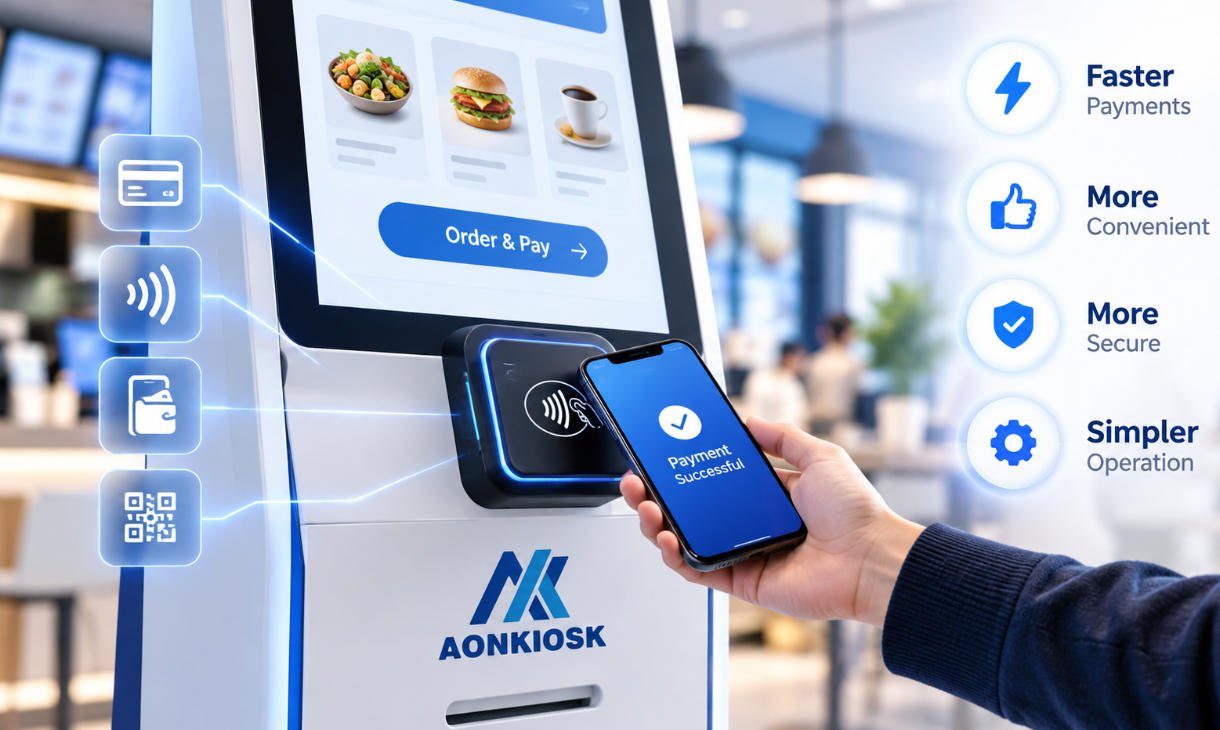
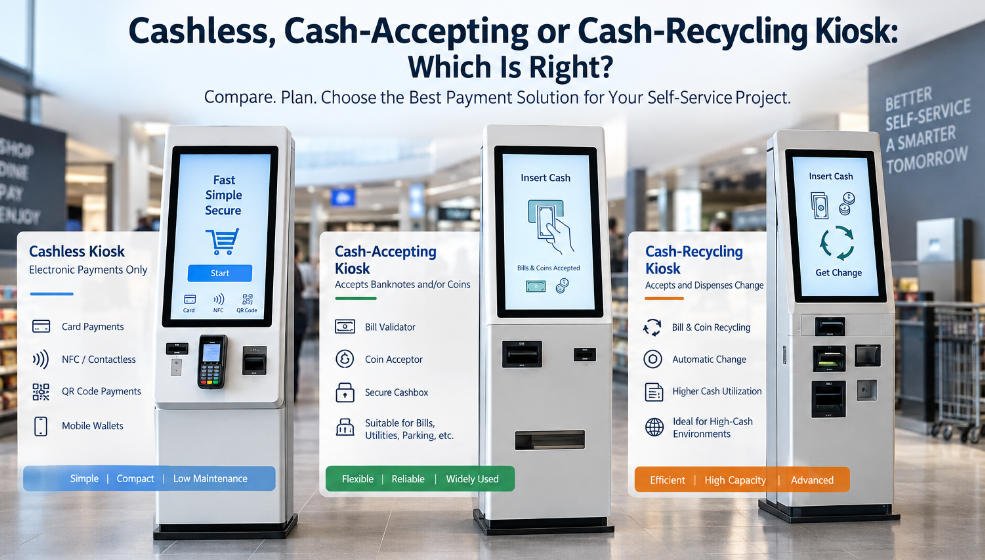
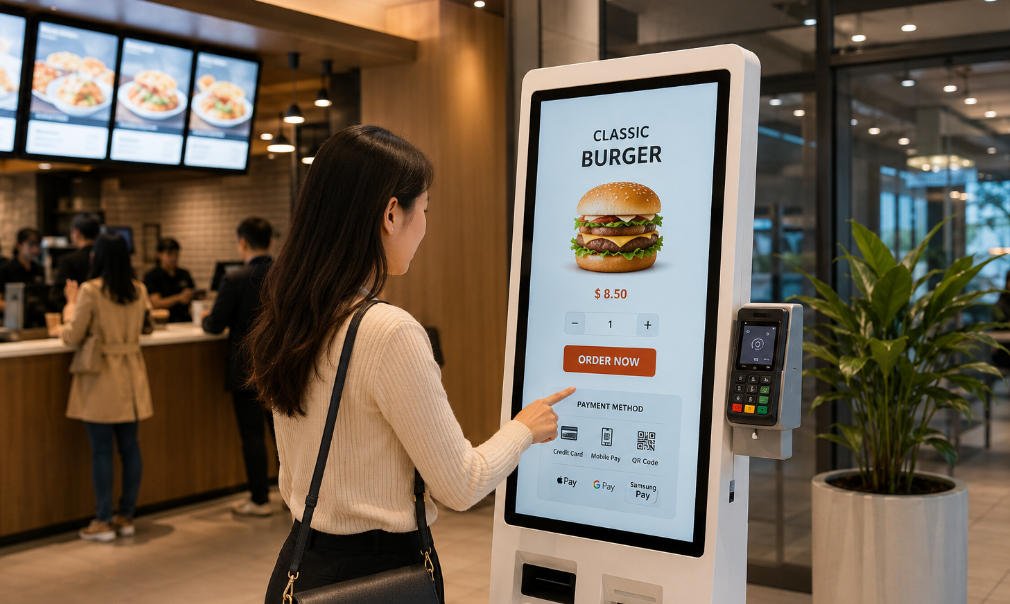
Modern payment kiosks integrate multiple payment technologies into a single platform, allowing customers to choose their preferred payment method.
Common supported payment methods include:
NFC Contactless Cards
Near Field Communication (NFC) enables customers to simply tap compatible credit or debit cards on the payment terminal.
Transactions typically complete within seconds.
Mobile Wallets
Digital wallets have become one of the fastest-growing payment methods worldwide.
Supported platforms commonly include:
- Apple Pay
- Google Pay
- Samsung Wallet
- Huawei Wallet
- Regional digital wallet providers
The kiosk’s payment terminal securely communicates with the customer’s device using encrypted NFC technology.
QR Code Payments
Particularly popular across Asia-Pacific markets, QR payments allow customers to scan merchant-generated QR codes using mobile banking or digital wallet applications.
This method has become standard in countries where mobile-first payments dominate consumer spending.
EMV Chip Cards
While contactless transactions continue growing, EMV chip card support remains essential.
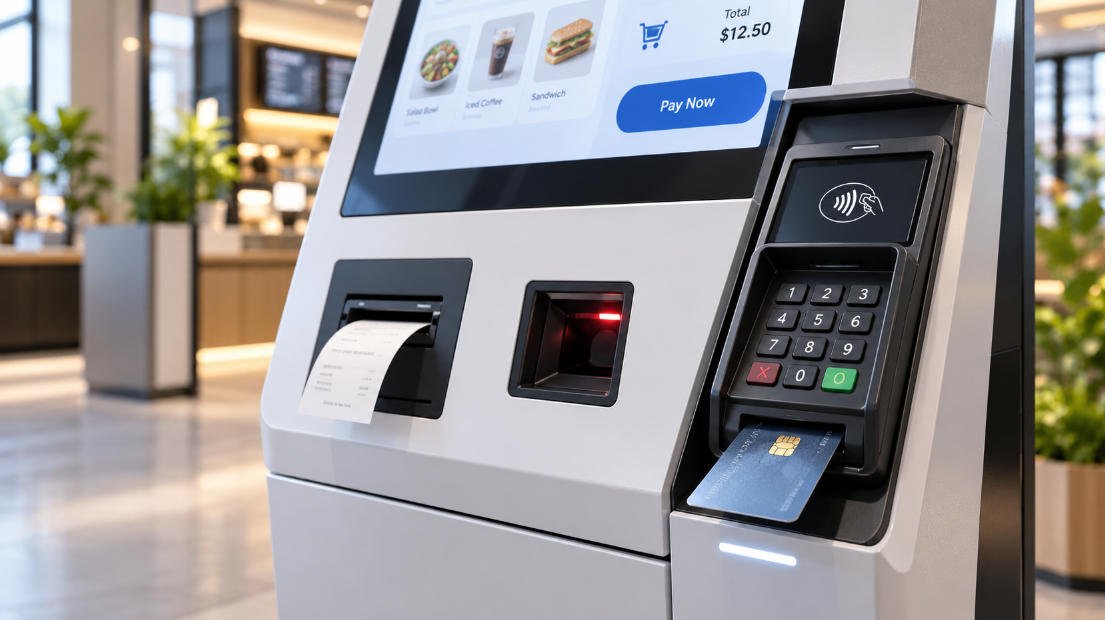
Modern payment kiosks typically provide:
- Tap
- Insert
- Swipe (where applicable)
ensuring compatibility with virtually every customer.
Security Is One of the Biggest Drivers of Adoption
Security concerns once slowed adoption of digital payments. Today, the opposite is true.
Modern payment kiosks incorporate advanced payment security technologies that often exceed traditional cashier-based transactions.
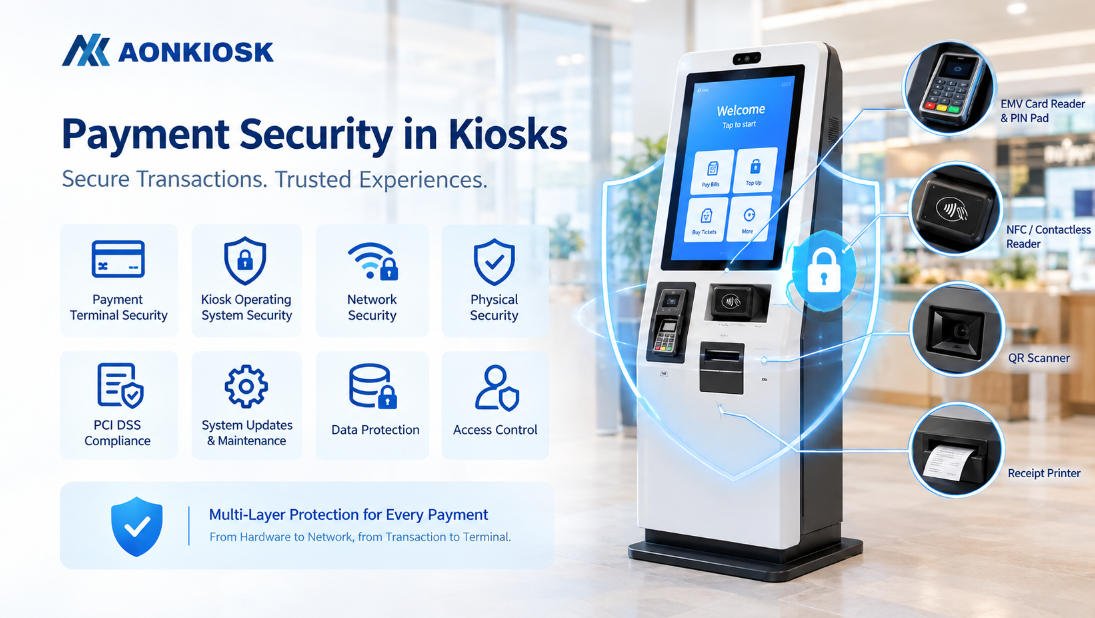
Key security features include:
EMV Compliance
EMV chip technology significantly reduces counterfeit card fraud by generating unique cryptographic transaction data for every payment.
Tokenization
Instead of transmitting actual card numbers, many digital wallets use tokenized credentials.
Even if intercepted, payment tokens cannot be reused.
End-to-End Encryption
Payment data remains encrypted from the payment terminal through the payment processor, minimizing exposure to sensitive information.
PCI DSS Compliance
Professional kiosk manufacturers design payment solutions that support Payment Card Industry Data Security Standard (PCI DSS) requirements.
Businesses deploying compliant systems reduce security risks while meeting payment industry regulations.
Industries Benefiting from Contactless Payment Kiosks
Quick-Service Restaurants (QSR)
Restaurants represent one of the fastest-growing markets for payment kiosks.
Customers appreciate the ability to:
- Customize orders
- Browse digital menus
- Pay immediately
- Avoid waiting in line
Restaurant operators benefit from:
- Higher average ticket sizes
- Improved order accuracy
- Reduced labor dependency
- Faster service during peak hours
Businesses looking to modernize food ordering workflows can explore AONKIOSK’s Restaurant Self-Service Solutions
Retail Stores
Retailers increasingly deploy payment kiosks for:
- Self-checkout
- Endless aisle ordering
- Click-and-collect pickups
- Loyalty program enrollment
- Product information
Combined with inventory systems, kiosks improve operational efficiency while allowing employees to focus on customer assistance rather than routine transactions.
Hotels
Hotel self-service check-in kiosks increasingly integrate secure payment capabilities.
Guests can:
- Verify reservations
- Upgrade rooms
- Purchase breakfast
- Pay deposits
- Complete check-in
without waiting at the reception desk.
Hospitality businesses can also learn about AONKIOSK’s Hotel Self Check-in Solutions
Healthcare
Hospitals and clinics are rapidly implementing payment-enabled kiosks for:
- Patient registration
- Appointment confirmation
- Insurance verification
- Co-payment collection
- Billing inquiries
This reduces administrative workload while improving patient flow.
Transportation
Airports, railway stations, metro systems, and parking facilities all benefit from automated payment kiosks.
Passengers can quickly:
- Purchase tickets
- Print boarding passes
- Pay parking fees
- Recharge transit cards
without waiting for service staff.
Improving Customer Experience Through Faster Transactions
Modern consumers value convenience as much as price. Long queues and slow checkout experiences are among the leading causes of customer dissatisfaction.
Research from payment providers consistently shows that reducing friction during checkout improves both customer loyalty and conversion rates.
Self-service payment kiosks contribute to a better customer experience by enabling:
- Shorter wait times during busy periods
- Multiple payment options to suit customer preferences
- Consistent user interfaces across locations
- Multilingual support for international visitors
- Accessibility features for users with disabilities
- Seamless integration with loyalty programs and promotional campaigns
In sectors such as retail, hospitality, and quick-service restaurants, even reducing the average transaction time by a few seconds can significantly increase throughput during peak operating hours. This allows businesses to serve more customers without expanding checkout counters or increasing staffing levels.
As consumer expectations continue to evolve, contactless-enabled kiosks are becoming an important competitive advantage rather than an optional technology investment.
The Business Benefits and ROI of Self-Service Payment Kiosks
For many organizations, the decision to invest in self-service payment kiosks is driven by measurable business outcomes rather than technology alone. While the initial hardware and software investment is an important consideration, the long-term operational benefits often generate a compelling return on investment (ROI).
1. Lower Labor Costs
Across industries, labor shortages and rising wages continue to challenge business operations. Self-service payment kiosks help alleviate these pressures by automating repetitive payment and checkout tasks.
Instead of assigning employees to process routine transactions, businesses can redirect staff toward higher-value activities such as customer service, sales assistance, or operational management.
This is particularly valuable in:
- Quick-service restaurants
- Retail stores
- Hotels
- Hospitals
- Transportation hubs
- Entertainment venues
Rather than replacing employees entirely, kiosks enhance workforce productivity by allowing smaller teams to serve more customers efficiently.
2. Increased Transaction Capacity
During peak hours, traditional cashier-operated checkout lanes often become bottlenecks. Every additional minute spent waiting in line increases the likelihood of customer frustration or abandoned purchases.
Self-service payment kiosks enable businesses to process significantly more transactions within the same physical footprint.
Examples include:
- Restaurants serving more lunch-hour customers
- Supermarkets reducing checkout queues
- Parking facilities minimizing vehicle congestion
- Hotels accelerating guest arrivals
- Healthcare providers shortening patient registration times
The result is improved operational efficiency without the need to expand facilities or hire additional staff.
3. Higher Average Order Value
One of the most widely recognized advantages of self-service kiosks is their ability to encourage additional purchases.
Unlike busy cashiers, kiosks consistently present:
- Product recommendations
- Meal upgrades
- Premium services
- Accessories
- Membership programs
- Limited-time promotions
Digital interfaces can intelligently display upsell opportunities at precisely the right moment during the purchasing journey.
For restaurants, this may include suggesting larger meal sizes or desserts. For hotels, it could involve room upgrades or breakfast packages. In retail, customers might be offered complementary products or extended warranties.
This standardized upselling process often contributes to increased average transaction values while maintaining a positive customer experience.
4. Improved Payment Accuracy
Manual payment processing can lead to errors, including incorrect change, duplicate charges, or pricing inconsistencies.
Automated payment kiosks reduce these risks by:
- Synchronizing with POS systems
- Applying promotions automatically
- Calculating taxes accurately
- Processing digital receipts
- Recording every transaction electronically
This improves financial accuracy while reducing administrative reconciliation work.
Integration with Modern Digital Business Systems
Today’s payment kiosks are no longer standalone devices. They function as intelligent endpoints within broader digital ecosystems.
Depending on the deployment, self-service payment kiosks can integrate with:
- Point-of-sale (POS) systems
- ERP platforms
- CRM software
- Membership databases
- Inventory management systems
- Hotel property management systems (PMS)
- Hospital information systems (HIS)
- Queue management software
- Cloud management platforms
- Business intelligence dashboards
These integrations allow businesses to collect operational data, monitor device health remotely, manage software updates, and analyze customer behavior across multiple locations.
For organizations operating chains or franchise networks, centralized management significantly reduces maintenance costs while ensuring consistent customer experiences.
AI Is Making Payment Kiosks Smarter
Artificial intelligence is becoming an increasingly important component of self-service technologies.
Modern AI-powered kiosks can provide:
Personalized Recommendations
Based on purchasing history, loyalty programs, or customer preferences, AI algorithms can recommend relevant products or services in real time.
Dynamic Promotions
Businesses can automatically display different promotional offers based on:
- Time of day
- Customer demographics
- Inventory levels
- Seasonal campaigns
- Local events
Predictive Maintenance
AI can monitor hardware performance and identify potential failures before they affect operations.
This minimizes downtime and reduces maintenance expenses.
Customer Behavior Analytics
Machine learning enables businesses to better understand:
- Popular products
- Transaction durations
- Peak operating hours
- User interaction patterns
- Abandoned transactions
These insights support continuous optimization of kiosk interfaces and operational workflows.
Cloud-Based Management Simplifies Large-Scale Deployment
Cloud technology has transformed how organizations manage kiosk networks.
Instead of updating each machine individually, administrators can remotely manage hundreds—or even thousands—of kiosks from a centralized dashboard.
Typical cloud management capabilities include:
- Remote software updates
- Security patch deployment
- Real-time device monitoring
- Usage analytics
- Payment terminal status
- Digital content management
- Promotional campaign scheduling
- Fault alerts and diagnostics
For multi-location businesses, this centralized approach reduces operational complexity while improving system reliability.
Challenges Businesses Should Consider
Although self-service payment kiosks offer substantial advantages, successful deployment requires thoughtful planning.
Choosing the Right Hardware
Different industries require different kiosk configurations.
Businesses should evaluate:
- Indoor or outdoor environments
- Screen size requirements
- Payment module compatibility
- Printer requirements
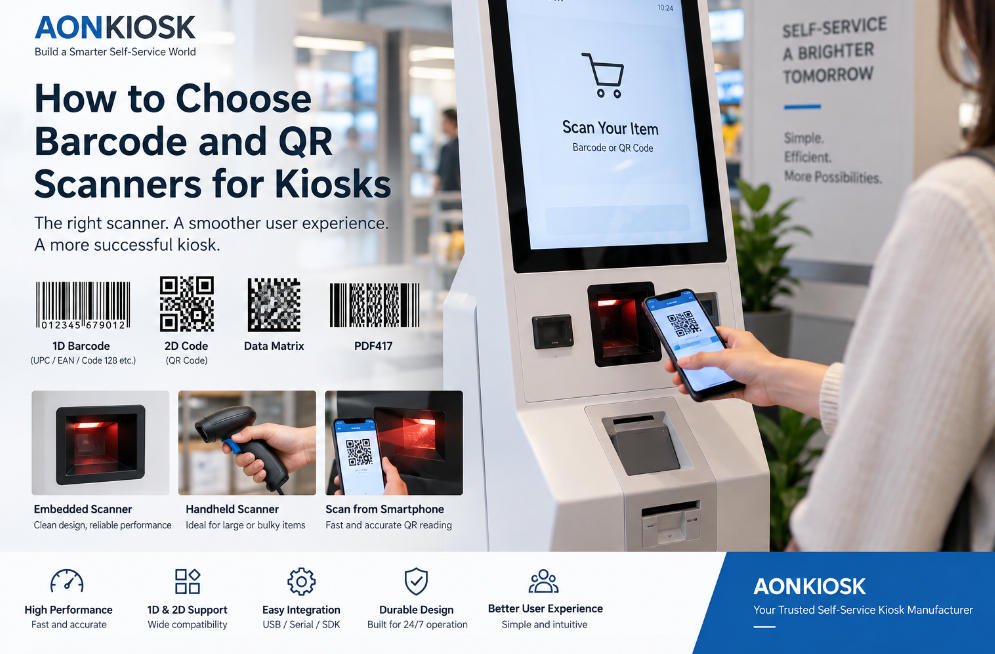
- Barcode or QR code scanning
- Camera integration
- Accessibility compliance
- Durability and vandal resistance
Selecting a modular platform allows future upgrades without replacing the entire kiosk.
Ensuring Payment Security
Businesses should work with experienced manufacturers capable of delivering solutions that support:
- EMV certification
- PCI DSS compliance
- End-to-end encryption
- Secure boot
- Trusted Platform Module (TPM)
- Remote security updates
Security should remain a priority throughout the entire kiosk lifecycle.
User Experience Design
Even the most advanced payment hardware cannot compensate for poor software design.
Successful kiosks emphasize:
- Clear navigation
- Minimal transaction steps
- Responsive touch interfaces
- Multilingual support
- Accessibility for users with disabilities
- Fast payment confirmation
- Intuitive error recovery
A well-designed user interface reduces customer confusion while increasing transaction completion rates.
The Future of Contactless Payment Kiosks
The evolution of digital payments shows no signs of slowing.
Several trends are expected to shape the next generation of self-service payment kiosks:
- Biometric authentication
- Facial recognition for identity verification
- Digital identity integration
- AI-powered virtual assistants
- Voice-guided transactions
- Cashierless retail environments
- Internet of Things (IoT) connectivity
- Edge computing for faster processing
- Real-time fraud detection using artificial intelligence
- Deeper integration with mobile applications and loyalty ecosystems
At the same time, the continued growth of cashless societies and digital banking will further increase demand for secure, flexible, and scalable self-service payment solutions.
Organizations investing today are not simply improving checkout—they are building digital infrastructure capable of supporting future innovations.
Conclusion
Contactless payments have fundamentally changed customer expectations. Consumers increasingly expect transactions to be immediate, secure, and effortless, regardless of whether they are ordering food, checking into a hotel, paying for healthcare services, purchasing retail products, or using public transportation.
Self-service payment kiosks address these expectations by combining intuitive user experiences with advanced payment technologies, robust security standards, and seamless integration into modern business systems.
Beyond convenience, these solutions help organizations reduce operational costs, improve efficiency, increase transaction capacity, and generate valuable business insights. As artificial intelligence, cloud management, and digital payment technologies continue to evolve, self-service payment kiosks will play an even greater role in enabling smart, customer-centric operations.
For businesses seeking to modernize customer interactions while preparing for the future of digital commerce, investing in reliable, contactless-enabled kiosk solutions is no longer optional—it is a strategic decision that supports long-term growth and competitiveness.
External References
- EMVCo – Contactless Payment Specifications
https://www.emvco.com/ - PCI Security Standards Council (PCI DSS)
https://www.pcisecuritystandards.org/ - Visa – Contactless Payments
https://usa.visa.com/ - Mastercard – Contactless Payments Insights
https://www.mastercard.com/ - Worldpay – Global Payments Report
https://worldpay.globalpaymentsreport.com/ - National Retail Federation (NRF)
https://nrf.com/ - Juniper Research – Digital Payments Research
https://www.juniperresearch.com/ - Statista – Digital Payment Market Statistics
https://www.statista.com/