





Ordering 500 identical kiosks is relatively easy once the design has been proven. Ordering five, ten, or twenty units before anyone knows whether the final configuration will work in the field is a very different manufacturing problem.
That is why low MOQ kiosk manufacturing matters.
For software companies, system integrators, start-ups, regional distributors, restaurant operators, and retailers testing a new self-service concept, the first production requirement is rarely a container full of machines. More often, the project needs enough units to validate the design, install them at several real locations, collect operating data, and decide what should change before committing to a larger rollout.
A low minimum order quantity makes that possible. But low MOQ should not be confused with mass-production economics at a smaller quantity. The unit cost is normally higher, customization has to be managed carefully, and some manufacturing processes simply do not become economical until volume increases.
The real question, therefore, is not whether a low MOQ is “good” or “bad.” It is whether a small batch kiosk strategy gives the project enough information to justify its additional cost.
For many deployments, it does.
What Does Low MOQ Mean in Kiosk Manufacturing?
MOQ, or minimum order quantity, is the smallest quantity a manufacturer is prepared to produce under a particular commercial and technical arrangement.
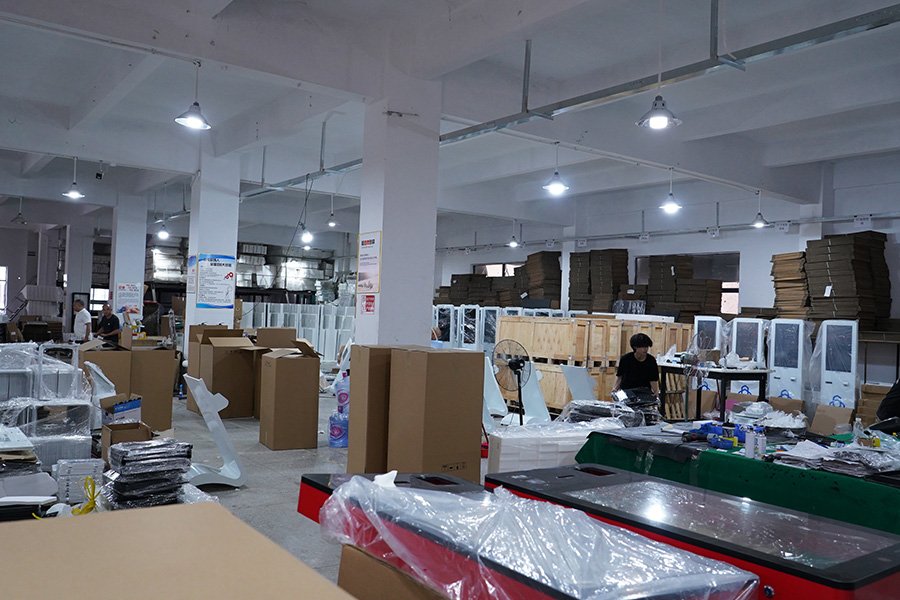
With simple off-the-shelf electronics, MOQ may be largely an inventory issue. Kiosk manufacturing is more complicated because one terminal can combine a sheet-metal enclosure, touchscreen, industrial PC or Android mainboard, power supply, printer, scanner, payment terminal, camera, NFC reader, speakers, antennas, locks, wiring harnesses, mounting brackets, surface finishing, packaging, and numerous project-specific components.
As a result, there is no single meaningful MOQ for every kiosk project.
A standard kiosk with an existing enclosure may be practical in very small quantities because its mechanical structure, tooling, drawings, assembly method, and component layout already exist. A fully customized terminal may also technically be manufactured in a small quantity, but the customer still has to absorb engineering and setup costs that would normally be distributed across hundreds of units.
This distinction is central to evaluating low MOQ kiosk manufacturing.
Low quantity does not automatically mean low project cost.
Why Buyers Start with Small-Batch Kiosk Production
The strongest reason to order a small batch is not cash-flow protection. It is information.
A kiosk that performs perfectly during a factory test may behave differently after being installed in a restaurant, supermarket, hotel lobby, hospital, or transport station.
Users may stand farther from the screen than expected. A printer door that seemed convenient during engineering may become awkward when the kiosk is placed beside a wall. Wi-Fi reception may be weaker at the installation site. A payment terminal may need to move 50 mm because customers instinctively reach toward another area of the machine.
These problems are inexpensive when discovered on ten machines. They become painful when discovered after five hundred have been fabricated.
A kiosk pilot production run therefore acts as a bridge between a prototype and commercial rollout.
The prototype proves that the kiosk can be built.
The pilot proves that the kiosk can be operated.
Those are not the same thing.
Benefit 1: Lower Risk Before a Large Hardware Commitment
Custom hardware decisions become progressively more expensive to reverse.
Changing the location of a barcode scanner during CAD development may require only a drawing revision. Changing it after one prototype has been fabricated involves some rework. Changing it after hundreds of powder-coated cabinets have been manufactured may involve scrapping panels, producing new brackets, altering cable harnesses, and repeating assembly.
Low MOQ production limits the number of units exposed to an unproven decision.
This is particularly valuable when a project includes a new software workflow, unfamiliar peripherals, a new installation method, or a customer-specific enclosure.
Instead of assuming that every engineering decision is correct, the buyer intentionally purchases a limited number of units and treats the first deployment as part of the validation process.
That is risk management rather than cautious purchasing.
Benefit 2: Real-World Validation Produces Better Design Decisions
A laboratory can test screen brightness, thermal behavior, printer operation, scanner performance, power stability, and device communication. It cannot fully reproduce how hundreds of customers will interact with the kiosk.
Consider a restaurant ordering terminal.
During engineering, the receipt printer may be positioned logically beneath the payment device. In operation, customers may repeatedly leave receipts behind because the outlet is outside their natural line of sight.
A retail kiosk may pass all scanner tests at the factory but reveal that customers struggle to scan large products because the scanner angle is too restrictive.
A hotel check-in unit may function correctly yet prove inconvenient for luggage users because the screen or passport reader is positioned too close to the floor-standing base.
A small batch kiosk deployment exposes these details early enough to change them.
For this reason, pilot feedback should include more than failure reports. Teams should examine transaction completion time, customer behavior, maintenance frequency, paper replacement, cleaning, cable access, peripheral errors, thermal conditions, installation stability, and staff intervention.
The objective is not simply to ask, “Did the kiosk work?”
A better question is, “What will become expensive when this system is deployed at scale?”
Benefit 3: Smaller Inventory Exposure
Hardware inventory carries a different risk from software.
Software can be updated remotely. A steel enclosure sitting in a warehouse cannot be patched.
If a company orders several hundred custom kiosks before the design is commercially proven, it is also committing to the specific screen size, enclosure dimensions, motherboard, peripheral layout, payment-terminal bracket, branding treatment, and internal architecture of those machines.
Requirements can change surprisingly quickly.
A payment provider may introduce another terminal model. The software team may require more processing power. A customer may change its branding. A new deployment site may require wall mounting instead of floor standing.
Keeping the first order intentionally small reduces the volume of hardware that can become obsolete because of a design change.
This is particularly useful for technology companies whose software platform is still evolving while hardware development is underway.
Benefit 4: Easier Market Testing
Not every kiosk project should begin as a nationwide rollout.
A restaurant chain may first install terminals at three stores. A retail software provider may place systems with two reference customers. A distributor entering a new country may need several demonstration and evaluation units before building inventory.
In these situations, low MOQ production allows hardware purchasing to follow actual commercial progress.
The business can test different environments, measure acceptance, gather customer feedback, and improve the configuration before committing working capital to larger inventory.
This is one reason low-volume manufacturing is especially relevant to system integrators and software companies. Their competitive advantage may lie in software, integration, or market access rather than hardware volume. They need manufacturing flexibility while a project is being proven.
AONKIOSK’s OEM & ODM kiosk manufacturing model is designed around this type of progression, allowing buyers to move from an existing platform or prototype toward customized and larger-volume hardware production as project requirements become clearer.
Benefit 5: Low MOQ Makes Customization More Accessible
Historically, highly customized hardware often required large quantities to justify development.
Modern kiosk projects can take a more modular approach.
Instead of designing every component from zero, a manufacturer can begin with an established enclosure platform and modify selected elements such as screen size, processor, memory, storage, printer, barcode scanner, NFC module, payment-terminal bracket, logo, cabinet color, mounting method, or internal hardware.
This approach can make low-volume customization more practical because much of the kiosk has already been engineered.
The key is to distinguish configuration from complete redesign.
Changing a logo or computing platform is not equivalent to creating a completely new cabinet. Procurement teams that understand this difference can keep pilot costs under control while still obtaining hardware that closely matches their application.
The Main Trade-Off: Unit Price Will Be Higher
The most obvious disadvantage of low MOQ manufacturing is unit cost.
Several manufacturing expenses do not shrink proportionally with quantity.
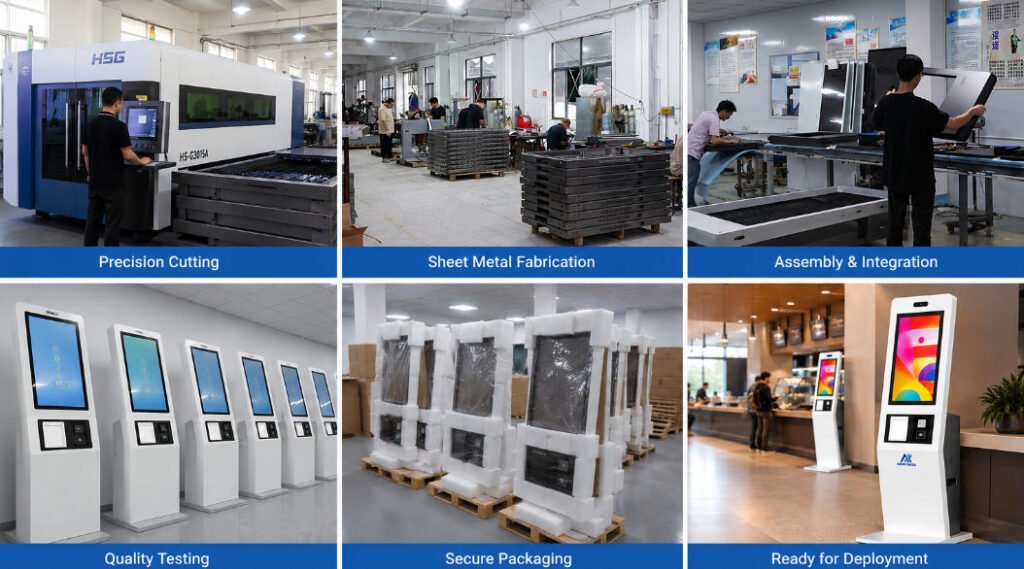
Engineering review still takes time. CAD drawings must still be prepared. Machines still need to be programmed. Powder-coating equipment must still be set up. Components must still be purchased, received, inspected, assembled, tested, and packed.
If those costs are divided among ten kiosks instead of five hundred, the cost attributed to each machine increases.
Component purchasing creates another difference. A factory buying touchscreens, industrial PCs, printers, power supplies, memory, or scanners in volume may receive better supplier pricing than it can obtain for a few pieces.
For this reason, buyers should not evaluate a pilot quotation as though it represents future mass-production pricing.
The purpose of the pilot is to reduce uncertainty. Volume production is where manufacturing efficiency becomes the priority.
Trade-Off 2: Full Customization Can Become Disproportionately Expensive
Low MOQ and extreme customization are sometimes opposing goals.
Suppose a buyer wants eight kiosks but also requires a completely original industrial design, new cabinet geometry, custom molds, unusual curved components, specialized glass, a unique lighting structure, and several new peripheral mechanisms.
The factory may be capable of manufacturing eight units, but the development and tooling cost still exists.
This creates a poor cost-per-unit relationship.
For pilot projects, it is often smarter to preserve the features that influence function while postponing expensive cosmetic customization.
Use the correct touchscreen, computer, printer, scanner, payment device, mounting method, and service-access design. Validate the workflow first. Unique decorative elements can be introduced after the commercial case is stronger.
This is one reason an experienced manufacturer should sometimes recommend less customization rather than automatically agreeing to every requested change.
Trade-Off 3: Component Availability Can Be Harder at Very Small Quantities
A kiosk BOM may contain components sourced from several suppliers, and not all of them operate with the same MOQ.
The kiosk manufacturer may accept ten complete machines while a specialized component supplier requires fifty pieces. An unusual display, industrial motherboard, card dispenser, printer mechanism, or custom cable may therefore create an upstream quantity problem.
Buyers should ask whether the quoted components are regular production items and whether the same models are likely to remain available when the project scales.
Otherwise, the pilot could be successfully built with parts that are difficult to purchase for the next phase.
BOM continuity is particularly important between kiosk pilot production and mass production. Unless there is a technical reason to change a component, the pilot should ideally validate the same core hardware that will be used later.
Trade-Off 4: A Pilot Can Create False Confidence
A small production run reduces risk, but it does not eliminate it.
Ten kiosks operating for two weeks cannot automatically predict the behavior of 2,000 units operating for several years.
Rare failures may not appear. Manufacturing tolerances become more important at larger scale. Different installation environments introduce additional variables. Supply-chain substitutions may appear when purchasing volume changes.
The pilot should therefore be treated as one stage in a controlled release process rather than as proof that no further quality management is required.
Before mass production, the approved drawings, BOM, firmware, cable routing, assembly procedure, test standards, packaging, labeling, and inspection criteria should be frozen or formally controlled.
Without configuration control, a successful pilot has limited value because the production units may no longer be identical to the machines that were validated.
Prototype, Pilot, and Mass Production Are Three Different Stages
Buyers frequently combine these terms, but each stage answers a different question.
| Stage | Main Question | Typical Focus |
|---|---|---|
| Prototype | Can the design work? | Mechanical fit, component integration, appearance, basic functionality |
| Pilot Production | Does it work in real deployment? | User behavior, stability, servicing, software-hardware interaction, field feedback |
| Mass Production | Can it be manufactured repeatedly and economically? | Process control, yield, BOM stability, QC, lead time, logistics |
Skipping the pilot may save money at the beginning, but it transfers unresolved questions directly into production.
For a detailed view of the entire transition, buyers can also review AONKIOSK’s Self-Service Kiosk Buying Guide: From Prototype to Mass Production, which covers specification development, prototype validation, pilot deployment, quality control, and production planning.
How to Make Low MOQ Kiosk Manufacturing Economical
The best low-MOQ projects are rarely the ones with the lowest quotation. They are the ones designed to preserve what can later be reused.
A buyer planning an initial batch should therefore think about the second and third production orders before approving the first.
Whenever possible, begin with an existing kiosk platform. Standardize the touchscreen, computing platform, power supply, printer, scanner, and connectors. Avoid tooling unless it creates a genuine functional advantage. Use replaceable brackets for payment terminals and other peripherals that may change. Define cable interfaces clearly. Make service items accessible without dismantling the complete machine.
Most importantly, document changes made during pilot testing.
If technicians drill new holes, move brackets, replace cables, or change a power supply in the field, those modifications need to return to the engineering documentation. Otherwise, the factory may unknowingly reproduce an obsolete version during the next production run.
A successful pilot should finish with a more mature manufacturing specification than the one with which it started.
Questions to Ask a Low MOQ Kiosk Manufacturer
Before selecting a supplier, buyers should understand exactly what the manufacturer’s low-volume offer includes. Useful questions include whether the MOQ applies to standard and custom designs equally, which engineering costs are one-time charges, whether prototype costs can be credited toward production, which components have separate supplier MOQs, how design revisions are managed, and whether the same BOM can be maintained when volume increases.
It is equally important to ask how the manufacturer handles testing and configuration control.
A low MOQ is valuable only if the factory can later reproduce the approved machine consistently.
The goal is not to find a supplier willing to manufacture one kiosk at any cost. It is to find a production path that can reasonably evolve from one machine to ten, from ten to one hundred, and eventually to the quantity the project requires.
When Low MOQ Manufacturing Makes the Most Sense
Low MOQ production is particularly suitable when the product is technically new, the software is still being validated, the installation environment is unfamiliar, the customer wants a controlled pilot, or future demand has not yet been established.
It is less attractive when the design is already mature, demand is confirmed, all specifications are frozen, and the only objective is minimizing unit cost. In that situation, larger production quantities may provide much better economics.
The correct MOQ therefore depends on the stage of the project rather than simply the buyer’s budget.
AONKIOSK’s Approach to Small-Batch Kiosk Projects
For international buyers, the ideal manufacturing path is often progressive rather than immediate.
A project can begin with a configurable existing platform, move into a prototype or small batch kiosk deployment, collect real operating feedback, finalize the engineering specification, and then transition into repeat production.
AONKIOSK focuses on self-service kiosk hardware for applications including restaurant ordering, retail and payment, hotel check-in, ticketing, information, and other unattended-service environments. Through its manufacturing and OEM/ODM capabilities, hardware configurations can be adapted around project-specific peripherals, mounting requirements, computing platforms, branding, and enclosure needs.
Buyers considering a pilot can review the broader AONKIOSK self-service kiosk manufacturing capabilities before deciding whether an existing platform or a new custom design provides the better starting point.
The important point is that low MOQ should not be viewed as the final production strategy.
It is a development strategy.
Final Thoughts
Low MOQ kiosk manufacturing gives buyers something that is often more valuable than an immediate volume discount: the ability to learn before scaling.
It allows project teams to validate hardware with real users, identify mechanical and operational problems, test software-peripheral integration, preserve working capital, and improve the design while the cost of change is still manageable.
The trade-offs are real. Small quantities normally carry higher unit costs. Custom tooling is harder to justify. Component purchasing can be less efficient. A pilot also cannot reproduce every condition of a large deployment.
But those disadvantages need to be compared with the alternative: discovering a design mistake after hundreds of machines have already been manufactured.
For many custom kiosk projects, the best production plan is therefore not “order as many as possible to reduce the price.”
It is build enough to learn, improve what the pilot reveals, freeze the right design, and then scale with confidence.