





Le marché européen des bornes libre-service entre dans une nouvelle phase d'expansion. Sous l'effet des pénuries de main-d'œuvre, de la hausse des coûts d'exploitation, des initiatives de transformation numérique et de l'évolution des attentes des consommateurs, les entreprises à travers l'Europe investissent de plus en plus dans les technologies libre-service.
Des restaurants à service rapide en Allemagne et en France aux systèmes de libre-service en caisse dans les supermarchés au Royaume-Uni, en passant par les bornes d'enregistrement automatique dans les hôtels du sud de l'Europe, les bornes libre-service sont devenues un élément essentiel des opérations en contact avec la clientèle.
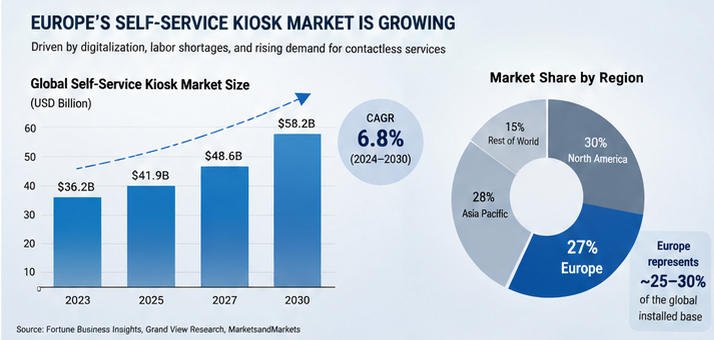
Selon Fortune Business Insights, Grand View Research, et MarketsandMarkets, l'industrie mondiale des bornes libre-service devrait maintenir un taux de croissance annuel composé solide tout au long de la décennie, l'Europe représentant l'un des marchés régionaux les plus matures et les plus prêts sur le plan technologique. Le soutien gouvernemental à la numérisation, l'adoption généralisée des paiements sans numéraire et l'augmentation des coûts de main-d'œuvre continuent d'accélérer le déploiement.
Pour les fabricants de bornes tels que AONKIOSK, l'Europe présente des opportunités significatives dans le domaine du matériel OEM/ODM personnalisé, des solutions de bornes spécifiques à certains secteurs, et des partenariats à long terme avec des fournisseurs de logiciels et des intégrateurs de systèmes.
Aperçu du marché européen des bornes libre-service
L'Europe possède l'un des taux d'adoption les plus élevés au monde en matière de paiement numérique et d'automatisation du commerce de détail.
Plusieurs facteurs macroéconomiques stimulent les investissements dans les bornes :
- Augmentation des salaires minimums dans les pays de l'UE
- Pénuries persistantes de main-d'œuvre dans l'hôtellerie et le commerce de détail
- Préférence des consommateurs pour les services sans contact
- Forte adoption des infrastructures de paiement numérique
- Initiatives gouvernementales soutenant la transformation numérique
- Déploiement croissant de services clients basés sur l'IA
Selon Eurostat, le secteur des services représente plus de 70 % de l'économie de l'UE, créant une demande considérable pour les technologies libre-service destinées aux clients.
Les analystes du secteur estiment que l'Europe représente environ 25 à 30 % de la base installée mondiale de bornes libre-service, en particulier dans le commerce de détail, l'hôtellerie, les transports, la santé et les services publics.
Pourquoi le commerce de détail stimule la croissance des bornes
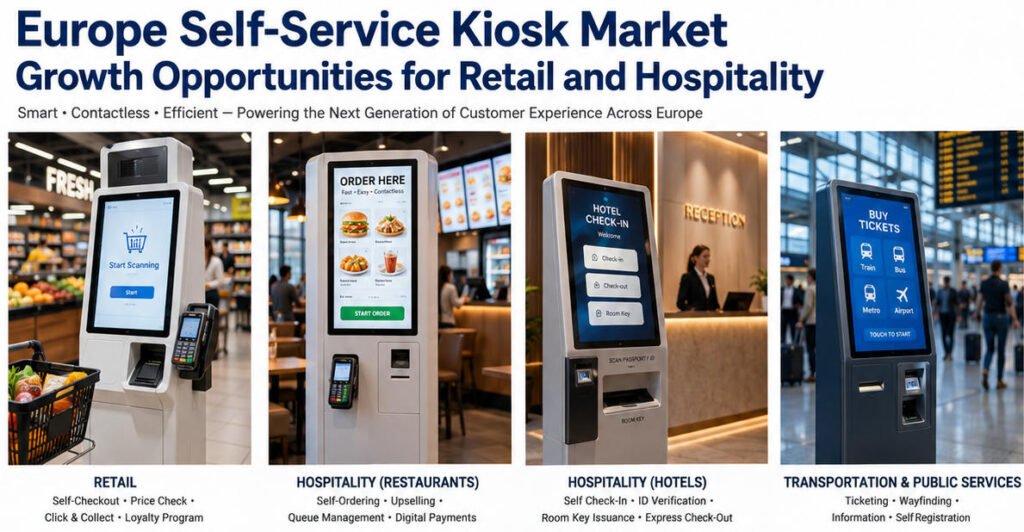
Le commerce de détail reste le segment d'application le plus important pour les bornes libre-service en Europe.
Les grands détaillants investissent massivement dans l'automatisation pour améliorer l'expérience client tout en réduisant les coûts opérationnels.
Les applications courantes des bornes dans le commerce de détail incluent :
- Systèmes de libre-service en caisse
- Bornes de catalogue infini
- Stations de vérification des prix
- Bornes de retrait "cliquer et collecter"
- Bornes de catalogue numérique de produits
- Terminaux de programmes de fidélité
- Orientation interactive
Les grands groupes de distribution ont considérablement étendu le déploiement des caisses libre-service ces dernières années, les consommateurs préférant de plus en plus des expériences d'achat plus rapides et sans caissier.
Avantages pour les détaillants européens
Réduction des coûts de main-d'œuvre
Les dépenses de main-d'œuvre continuent d'augmenter dans toute l'Europe.
Les bornes libre-service permettent à un employé de superviser plusieurs terminaux de caisse au lieu d'opérer des postes de caissier individuels.
Expérience de paiement plus rapide
La gestion des files d'attente est l'un des principaux facteurs de satisfaction client.
Les bornes modernes réduisent les temps d'attente pendant les heures de pointe tout en augmentant la capacité de passage en caisse.
Augmentation du panier moyen
Les bornes interactives recommandent des produits complémentaires, des promotions et des offres de fidélité lors du passage en caisse.
Des études sectorielles indiquent que la vente incitative numérique peut augmenter la valeur moyenne des transactions par rapport aux interactions traditionnelles avec un caissier, en particulier dans le commerce alimentaire et les magasins de proximité.
Intégration omnicanale
Les bornes de vente au détail relient les magasins physiques aux stocks en ligne.
Les clients peuvent :
- Commander des produits indisponibles
- Parcourir des catalogues étendus
- Planifier une livraison à domicile
- Réserver des produits
- Récupérer des achats en ligne
Cela crée une expérience d'achat omnicanale fluide.
L'hôtellerie adopte rapidement le libre-service
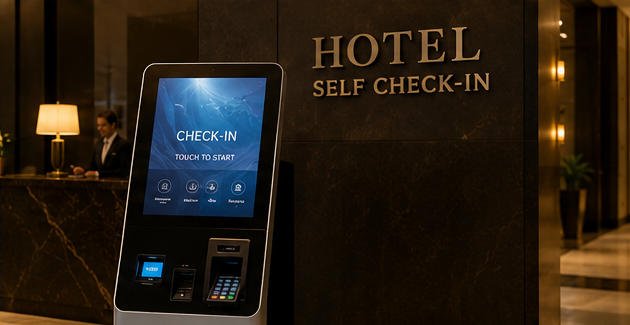
L'hôtellerie est devenue le secteur d'application des bornes à la croissance la plus rapide en Europe.
Les hôtels, restaurants, cafés, aéroports et lieux de divertissement s'appuient de plus en plus sur l'automatisation pour améliorer la qualité du service tout en gérant les défis de personnel.
Les applications courantes des bornes dans l'hôtellerie incluent :
- Bornes d'enregistrement automatique pour hôtels
- Bornes de commande en libre-service pour restaurants
- Terminaux de gestion des files d'attente
- Bornes de billetterie
- Systèmes d'enregistrement des visiteurs
- Bornes de paiement
Les pays dotés d'une forte industrie touristique – notamment l'Espagne, l'Italie, la France et la Grèce – augmentent leurs investissements dans les services numériques aux clients afin d'améliorer l'efficacité opérationnelle pendant les saisons touristiques de pointe.
La commande en libre-service en restaurant transforme les opérations de la restauration rapide
Les restaurants rapides européens ont rapidement adopté les bornes de commande en libre-service.
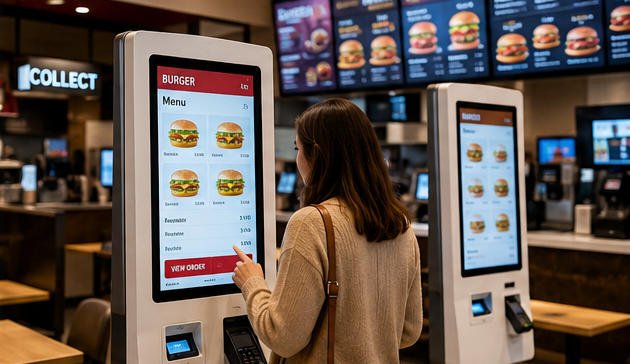
Les grandes chaînes de restauration signalent plusieurs avantages opérationnels :
- Une valeur moyenne de commande plus élevée
- Une meilleure précision des commandes
- Réduction des files d'attente
- Processus de commande plus rapide
- Besoins réduits en main-d'œuvre
- Expérience client plus cohérente
Les présentations visuelles des menus incitent les clients à explorer des articles supplémentaires, ce qui augmente les opportunités de vente incitative.
De nombreux exploitants de restaurants intègrent également :
- Commandes mobiles
- Les programmes de fidélité
- Systèmes d’affichage en cuisine (KDS)
- Des plateformes POS cloud
- Des passerelles de paiement numérique
Cette combinaison crée un écosystème de commande hautement automatisé.
L'enregistrement hôtelier en libre-service continue de se développer
L'industrie hôtelière européenne utilise de plus en plus les bornes en libre-service pour simplifier les opérations de réception.
Les bornes hôtelières modernes prennent généralement en charge :
- La numérisation des passeports
- La vérification d'identité
- La reconnaissance faciale (lorsque la réglementation le permet)
- L'enregistrement numérique
- Distribution des cartes d'accès aux chambres
- L'enregistrement par code QR
- Des paiements sans contact
- Impression de factures
Ces solutions réduisent l'encombrement de la réception tout en permettant au personnel hôtelier de se concentrer sur des services clients à plus forte valeur ajoutée.
Les hôtels indépendants, les hôtels d'affaires et les hébergements de type appartement figurent parmi les plus rapides à adopter ces solutions.
Les paiements sans espèces accélèrent le déploiement des bornes
L'Europe est leader mondial en matière d'adoption des paiements numériques.
Selon la Banque centrale européenne, les paiements par carte sans contact continuent de croître rapidement, tandis que les portefeuilles mobiles tels que Apple Pay et Google Pay sont largement acceptés dans toute la région.
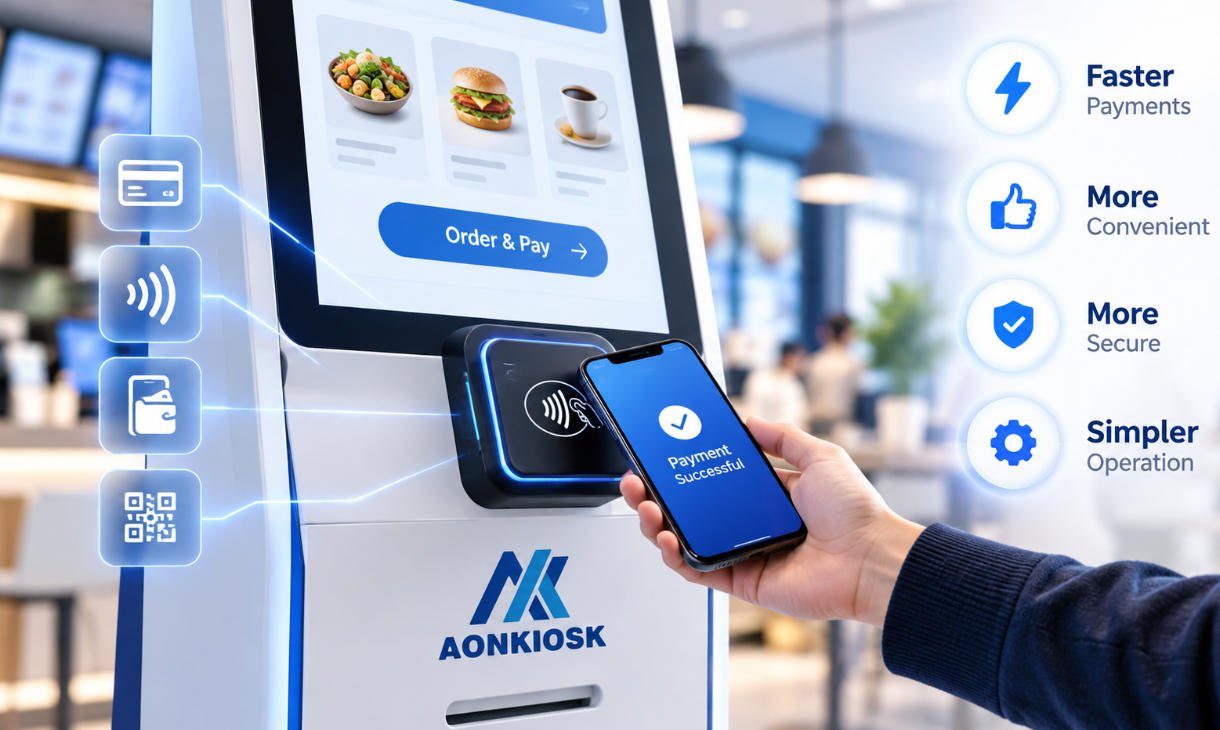
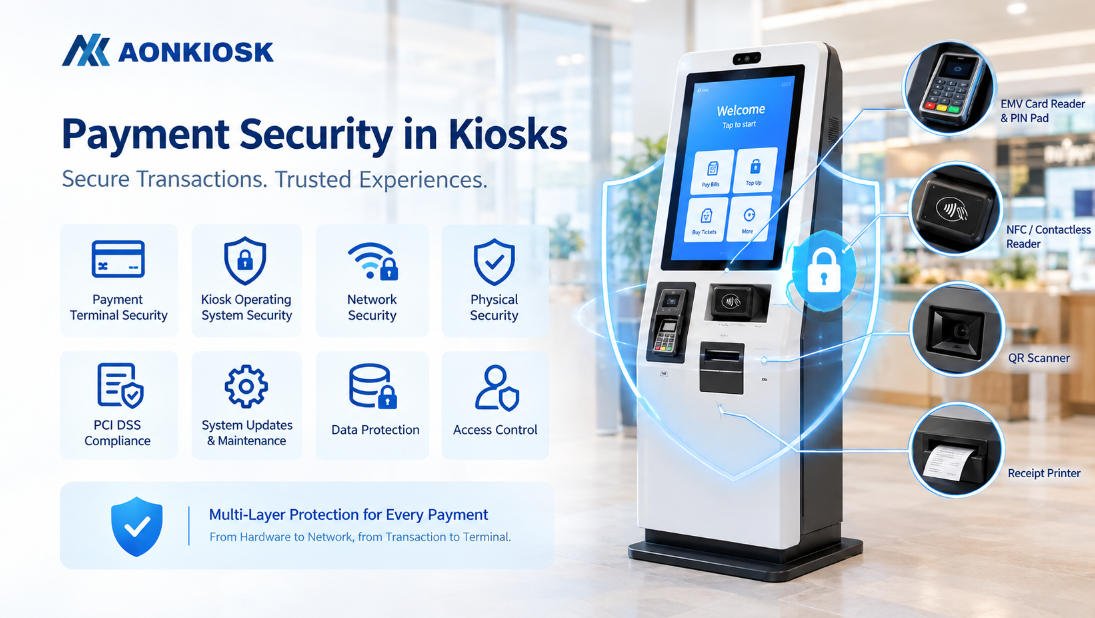
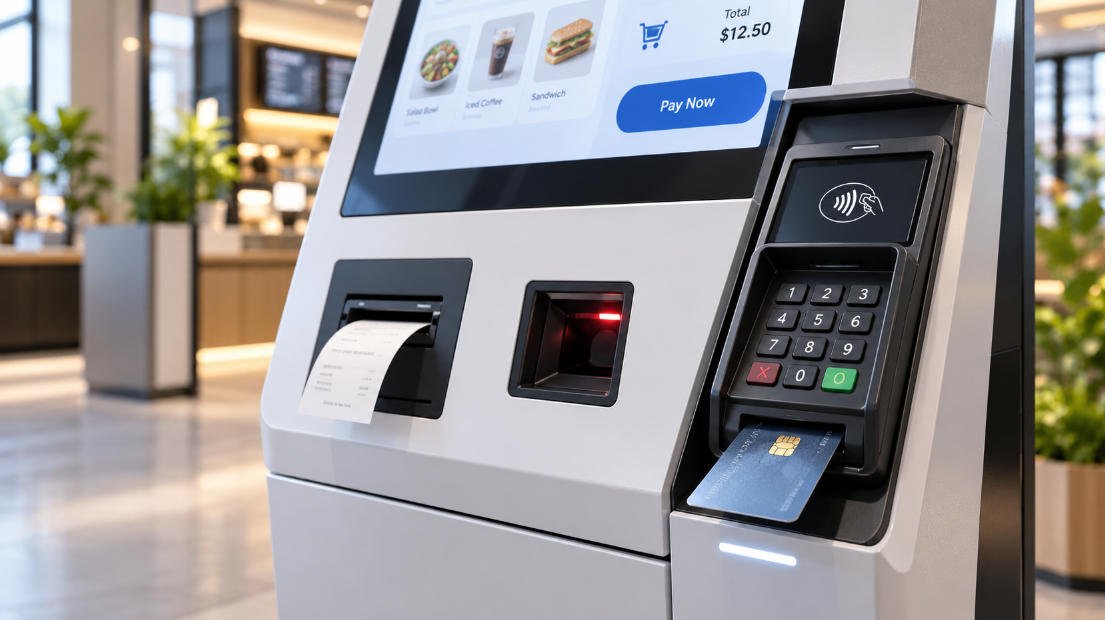
Le matériel des bornes modernes prend généralement en charge :
- Les cartes à puce EMV
- Paiements NFC
- Les paiements par QR
- Portefeuilles mobiles
- La saisie du code PIN
- Le traitement multi-devises
La flexibilité des paiements améliore considérablement le confort des clients tout en soutenant les voyageurs internationaux.
L'IA et les logiciels intelligents façonnent la prochaine génération de bornes
L'intelligence artificielle devient un différenciateur clé dans la technologie en libre-service.
Les nouveaux déploiements de bornes incluent de plus en plus :
- Recommandations de produits basées sur l’IA
- Des interfaces multilingues
- Interaction vocale
- La vision par ordinateur
- Maintenance prédictive
- Surveillance à distance des appareils
- L'analyse du comportement client
Ces technologies aident les entreprises à personnaliser l'expérience client tout en optimisant l'efficacité opérationnelle.
La durabilité devient un facteur d'achat
Les acheteurs européens évaluent de plus en plus les fournisseurs de bornes en fonction de leurs performances environnementales.
Les priorités d'achat croissantes incluent :
- Des écrans à faible consommation
- Des processeurs économes en énergie
- Des structures métalliques recyclables
- Du matériel modulaire pour des réparations plus faciles
- Des cycles de vie de produits longs
- Une réduction des déchets d'emballage
Les fabricants capables de fournir du matériel respectueux de l'environnement obtiennent un avantage concurrentiel lors des appels d'offres.
Défis rencontrés par le marché européen
Malgré une forte croissance, plusieurs défis subsistent.
Conformité au RGPD
Les données clients collectées via les bornes doivent être conformes au Règlement Général sur la Protection des Données (RGPD).
Les entreprises doivent garantir un traitement sécurisé des informations personnelles, en particulier pour les applications d'enregistrement hôtelier et de soins de santé.
Normalisation du matériel
Différents pays ont des exigences variables concernant :
- Terminaux de paiement
- Les certifications électriques
- Accessibilité
- Le support linguistique
- Les normes de sécurité
Les fabricants doivent concevoir des plateformes matérielles flexibles répondant à plusieurs exigences réglementaires.
Complexité de l'intégration
Un déploiement réussi des bornes nécessite une intégration avec :
- Systèmes de point de vente (POS)
- Les logiciels ERP
- Plateformes CRM
- Passerelles de paiement
- Les systèmes de fidélité
- Gestion des stocks
- La surveillance cloud
Les fabricants OEM collaborent de plus en plus avec des fournisseurs de logiciels pour proposer des solutions clés en main complètes.
Opportunités pour les fabricants de bornes OEM et ODM
L’Europe offre des opportunités substantielles aux fabricants de matériel capables de proposer des solutions de personnalisation.
La demande continue d’augmenter pour :
- La fabrication de bornes en marque blanche
- La conception de boîtiers personnalisés
- Les services de branding
- Intégration périphérique
- Compatibilité des dispositifs de paiement
- La production à grande échelle
- Les faibles quantités minimales de commande
- Le matériel conforme aux normes CE
- Le support de gestion à distance des parcs de bornes
Les fabricants chinois disposant de chaînes d’approvisionnement matures, de coûts de production compétitifs et de capacités d’ingénierie flexibles sont bien positionnés pour soutenir les distributeurs, les éditeurs de logiciels et les fournisseurs de solutions européens.
AONKIOSK se spécialise dans la conception et la fabrication de bornes libre-service personnalisées pour les secteurs du commerce de détail, de l’hôtellerie, de la santé, des transports et des services publics. Forte d’une vaste expérience en OEM/ODM, d’une intégration de la tôlerie, de l’intégration d’écrans tactiles et de capacités d’exportation mondiales, AONKIOSK aide les partenaires européens à accélérer leur déploiement tout en maintenant une qualité élevée et des prix compétitifs.
Perspectives d’avenir
Le marché européen des bornes libre-service devrait maintenir une forte dynamique pour le reste de la décennie.
La croissance sera soutenue par :
- La pénurie persistante de main-d’œuvre
- L’automatisation du commerce de détail
- La digitalisation du secteur hôtelier
- L’expansion des paiements sans numéraire
- Le service client basé sur l’IA
- Les initiatives de villes intelligentes
- L’augmentation des investissements dans les infrastructures numériques publiques
Les entreprises qui combinent un matériel fiable avec une intégration logicielle évolutive seront les mieux placées pour capter la prochaine vague de demande du marché.
Pour les fabricants comme pour les fournisseurs de solutions, l’Europe reste l’une des régions les plus attractives au monde pour un investissement à long terme dans les bornes libre-service.
Conclusion
Le marché européen des bornes libre-service évolue au-delà de la simple automatisation pour devenir un outil stratégique d’efficacité opérationnelle et d’engagement client. Les détaillants modernisent les expériences de paiement, les restaurants augmentent le montant moyen des commandes grâce aux systèmes de commande en libre-service, et les hôtels optimisent les services aux clients avec des solutions d’enregistrement numériques.
Alors que les coûts de main-d’œuvre continuent d’augmenter et que les consommateurs attendent de plus en plus des expériences rapides et sans contact, la demande de bornes intelligentes continuera de croître. Les fabricants capables de fournir des solutions personnalisables, conformes et prêtes pour l’avenir joueront un rôle essentiel dans le soutien de la transformation numérique de l’Europe dans les secteurs du commerce de détail, de l’hôtellerie, de la santé, des transports et des services publics.
Références
- Fortune Business Insights – Rapport sur le marché des bornes libre-service
https://www.fortunebusinessinsights.com/self-service-kiosk-market-102112 - Grand View Research – Rapport sur la taille du marché des bornes libre-service
https://www.grandviewresearch.com/industry-analysis/self-service-kiosk-market - MarketsandMarkets – Marché des bornes interactives
https://www.marketsandmarkets.com/Market-Reports/interactive-kiosk-market-262058222.html - Eurostat – Statistiques sur les services
https://ec.europa.eu/eurostat - Banque centrale européenne – Statistiques sur les paiements
https://www.ecb.europa.eu/stats/payments_statistics