





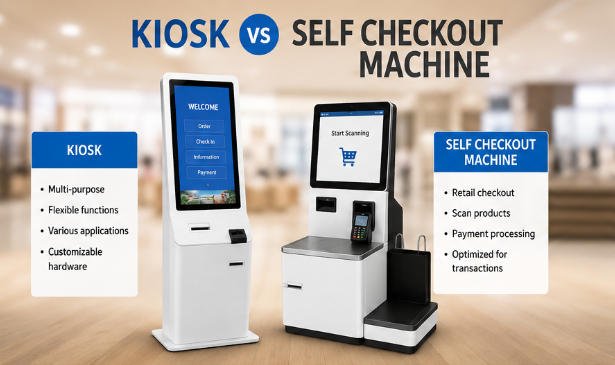
Although the terms kiosk and self checkout machine are often used interchangeably, they do not describe the same type of equipment.
A self checkout machine is a specialized retail device designed specifically for customer-operated checkout.
A self-service kiosk is a broader hardware platform capable of supporting many different applications beyond payment and checkout.
Understanding this distinction helps system integrators, software developers, retailers, and OEM partners select the correct hardware architecture for their deployment.
Definition
What is a Self-Service Kiosk?
A self-service kiosk is an interactive computer terminal that allows users to perform predefined tasks without assistance from staff.
The functionality of a kiosk is determined primarily by its software and integrated hardware modules.
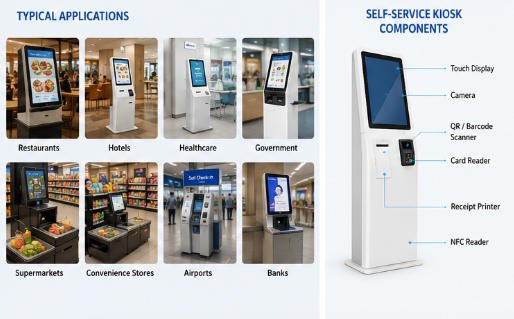
Typical applications include:
- Self ordering
- Hotel check-in
- Visitor registration
- Ticket issuing
- Queue management
- Information inquiry
- Bill payment
- Membership services
- Document printing
A kiosk is considered a general-purpose self-service platform.
What is a Self Checkout Machine?
A self checkout machine is a retail checkout terminal designed to replace or supplement traditional cashier stations.
Its software workflow focuses exclusively on completing retail transactions.
Typical functions include:
- Product scanning
- Basket management
- Payment processing
- Receipt printing
- Purchase confirmation
Unlike general kiosks, self checkout machines are optimized for retail environments where speed, transaction accuracy, and loss prevention are critical.
Functional Comparison
| Function | Self-Service Kiosk | Self Checkout Machine |
|---|---|---|
| Customer Registration | ✔ | — |
| Food Ordering | ✔ | — |
| Product Checkout | Optional | ✔ |
| Product Scanning | Optional | ✔ |
| Membership Services | ✔ | Limited |
| Queue Management | ✔ | — |
| Ticket Printing | ✔ | — |
| Hotel Check-in | ✔ | — |
| Retail Payment | Optional | ✔ |
Hardware Architecture
Although both products use industrial touchscreen computers, their peripheral configurations differ.
Typical Self-Service Kiosk Components
A kiosk may include:
- Touch display
- Embedded PC
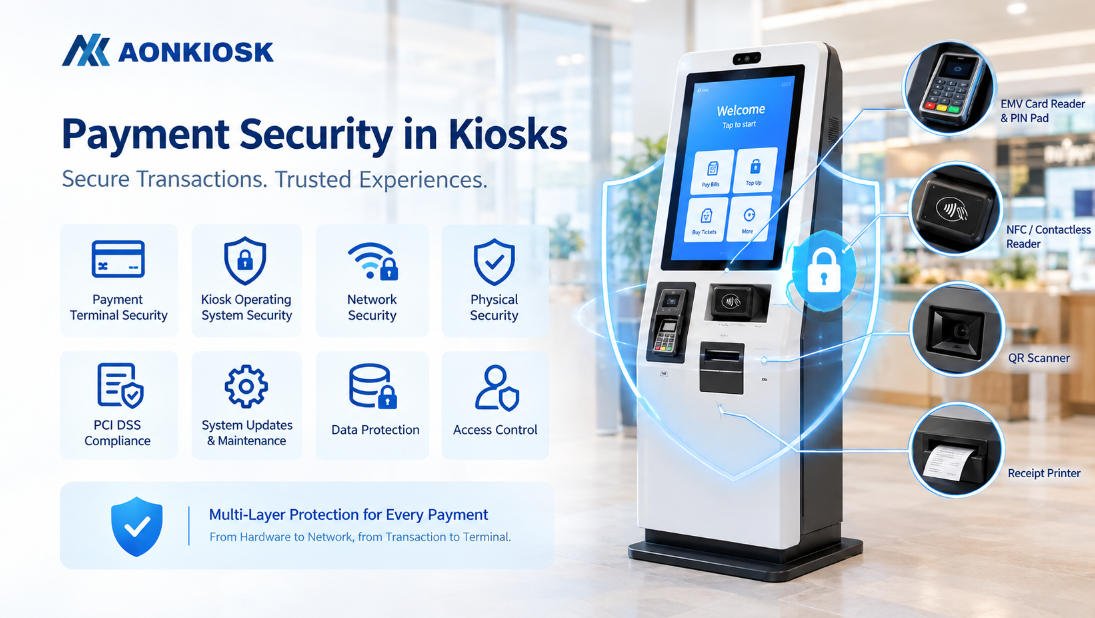
- QR scanner
- NFC reader
- Camera
- Thermal printer
- RFID reader
- Passport scanner
- ID reader
- Fingerprint module
- Face recognition camera
- Card dispenser
Component selection depends on the software application.
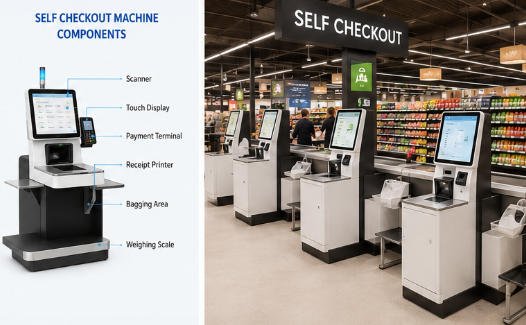
Typical Self Checkout Components
Retail checkout systems commonly integrate:
- Barcode scanner
- Customer display
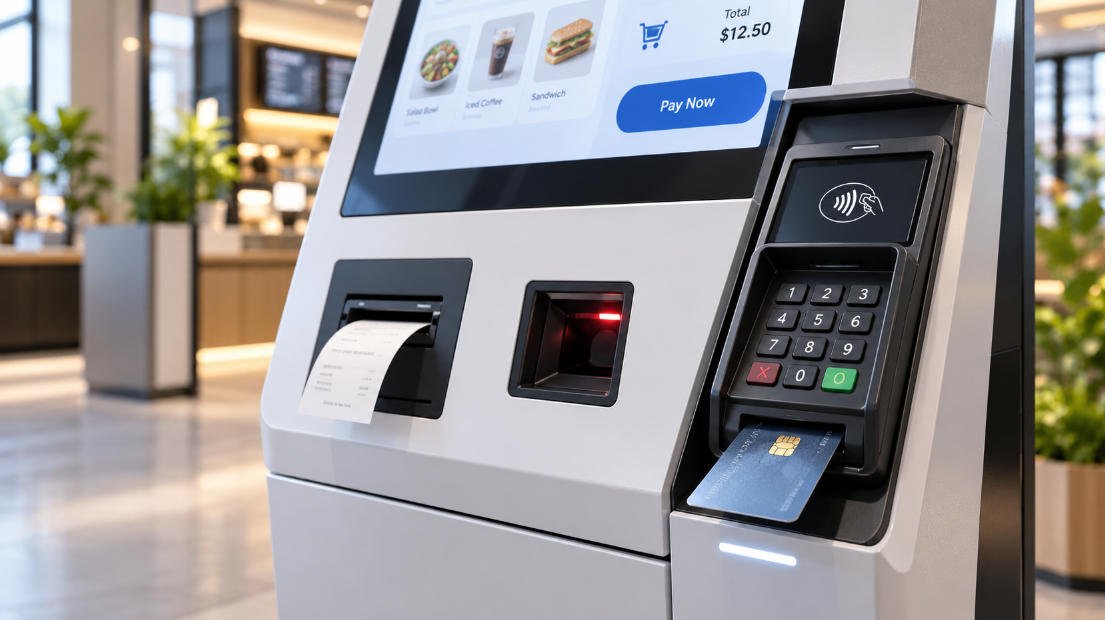
- Payment terminal
- Receipt printer
- POS computer
- Bagging scale
- Cash recycler (optional)
- Coin dispenser (optional)
- Security camera
These devices support efficient retail transaction processing.
Software Differences
The software architecture is one of the primary distinctions between the two systems.
Self-Service Kiosk Software
Usually connects with:
- ERP
- CRM
- Queue Management
- Hotel PMS
- Hospital HIS
- Visitor Management
- Membership Platform
- Ticketing System
The workflow varies according to the application.
Self Checkout Software
Typically integrates with:
- Retail POS
- Inventory Management
- Pricing Database
- Promotion Engine
- Loyalty Program
- Payment Gateway
- Loss Prevention System
The workflow remains largely standardized across retail environments.
Deployment Scenarios
Self-Service Kiosk
Recommended for:
- Restaurants
- Hotels
- Hospitals
- Government offices
- Airports
- Banks
- Educational institutions
- Visitor centers
Self Checkout Machine
Recommended for:
- Supermarkets
- Grocery stores
- Convenience stores
- Pharmacies
- Retail chains
- Department stores
Can One Device Perform Both Functions?
Yes.
Many modern kiosk platforms are modular.
By integrating retail peripherals such as:
- Barcode scanner
- Payment terminal
- Scale
- Receipt printer
a standard self-service kiosk can be configured as a self checkout machine.
The final functionality depends on:
- Installed software
- Peripheral devices
- Business workflow
Selection Guidelines
Choose a self-service kiosk when your application involves customer interaction beyond checkout, such as registration, ordering, check-in, or information services.
Choose a self checkout machine when the primary objective is retail transaction processing with integrated product scanning, payment, and receipt generation.