





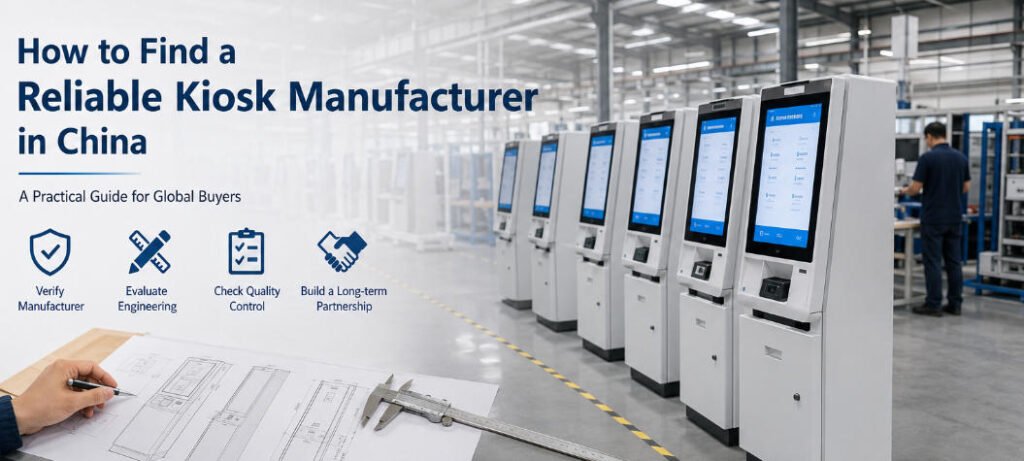
Finding a reliable kiosk manufacturer in China can give international buyers access to strong manufacturing capabilities, flexible customization, mature electronics supply chains, and competitive production costs. However, identifying the right factory requires more than searching online, comparing catalogues, and choosing the lowest quotation.
A self-service kiosk is a complete commercial hardware system. The enclosure, touchscreen, industrial computer, printer, scanner, payment terminal, wiring, power supply, cooling system, mounting structure, and maintenance access must all work together reliably. A supplier that performs well at metal fabrication but lacks experience in hardware integration can create serious problems once a project moves from prototype to field deployment.
For software companies, system integrators, distributors, restaurant technology providers, retailers, and project contractors, supplier evaluation should therefore focus on engineering capability, manufacturing control, communication, quality assurance, and long-term support.
This guide explains how to identify a dependable China kiosk factory, what questions to ask before ordering, which warning signs to avoid, and how to reduce procurement risk before entering mass production.
1. Determine Whether You Are Talking to a Factory or a Trading Company
One of the first challenges when sourcing kiosks from China is determining who actually manufactures the product.
Trading companies are not necessarily a problem. Some provide valuable sourcing and export services. However, when you require custom enclosure engineering, peripheral integration, prototype modification, or long-term OEM production, direct communication with the manufacturing and engineering team becomes much more important.
Ask the supplier basic questions such as:
- Where is your production facility located?
- Which production processes are completed internally?
- Do you have your own kiosk engineers?
- Who creates mechanical drawings and 3D designs?
- Where are prototypes assembled?
- Who controls the bill of materials?
- Can you provide factory photos or arrange a live video factory tour?
- Can customers visit the production facility?
A genuine kiosk manufacturer should be comfortable explaining its production structure.
For example, buyers evaluating a China kiosk factory should look beyond finished product photographs. Manufacturing information should show how engineering, prototype development, assembly, testing, quality inspection, and production scaling are handled.
The goal is not simply to confirm that a physical factory exists. You need to establish whether the supplier actually controls the processes that affect your project.
2. Choose a Specialist Kiosk Manufacturer, Not Just a Metal Fabricator
Kiosk cabinets often use sheet metal construction, but producing a kiosk is very different from manufacturing an ordinary metal enclosure.
A commercial kiosk must accommodate electronics and peripherals while providing:
- Structural stability
- Effective heat dissipation
- Safe electrical design
- Proper cable routing
- Secure peripheral mounting
- Convenient service access
- User-friendly positioning
- Protection against unauthorized access
- Reliable operation over long deployment periods
This becomes more complicated when printers, card readers, payment terminals, scanners, cameras, speakers, passport readers, RFID devices, or other components must be integrated.
A specialist kiosk supplier should understand these relationships before the first prototype is built.
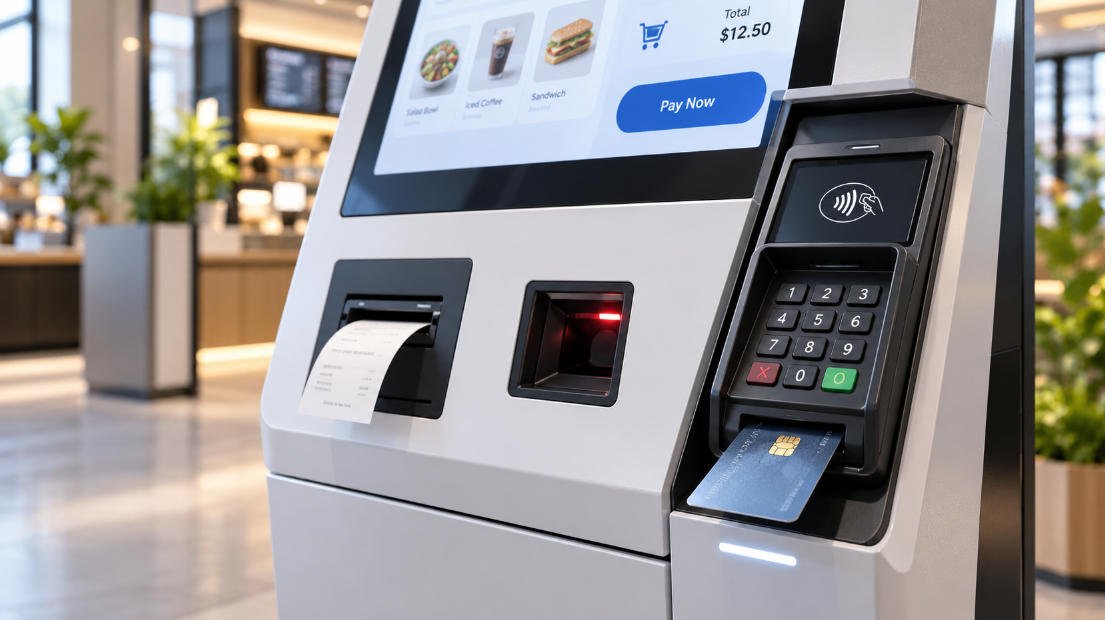
For instance, an 80 mm thermal printer requires more than enough internal space to fit the device. Engineers must consider the paper loading direction, paper-roll capacity, cutter position, receipt outlet, cabling, heat generation, and how quickly store employees can replace the paper.
The same principle applies to payment terminals. Mounting angle, customer reach, cable protection, security, and future replacement all influence the mechanical design.
A supplier that only asks for dimensions and enclosure colors may not be evaluating the complete system.
3. Evaluate Engineering Capability Before Comparing Prices
One of the strongest indicators of a reliable kiosk manufacturer China buyers can work with is the quality of its engineering questions.
Experienced suppliers rarely provide a serious custom quotation based only on a product picture.
Before engineering a kiosk, they should ask about:
- Application
- Installation environment
- Screen size
- Operating system
- CPU platform
- Touch technology
- Required peripherals
- Payment device model
- Printer model
- Scanner type
- Connectivity
- Mounting method
- Branding requirements
- Expected order quantity
- Target market
- Certification requirements
- Maintenance method
These questions help identify integration risks before production begins.
You should also ask whether the manufacturer can provide 2D drawings, 3D models, internal-layout drawings, and revisions before manufacturing.
AONKIOSK, for example, describes its OEM and ODM kiosk manufacturing process as moving through requirements discussion, engineering evaluation, quotation, 3D design, prototype development, testing, production, quality inspection, and shipping. Its published customization scope includes enclosure structures, display options, Intel or ARM computing platforms, payment modules, printers, scanners, cameras, mounting configurations, and branding.
Regardless of which manufacturer you choose, you should expect a similarly structured engineering process.
4. Ask for Relevant Project Experience
A factory may have years of manufacturing experience but limited experience in your specific type of kiosk.
A restaurant self-ordering kiosk, for example, has different requirements from an outdoor ticketing terminal or hotel check-in kiosk.
Restaurant projects may prioritize:
- Fast touchscreen interaction
- Payment terminal integration
- Receipt printing
- Compact footprints
- Easy cleaning
- High transaction frequency
Retail self-checkout kiosks may additionally require barcode scanners, weighing systems, bagging areas, security devices, or larger service compartments.
Hotel kiosks can involve passport scanners, card dispensers, room-card encoders, cameras, and payment devices.
Ticketing kiosks may require higher-capacity printers, scanners, vandal-resistant structures, and frequent maintenance access.
Ask potential suppliers to show relevant production examples rather than simply sending a catalogue containing dozens of unrelated products.
The closer their previous projects are to your application, the easier it will be for their engineers to identify practical design problems early.
5. Check Whether Customization Goes Beyond Logo Printing
Many suppliers advertise OEM or ODM services, but the meaning of “custom kiosk” varies significantly.
Basic customization may include only:
- Logo printing
- Cabinet color
- Minor exterior changes
Deeper OEM customization may involve:
- New enclosure dimensions
- Custom structural design
- Different touchscreen sizes
- Modified screen angles
- Custom peripheral positions
- Payment-device brackets
- Printer integration
- Scanner integration
- Industrial PC configuration
- Ventilation changes
- Internal cable routing
- Locks and service doors
- Wall-mounted, desktop, or floor-standing structures
Before choosing a kiosk supplier, identify which category your project belongs to.
If an existing kiosk platform already meets 80–90% of your requirements, modifying it may save development time and tooling costs.
If your user journey, installation environment, or component layout is unique, a more extensive mechanical redesign may be justified.
A reliable supplier should help you understand that trade-off instead of automatically pushing the most expensive customization option.

6. Never Skip the Prototype Stage
For a custom kiosk project, ordering hundreds of units directly from drawings is unnecessarily risky.
The prototype is where assumptions become physical reality.
Use it to verify:
- Cabinet dimensions
- Overall appearance
- Screen height and angle
- Touch response
- Peripheral positioning
- Payment-terminal reach
- Scanner performance
- Printer access
- Receipt output
- Cable routing
- Door operation
- Lock position
- Ventilation
- Noise
- Stability
- Software compatibility
- Network connectivity
- Packaging
Whenever possible, install your actual software and perform complete transactions on the prototype.
A kiosk successfully powering on does not mean it is ready for deployment.
For example, a scanner may technically work while being positioned at an inconvenient angle. A printer may function correctly but require several panels to be removed whenever paper is replaced. A payment terminal may communicate with the system while remaining uncomfortable for wheelchair users.
These issues are inexpensive to correct during prototyping and expensive to correct after mass production.
7. Examine the Factory’s Quality-Control Process
Statements such as “high quality” and “strict QC” mean very little without a defined inspection process.
Ask suppliers exactly what happens before, during, and after assembly.
A useful quality-control structure can include:
Incoming inspection: checking electronic components, sheet-metal parts, touchscreens, power supplies, and peripherals before assembly.
In-process inspection: confirming wiring, mounting, grounding, hardware configuration, structural assembly, and workmanship during production.
Functional testing: testing screens, touch functionality, PCs, scanners, printers, cameras, speakers, network interfaces, and other configured modules.
Aging or reliability testing: operating complete machines for a defined period to identify early hardware failures.
Final inspection: confirming appearance, configuration, dimensions, branding, functionality, accessories, and packaging before shipment.
For repeat orders, configuration control is equally important.
A manufacturer should not replace an industrial PC, LCD panel, scanner, printer, or power supply with a different model without discussing the change with the customer.
The approved BOM should become the reference for subsequent batches.
AONKIOSK states that its production process includes prototype inspection, in-process quality control, functional verification, aging testing, and final inspection before shipment. Its factory information also describes retaining BOM and project documentation for future production and hardware revisions.
These are the types of controls buyers should investigate when comparing suppliers.
8. Verify Certifications for the Actual Configuration
Certificates should never be treated as a simple checkbox.
Requirements depend on:
- Destination country
- Power system
- Wireless modules
- Enclosure design
- Installation environment
- Product configuration
- Payment hardware
- Industry requirements
A supplier may hold CE, FCC, RoHS, or other documentation for certain products, but that does not automatically mean every customized configuration is covered.
Before ordering, provide the destination market and ask which standards apply to your exact hardware configuration.
Outdoor projects may also require environmental protection testing, while public installations may require specific impact-resistance or accessibility considerations.
Certification discussions should take place during engineering—not after manufacturing is complete.
9. Evaluate Communication Quality
International OEM projects often involve dozens of small technical decisions.
Good communication is therefore part of manufacturing capability.
During the quotation and prototype stage, observe whether the supplier:
- Answers technical questions clearly
- Confirms changes in writing
- Provides updated drawings
- Identifies unclear requirements
- Explains technical risks
- Records approved configurations
- Distinguishes hardware responsibility from software responsibility
- Communicates production delays early
Be cautious when every answer is “yes, no problem.”
Good engineers sometimes disagree with customer assumptions.
If your proposed layout creates poor ventilation, weak structural support, difficult printer maintenance, or cable interference, a competent supplier should tell you.
The ability to identify problems before production is more valuable than simply agreeing with every request.
10. Compare Total Project Cost, Not Only Unit Price
Kiosk quotations from different Chinese manufacturers can vary substantially.
However, a lower unit price does not necessarily mean lower project cost.
Evaluate:
- Prototype charges
- Engineering fees
- Tooling costs
- Unit price
- Peripheral specifications
- Packaging
- Spare parts
- Certification
- Shipping
- Payment terms
- Warranty
- Replacement-part costs
- Future production pricing
Also check exactly which components are included.
Two kiosks that look identical externally may use completely different LCD panels, touchscreens, computers, SSDs, power supplies, printers, or scanners.
Instead of asking only:
“How much is this kiosk?”
Ask:
“What exactly is included in this configuration?”
A transparent quotation should make comparison significantly easier.
11. Confirm Production Scalability Before the Pilot Succeeds
Many buyers focus entirely on producing the first 5 or 10 units.
But what happens if the pilot succeeds and you suddenly need 500?
Before selecting your supplier, understand whether the manufacturer can scale while maintaining the approved design.
Ask about:
- Production capacity
- Typical production lead times
- Long-lead components
- Component sourcing
- BOM management
- Production scheduling
- Quality records
- Batch traceability
- Component-change approval
- Spare-part planning
Flexible low-volume manufacturing is especially valuable during early project stages because it allows hardware and software to be validated without committing immediately to large inventory.
AONKIOSK’s published manufacturing structure supports prototype development, pilot quantities, small batches, and subsequent volume manufacturing rather than requiring every OEM project to begin at high MOQ.
For growing kiosk businesses, that progression can reduce initial procurement risk.
12. Review Warranty, Spare Parts, and After-Sales Support
A kiosk manufacturer remains part of your supply chain long after the first shipment.
Before ordering, clarify:
- Warranty duration
- What components are covered
- How defective parts are diagnosed
- Who pays replacement shipping
- Whether remote technical support is available
- How spare parts are purchased
- How long key components will remain available
- What happens when components become obsolete
- Whether technical drawings and BOM records are retained
This is particularly important for distributors and system integrators selling kiosks under their own brands.
Your end customer sees your company—not the factory behind the product.
A manufacturing issue therefore becomes your customer-service issue.
The best suppliers understand this and treat lifecycle support as part of the OEM relationship.
13. Request a Video Factory Tour or Conduct an Audit
If the project value is significant, verify the supplier before issuing a large purchase order.
An on-site factory visit is ideal, but a structured live video audit can also provide useful evidence.
Ask to see:
- Factory entrance
- Office and engineering areas
- Assembly lines
- Testing stations
- Warehouse
- Current kiosk production
- Finished units
- Packaging areas
- QC equipment
Avoid relying entirely on professionally edited promotional videos.
A real-time walkthrough allows you to ask questions and confirm whether the operation matches what has been presented during sales discussions.
For larger deployments, some buyers also use independent third-party factory audits or pre-shipment inspections.
The cost is small compared with discovering major production problems after an international shipment has arrived.
Red Flags When Choosing a Kiosk Supplier in China
Certain warning signs deserve additional investigation:
- Extremely low prices compared with every competitor
- Refusal to show the factory
- No engineering drawings
- Vague component specifications
- Frequent unexplained component substitutions
- No prototype process
- Immediate pressure to order large quantities
- Poor understanding of peripheral integration
- No documented quality procedures
- Certifications that do not match the quoted product
- Unclear warranty conditions
- Changing bank-account information without formal verification
- Significant differences between the sample and production units
One red flag does not automatically prove that a supplier is unreliable. However, several appearing together should stop the procurement process until they are resolved.
A Practical Supplier Evaluation Scorecard
Instead of selecting manufacturers based on intuition, create a simple scorecard.
You can evaluate each candidate using categories such as:
| Evaluation Area | Suggested Weight |
|---|---|
| Kiosk manufacturing experience | 15% |
| Engineering capability | 20% |
| Hardware integration | 15% |
| Quality control | 15% |
| Prototype capability | 10% |
| Communication | 10% |
| Price competitiveness | 5% |
| Production scalability | 5% |
| Warranty and support | 5% |
The weighting can change according to your project.
For a fully customized OEM kiosk, engineering and prototype capability may deserve even greater weight. For an established standard product, production consistency and cost may become more important.
This approach prevents a purchasing decision from being dominated by price alone.
Why Shenzhen Is an Important Location for Kiosk Manufacturing
Location alone does not guarantee quality, but manufacturing ecosystem matters.
Kiosk production depends on many specialized components: displays, touch panels, industrial computers, printers, scanners, cameras, payment hardware, cables, power supplies, metal fabrication, surface finishing, and electronic accessories.
Manufacturers located close to established electronics and industrial supply chains can often communicate with component suppliers more efficiently and respond faster when prototype modifications or sourcing changes are required.
AONKIOSK is based in Shenzhen and focuses specifically on self-service kiosk hardware, with engineering activities covering industrial design, mechanical engineering, peripheral integration, prototype validation, testing, and scalable production.
That does not mean buyers should choose a manufacturer solely because it is located in Shenzhen. Factory specialization, project management, engineering competence, and quality control remain more important than geography itself.
Final Thoughts: Reliability Must Be Verified, Not Assumed
Finding a reliable kiosk manufacturer in China is less about discovering the factory with the largest catalogue and more about identifying the company capable of controlling your project from engineering through production.
A dependable partner should understand your application, challenge unclear requirements, provide engineering documentation, build and validate prototypes, maintain consistent components, control quality, communicate production changes, and support the hardware after shipment.
For most buyers, the safest process is straightforward:
Define the requirement clearly, shortlist specialized manufacturers, verify the factory, compare engineering capabilities, build a functional prototype, test it in realistic conditions, document the approved configuration, and only then scale production.
A capable kiosk supplier does more than manufacture the enclosure. It helps remove engineering and production risks before those risks become expensive field failures.
For companies developing restaurant ordering kiosks, retail self-checkout systems, hotel check-in terminals, ticketing machines, payment kiosks, or other customized self-service hardware, AONKIOSK provides OEM/ODM development from prototype through mass production.
The objective should never be simply to find the cheapest supplier in China.
It should be to find a manufacturing partner capable of producing the same reliable kiosk—again and again—as your deployment grows.