





For many self-service projects, the payment decision initially sounds simple: should the kiosk accept cash?
In practice, that question is not specific enough.
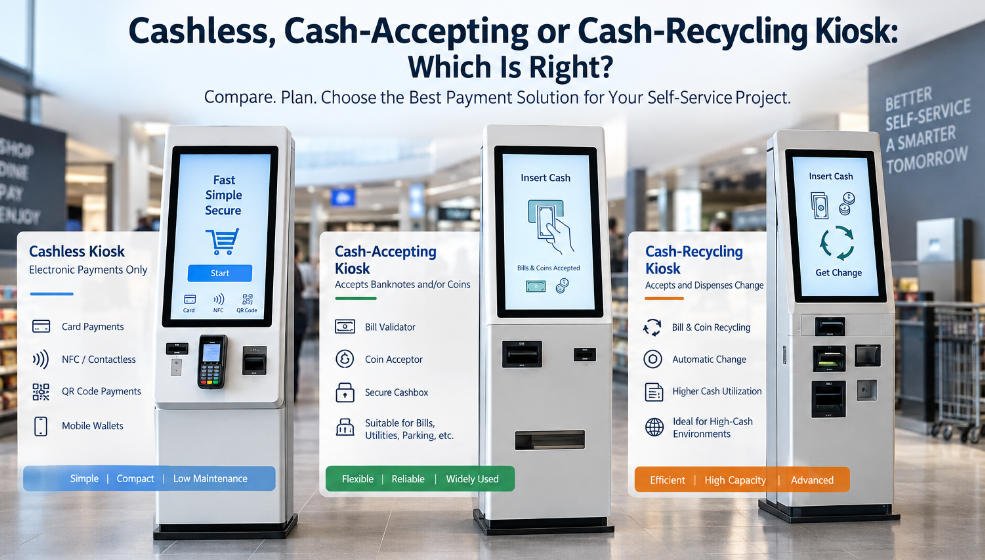
A kiosk can be designed as a completely cashless terminal, equipped with a basic cash acceptance module, or built around a cash-recycling system that accepts notes and coins and reuses them for change. These three configurations have very different implications for enclosure size, hardware cost, internal layout, maintenance, security, software integration, and daily cash management.
That makes cashless vs cash kiosk selection an engineering and operational decision rather than simply a payment preference.
A supermarket self-checkout system processing hundreds of cash transactions per day has different requirements from a restaurant ordering kiosk where 95% of customers pay by card or mobile wallet. Likewise, a utility payment terminal serving customers who regularly use banknotes may need capabilities that would be unnecessary in an airport check-in kiosk.
This guide explains how to compare cashless, cash-accepting, and cash-recycling kiosk configurations—and what procurement teams should evaluate before specifying the hardware.
The Three Main Payment Configurations
Before comparing costs or hardware, it helps to separate the three architectures clearly.
1. Cashless Kiosk
A cashless kiosk accepts electronic payments only. Depending on the application and market, this may include:
- Credit and debit cards
- EMV chip payments
- Contactless/NFC payments
- QR code payments
- Mobile wallets
- Closed-loop membership or stored-value cards
Because there is no banknote or coin handling system, the internal structure is relatively simple.
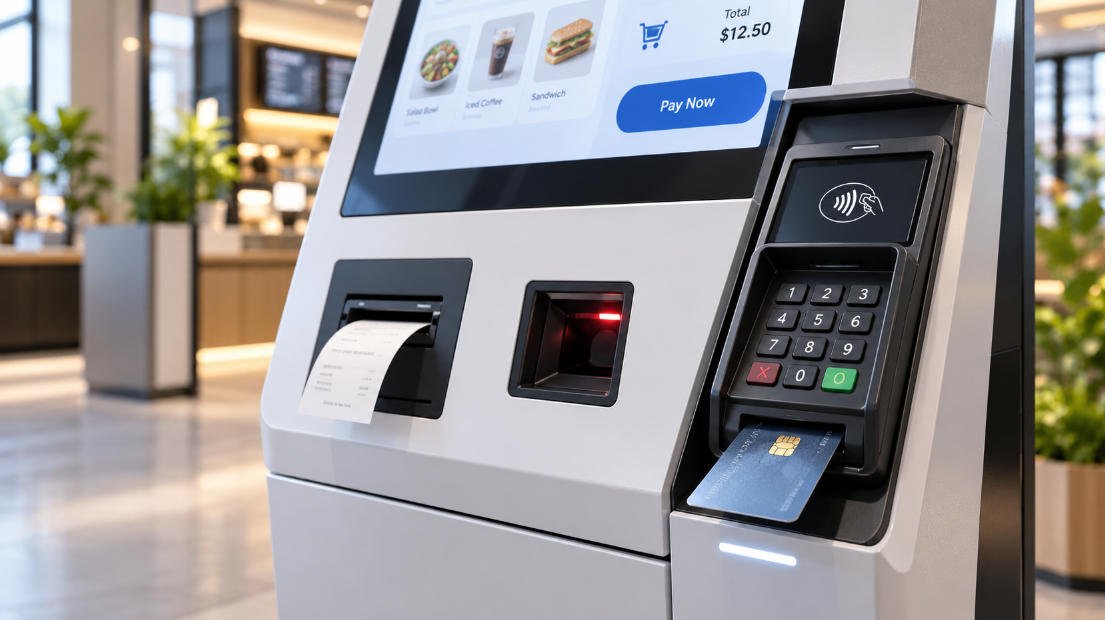
A typical cashless kiosk may only require a payment terminal, receipt printer, scanner and the computer/display hardware needed for the application.
2. Cash-Accepting Kiosk
A cash payment kiosk accepts notes, coins, or both, but does not necessarily return the same cash to another customer.
For example, a bill-payment terminal might accept banknotes into a secure cashbox. The collected notes remain inside the kiosk until authorized staff remove them.
Depending on the transaction model, the kiosk may operate on an exact-payment basis or include a separate change dispenser.
This architecture sits between a simple cashless terminal and a full recycler.
3. Cash-Recycling Kiosk
A cash recycler kiosk goes one step further.
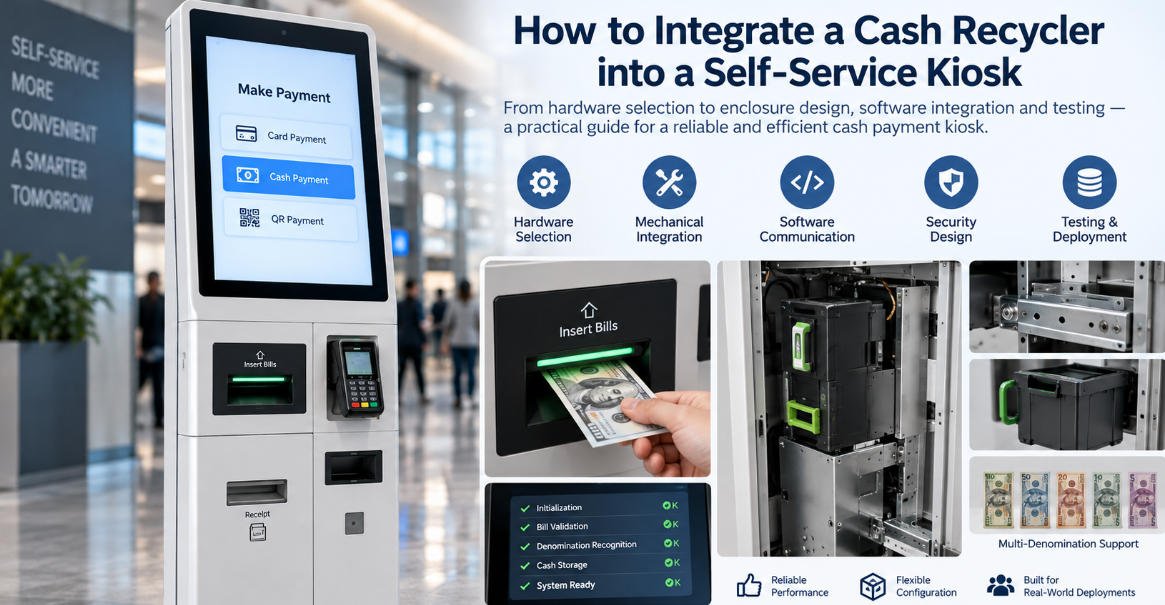
Instead of simply storing accepted banknotes or coins, compatible cash is validated, sorted and retained in recycling modules. Those notes or coins can then be used for subsequent transactions requiring change.
Imagine one customer inserts a $20 note for a $12 transaction. The machine returns $8. Later, some of the cash accepted from earlier customers can become part of that payout inventory.
The principle sounds straightforward. The engineering behind it is not.
A recycler introduces more complex cash-routing mechanisms, denomination management, security requirements, sensors, software communication and service procedures.
Cashless vs Cash Kiosk: A Practical Comparison
There is no universally correct payment architecture.
The right configuration depends on transaction behavior and the operating environment.
| Factor | Cashless | Cash-Accepting | Cash-Recycling |
|---|---|---|---|
| Initial hardware complexity | Low | Medium | High |
| Cabinet space required | Low | Medium | High |
| Cash collection required | No | Yes | Yes |
| Can accept banknotes/coins | No | Yes | Yes |
| Can provide change | No | Optional/separate | Yes |
| Cash float requirement | None | Depends on design | Yes |
| Mechanical maintenance | Low | Medium | Higher |
| Cash management complexity | Low | Medium | Higher |
| Suitable for cash-heavy locations | Limited | Good | Very good |
| Integration difficulty | Low | Medium | High |
This table is useful for initial planning, but purchasing decisions should be based on transaction data rather than features alone.
A recycler is not automatically “better” because it offers more functionality. In a predominantly cashless environment, the extra mechanisms may add cost and maintenance without providing enough operational value.
Conversely, removing cash purely to simplify the kiosk can create accessibility or conversion problems in markets where a meaningful percentage of customers still rely on physical currency.
When a Cashless Kiosk Makes Sense
Cashless hardware is usually the simplest configuration from a kiosk engineering perspective.
Removing note validators, coin acceptors, cashboxes and recycler assemblies frees significant internal space. That can allow a slimmer enclosure, easier cable routing and better service access.
It also reduces the number of moving mechanical components.
Cashless kiosks are particularly suitable for environments such as:
- Quick-service restaurants with strong card/mobile adoption
- Corporate cafeterias
- Airports
- Hotels
- Membership-based facilities
- Modern retail environments
- Check-in applications
- Ticketing locations with predominantly digital payments
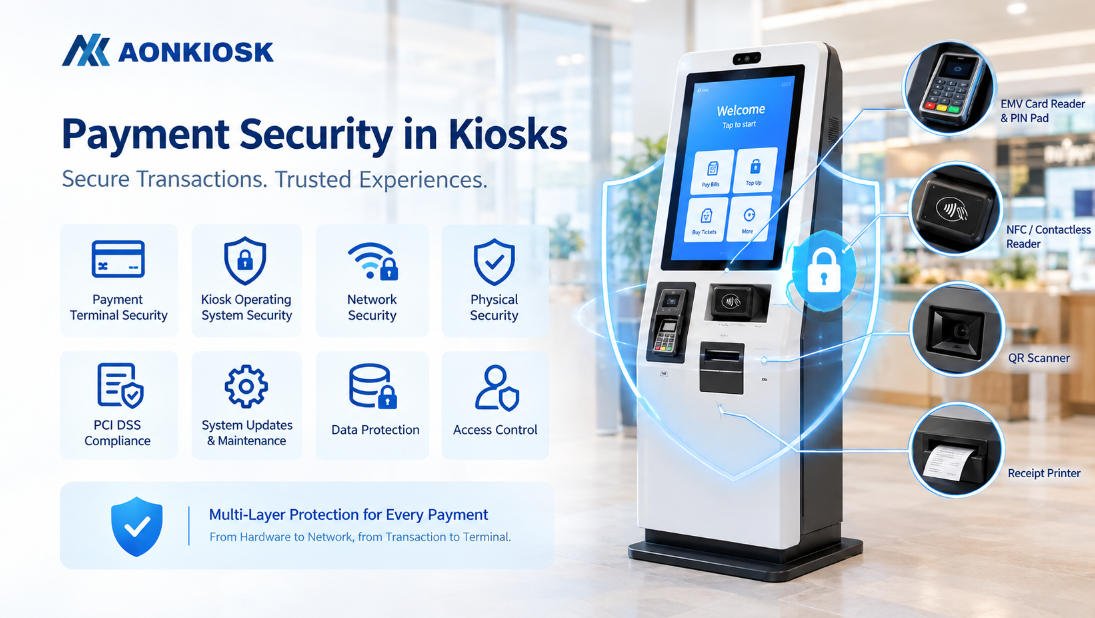
AONKIOSK’s Retail & Payment Kiosks can be configured around card, QR, NFC and other payment hardware depending on project requirements.
However, payment adoption should be verified locally before standardizing a large deployment.
Do not assume that a successful cashless configuration in one country, city or store format will automatically work in another. Customer demographics, transaction value, banking penetration and local payment habits can materially change the result.
When a Cash-Accepting Kiosk Is the Better Compromise
Sometimes customers need to pay with cash, but the transaction model does not justify a full recycler.
That is where a basic cash payment kiosk can make sense.
Consider a utility payment terminal.
Customers may insert banknotes to pay electricity, telecommunications or other bills. If the workflow allows fixed denominations, account credit, or another method of handling excess payment, the kiosk may only need to validate and securely store the notes.
The system is therefore considerably simpler than a machine that must constantly maintain the correct combination of denominations for change.
Cash acceptance can be especially relevant for:
- Utility payment kiosks
- Government service terminals
- Transportation systems
- Parking payment machines
- Unattended retail
- Bill payment terminals
- Certain ticketing applications
A basic cash-accepting system still requires careful mechanical design.
The validator needs an ergonomic insertion position. The cashbox must be accessible to authorized staff but protected from unauthorized access. Doors, locks, mounting structures and internal brackets need to account for both security and routine servicing.
Capacity matters as well.
A small cashbox might work perfectly during a prototype demonstration but become a major operational problem when the kiosk processes hundreds of transactions between service visits.
This is why transaction volume should be discussed before the enclosure is finalized.
When Does a Cash Recycler Kiosk Become Worth Considering?
The strongest case for a cash recycler kiosk appears when a location has substantial cash usage and frequently needs to provide change.
Supermarkets are an obvious example.
If customers continuously insert multiple denominations and the kiosk must return change throughout the day, simply collecting all incoming cash while maintaining a separate payout inventory can be inefficient.
Recycling can reduce that imbalance by reusing eligible cash.
But the business case should be based on actual operating numbers.
Before specifying a recycler, estimate:
Cash transaction share. If only 5% of transactions use cash, an expensive recycling mechanism may have a weak return.
Daily transaction volume. Higher throughput makes cash automation more valuable.
Average transaction value. A $3 transaction and a $300 transaction create very different denomination requirements.
Typical notes inserted. Customers frequently paying small transactions with large notes can rapidly drain certain payout denominations.
Service frequency. How often can staff realistically replenish and collect cash?
Downtime cost. What happens commercially if the recycler cannot accept or dispense a required denomination?
These questions are much more useful than simply asking a kiosk manufacturer to “add a cash recycler.”
The Hidden Cost Is Often the Enclosure, Not Just the Cash Module
One of the most overlooked differences in cashless vs cash kiosk projects is what cash hardware does to the physical kiosk.
A payment terminal is relatively compact.
Cash-handling equipment is not.
Banknote validators, recyclers, coin hoppers, coin recyclers, cashboxes and associated routing systems can consume a substantial portion of the enclosure.
They also require service clearance.
A module that technically fits inside a CAD model may still be impossible to remove conveniently when the kiosk is installed against a wall.
For this reason, cash integration can affect:
- Overall kiosk width and depth
- Internal mounting frames
- Door dimensions
- Lock placement
- Center of gravity
- Ventilation
- Cable routing
- Service access
- Shipping weight
- Anti-tipping requirements
At AONKIOSK, our OEM & ODM kiosk manufacturing process allows the enclosure, internal structure and peripheral mounting system to be developed around the required hardware rather than forcing every project into the same standard cabinet.
For cash projects in particular, that distinction matters.
Cash Capacity Should Be Calculated Before Hardware Selection
Procurement teams often compare cash modules by specification sheets: accepted denominations, cassette capacity, interface and dimensions.
Those specifications are important, but they do not tell you whether the machine is correctly sized for your operation.
Start with expected transaction behavior.
Suppose a kiosk processes 400 transactions per day and 35% are cash payments. That means approximately 140 cash transactions—not 400.
The next question is what those 140 transactions look like.
How many notes does the average customer insert? Which denominations? How much change is normally required? How many days should the kiosk operate before cash collection?
A module with apparently generous capacity can still become a bottleneck if one denomination fills much faster than others.
For a recycler, denomination balance becomes even more important because availability affects the machine’s ability to return change.
Real transaction data from existing stores or comparable locations is therefore far more valuable than choosing capacity based on maximum specifications alone.
Maintenance Changes Dramatically Once Cash Is Added
Electronic payment devices generally have few moving parts exposed to customers.
Cash hardware is different.
Banknotes may be folded, damaged or dirty. Coins vary in wear and condition. Foreign objects can enter openings. Transport mechanisms, sensors and belts operate repeatedly.
That means maintenance planning should be part of the purchasing decision from the beginning.
Ask who will:
- Clear note or coin jams
- Empty cashboxes
- Replenish denominations
- Replace wear components
- Perform preventive cleaning
- Reconcile physical cash with transaction records
- Respond when a module goes offline
A cash recycler kiosk that is excellent on paper can become expensive if every minor service event requires a specialist technician.
Accessibility matters here too. Well-designed service doors, removable mounting brackets and organized internal cabling can significantly reduce repair time.
AONKIOSK’s manufacturing approach includes mechanical engineering considerations such as internal layout, maintenance access, cable management and peripheral compatibility—areas that become particularly important as kiosk hardware complexity increases.
Do Not Treat Security as a Component-Level Question
Cash security involves more than selecting a lockable cashbox.
Once a kiosk holds meaningful amounts of money, the entire enclosure becomes part of the security architecture.
Project teams should evaluate:
- Reinforced internal mounting
- Controlled service-door access
- Lock selection
- Cash cassette removal procedures
- Tamper detection
- Kiosk anchoring
- Camera placement where appropriate
- Audit logs
- Staff access permissions
- Cash collection procedures
The operating location also changes the risk.
A supervised indoor supermarket kiosk and an unattended payment machine accessible late at night should not automatically use identical enclosure designs.
Security therefore needs to be considered at both hardware and operational levels.
Software Integration Is More Complex with Recycling
A card terminal typically communicates transaction status such as approval, decline or cancellation.
Cash recycling requires a much richer conversation between the application and hardware.
The software may need to know:
- Which denomination was inserted
- Whether the note or coin is valid
- Current denomination inventory
- Required change
- Whether sufficient change is available
- Which denominations were dispensed
- Whether a note jam occurred
- Whether a cassette is full
- Whether a recycler module is unavailable
Error handling deserves particular attention.
What should happen if a customer inserts $50 and the kiosk discovers that it cannot dispense the required change?
The answer cannot be decided by the enclosure manufacturer alone. It requires coordination between the kiosk application, cash-module SDK/API, payment workflow and operational policy.
That is why hardware-software validation should happen during prototype development rather than after mass production.
A Better Way to Specify Your Payment Kiosk
Instead of sending a supplier a request saying, “We need a kiosk with cash payment,” prepare a payment profile.
Include expected transaction volume, cash percentage, currencies, denominations, average transaction value, change requirements, collection schedule and preferred cash hardware if already selected.
Then add environmental information: installation location, available floor space, operating hours, supervision level and accessibility requirements.
Finally, define the other peripherals.
A cash system may need to coexist with:
- Touchscreen
- Industrial PC
- Receipt printer
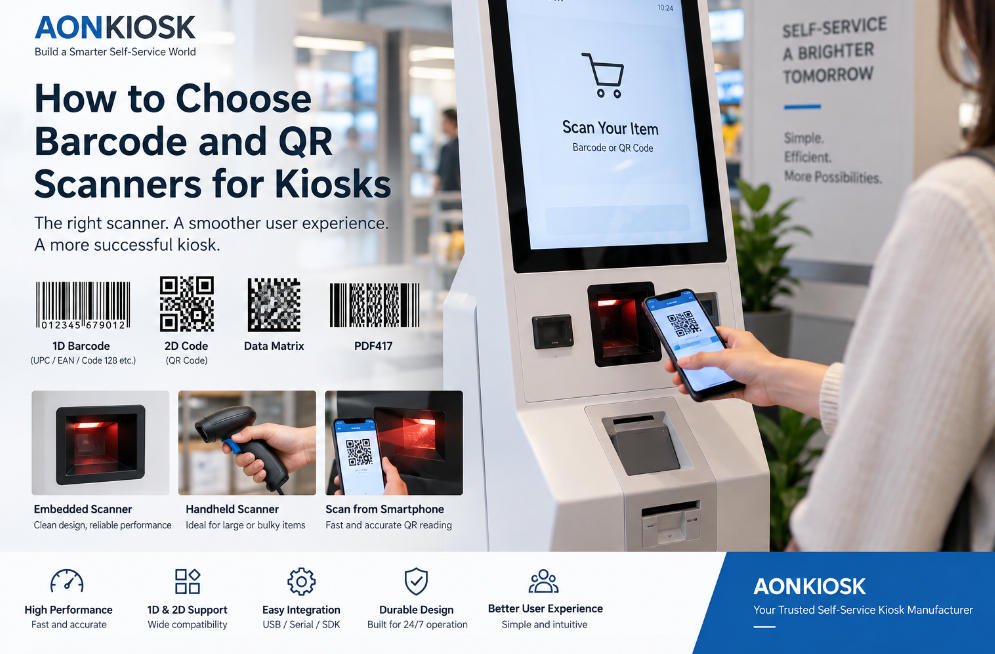
- Barcode/QR scanner
- Payment terminal
- NFC reader
- Camera
- Speakers
- UPS
- Network equipment
The challenge is not integrating each component individually. It is making all of them fit, operate and remain serviceable as one commercial machine.
That is the role of the kiosk’s mechanical and integration design.
Which Configuration Should You Choose?
A useful decision framework is surprisingly simple.
Choose cashless when electronic payments dominate, compact hardware and low maintenance are priorities, and excluding cash does not create a meaningful customer-access problem.
Choose cash acceptance when physical currency remains important but the transaction workflow does not require sophisticated automatic change management.
Consider a cash recycler kiosk when cash volume is substantial, providing change is essential, and reducing manual replenishment or improving cash utilization can justify the additional hardware and service complexity.
Most importantly, do not select the payment architecture based on the longest feature list.
The best configuration is the simplest one that reliably supports the real transaction behavior of the deployment.
Designing the Kiosk Around the Payment Workflow
A payment module should not be added at the end of kiosk development.
It influences enclosure dimensions, internal structure, service doors, user ergonomics, cable routing, security and software integration from the beginning.
For custom projects, AONKIOSK focuses on developing self-service kiosk hardware around the required peripherals and deployment environment. Configurations can include touchscreens, industrial computers, payment terminals, QR/barcode scanners, receipt printers and other modules, with prototype and production support available for OEM/ODM projects.
If you are planning a new cash payment kiosk, start with the transaction workflow rather than the cabinet.
Define who will use it, how they will pay, how much cash will move through the machine, how change will be handled, and who will service it.
Once those answers are clear, the hardware architecture becomes much easier to engineer.
Explore AONKIOSK custom self-service kiosk solutions for payment kiosk platforms and OEM/ODM hardware integration options.
Frequently Asked Questions
What is the main difference between a cash-accepting kiosk and a cash recycler kiosk?
A cash-accepting kiosk validates and stores physical currency, typically inside a secure cashbox. A cash recycler can retain suitable accepted denominations and later use them to dispense change. Recycling therefore requires more sophisticated hardware, inventory management and software integration.
Is a cash recycler kiosk always better than a standard cash payment kiosk?
No. A recycler provides additional capabilities but also increases hardware cost, integration complexity and maintenance requirements. For low cash volumes or transactions that do not require change, simpler cash acceptance may be more appropriate.
Can one kiosk accept cash, cards and QR payments?
Yes. A multi-payment kiosk can be designed with cash hardware alongside card terminals, NFC readers and QR scanners, provided sufficient internal space, interface compatibility and software support are available.
Does adding cash handling make a kiosk larger?
Usually, yes. Cash validators, recyclers, coin modules and secure storage require considerably more internal space than most electronic payment terminals. The exact effect depends on the selected components and required cash capacity.
What information should I provide when requesting a cash kiosk quotation?
Provide the target country and currency, accepted denominations, whether change is required, expected daily transaction volume, estimated cash-payment percentage, preferred cash module if known, required peripherals, kiosk installation environment and anticipated service schedule.
Can AONKIOSK integrate third-party payment and cash-handling hardware?
AONKIOSK supports customized kiosk hardware and third-party peripheral integration based on project requirements. Compatibility should be evaluated using the exact model, mechanical dimensions, interfaces and integration requirements before the enclosure design is finalized.