





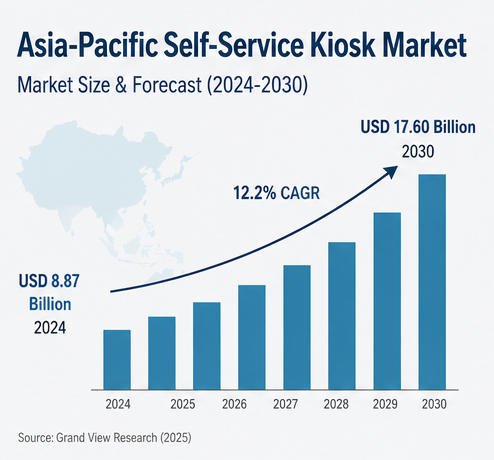
The Asia-Pacific self-service kiosk market is entering a high-growth stage as retailers, banks, hospitals, restaurants, transportation operators and public-service organizations invest in automation to reduce queues, improve service speed and support digital payment behavior. In 2024, the Asia-Pacific self-service kiosk market generated approximately USD 8.87 billion in revenue and is projected to grow at a 12.2% CAGR from 2025 to 2030, making it one of the most dynamic regional markets worldwide. China is expected to record the fastest country-level growth in the region during this period.
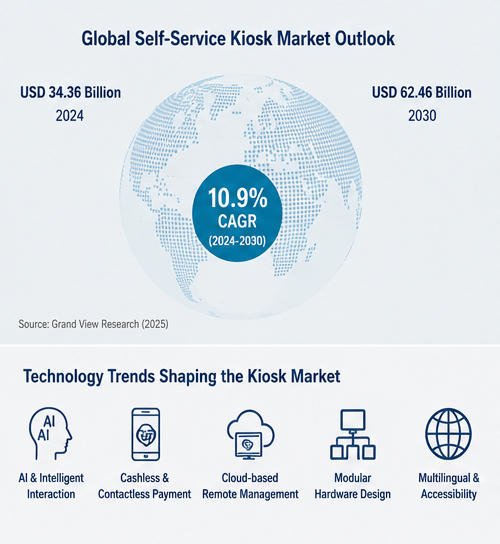
Globally, the self-service kiosk market was valued at about USD 34.36 billion in 2024 and is forecast to reach USD 62.46 billion by 2030, growing at a 10.9% CAGR. Asia-Pacific is growing faster than the global average because of dense urban populations, rapid digital payment adoption, labor-cost pressure, smart-city investment and rising customer expectations for contactless, multilingual and always-available service.
Why Asia-Pacific Is Becoming a Self-Service Kiosk Growth Engine
Asia-Pacific has several structural advantages for kiosk adoption. First, the region has a large and increasingly urban consumer base. Shopping malls, railway stations, airports, hospitals, convenience stores and quick-service restaurants require high-throughput service systems. Second, consumers in major Asian markets are already familiar with QR codes, mobile wallets, digital identity tools and app-based ordering. This makes kiosk adoption easier than in markets where cash and manual service remain dominant.
Third, labor shortages and rising wages are pushing businesses to automate repetitive front-end tasks such as ordering, check-in, ticketing, payment, registration and wayfinding. Kiosks do not fully replace staff; instead, they allow staff to focus on customer support, fulfillment, maintenance and higher-value service.
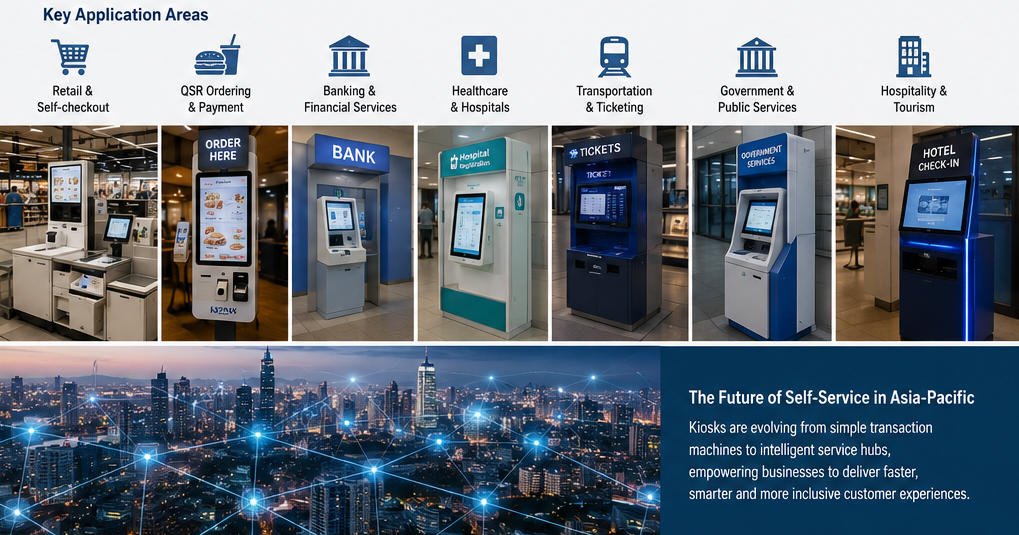
The most active application areas include:
Retail self-checkout and product lookup
QSR ordering and payment kiosks
Banking, ATM and financial-service kiosks
Hospital registration and queue-management kiosks
Airport, railway and metro ticketing kiosks
Government-service and smart-city terminals
Hotel check-in and tourism information kiosks
EV charging, parking and unattended payment kiosks
China: The Fastest-Growing Opportunity in Asia-Pacific
China is expected to be the fastest-growing self-service kiosk market in Asia-Pacific from 2025 to 2030. The country’s growth is driven by its advanced digital payment ecosystem, large retail networks, smart-city programs and strong consumer acceptance of automation.
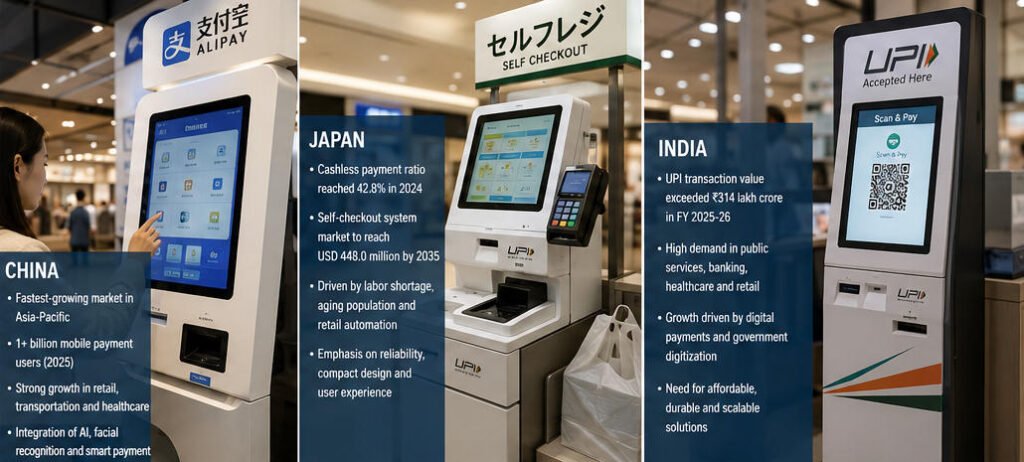
China has one of the world’s most mature mobile payment environments. As of June 2025, China had more than 1 billion mobile payment users, according to Statista. This payment infrastructure is highly favorable for kiosks because many machines can integrate QR payment, facial recognition payment, loyalty systems and mini-program ordering.
Retail is one of the most important kiosk use cases in China. Supermarkets, convenience stores, shopping malls and specialty retailers are adopting self-checkout terminals, interactive product displays and smart cash-register systems. A recent example is the launch of HarmonyOS-powered smart cash registers in China through cooperation involving Huawei, Alipay and Meiyijia, with rollout plans connected to tens of thousands of convenience stores. This shows how China’s kiosk ecosystem is moving beyond standalone hardware toward integrated payment, loyalty, advertising and retail-data platforms.
China’s transportation sector is another major driver. High-speed rail stations, metro systems, airports and bus terminals rely on ticketing, identity verification, information and passenger-service kiosks. Hospitals are also expanding self-registration, payment and report-printing terminals to reduce crowding and improve patient flow.
The key growth opportunities in China include AI-powered kiosks, multilingual tourism kiosks, smart retail terminals, hospital self-service systems, unattended payment kiosks and outdoor public-service kiosks. However, the market is also highly competitive. Buyers increasingly demand customized software, cloud management, payment security, durable hardware and fast after-sales support.
Japan: Stable Growth Driven by Labor Shortage and Cashless Transformation
Japan’s self-service kiosk market is more mature than many other Asian markets, but it continues to grow steadily because of labor shortages, an aging population, tourism recovery and the shift toward cashless payments.
Japan’s cashless payment ratio reached 42.8% in 2024, up from 13.2% in 2010, surpassing the government’s 40% target one year early. This is important because kiosks become more efficient when customers can pay quickly with cards, QR codes, IC cards and mobile wallets.
Self-checkout is one of Japan’s strongest kiosk segments. Japan’s self-checkout systems demand was valued at about USD 211.4 million in 2025 and is forecast to reach USD 448.0 million by 2035, growing at a 7.8% CAGR. The adoption is especially visible in supermarkets, pharmacies, convenience stores and specialty retailers. Grand View Research also notes that Japan’s self-checkout market is supported by aging demographics, labor shortages and strong technology infrastructure.
Japan is also a strong market for compact, reliable and space-efficient kiosk designs. Retail floor space is expensive, and operators often prefer smaller systems with intuitive interfaces, barcode scanning, cashless payment, RFID support and multilingual functions. For transportation and tourism, kiosks must support English, Chinese, Korean and Japanese interfaces to serve international travelers.
Unlike China, where rapid digital transformation often drives large-scale deployment, Japan’s market emphasizes reliability, user experience, precision engineering and long product life cycles. For kiosk manufacturers, success in Japan depends on quality certification, stable components, low failure rates, accessibility design and strong local service partnerships.
India: High-Growth Market Supported by Digital Payments and Public Digitization
India is becoming one of the most promising self-service kiosk markets in Asia-Pacific. The country has a large population, fast-growing digital payment infrastructure, expanding organized retail, rising healthcare demand and increasing government digitization.
India’s Unified Payments Interface, or UPI, has become a major foundation for kiosk adoption. According to India’s Ministry of Finance, UPI transaction value exceeded ₹314 lakh crore in FY 2025–26, and more than 700 banks were connected to the system. UPI’s scale makes India highly suitable for low-cost QR-enabled kiosks in retail, transportation, government services, bill payment, ticketing and food ordering.
India’s kiosk opportunity is different from China and Japan. The market is not only about high-end automation; it also requires affordable, rugged and scalable solutions. Many deployments need to work in high-traffic environments, semi-urban areas and public-service locations where reliability, multilingual support and easy maintenance are essential.
Key Indian use cases include:
Government-service kiosks for certificates, payments and citizen services
Banking and financial-inclusion kiosks
Hospital registration and queue-management systems
Railway, metro and bus ticketing kiosks
QSR and food-court ordering kiosks
Retail self-checkout and bill-payment terminals
Education, telecom and utility-service kiosks
India’s long-term potential is strong because kiosks can help bridge service gaps in areas where staff availability, branch networks or physical counters are limited. For manufacturers, the winning formula in India is cost-effective hardware, UPI integration, local-language UI, offline/online hybrid operation, thermal management and durable enclosure design.
Key Technology Trends Across China, Japan and India
1. AI-Enabled Self-Service
AI is turning kiosks from simple transaction machines into intelligent service terminals. AI-powered kiosks can support voice interaction, product recommendation, customer recognition, fraud detection, predictive maintenance and real-time analytics. In multilingual Asia-Pacific markets, AI voice and translation features are especially valuable.
2. Cashless and Contactless Payment
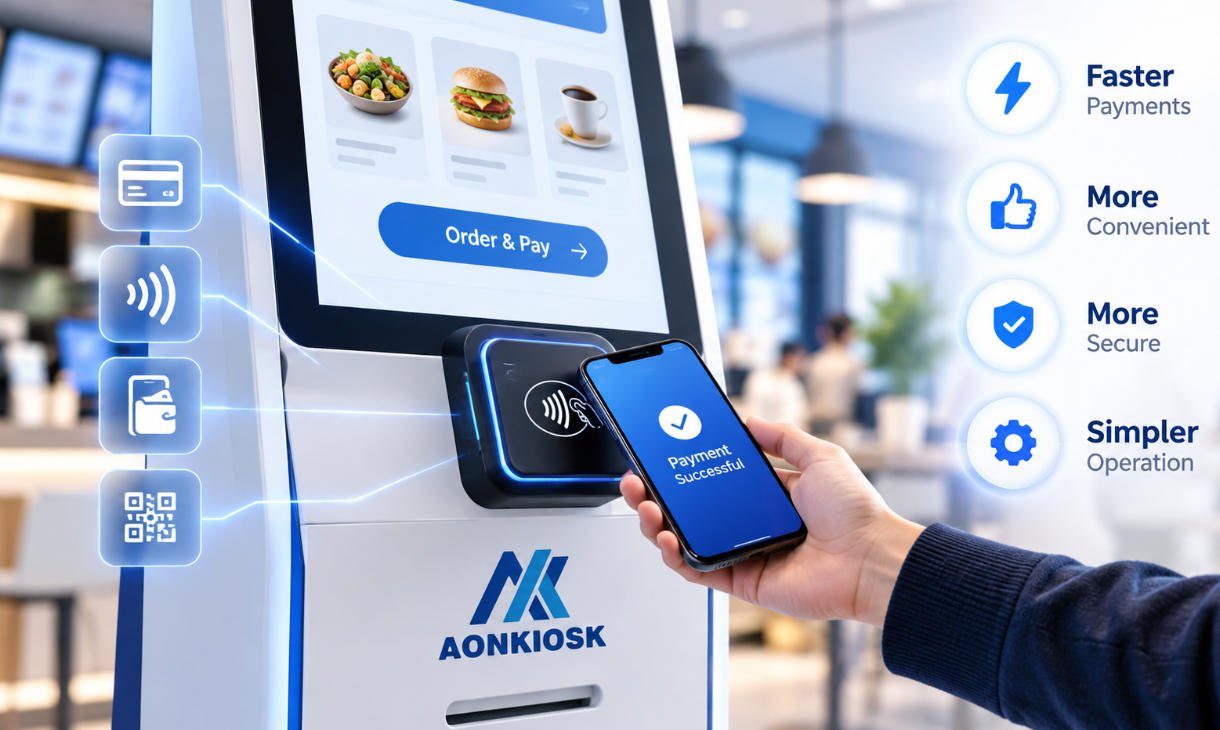
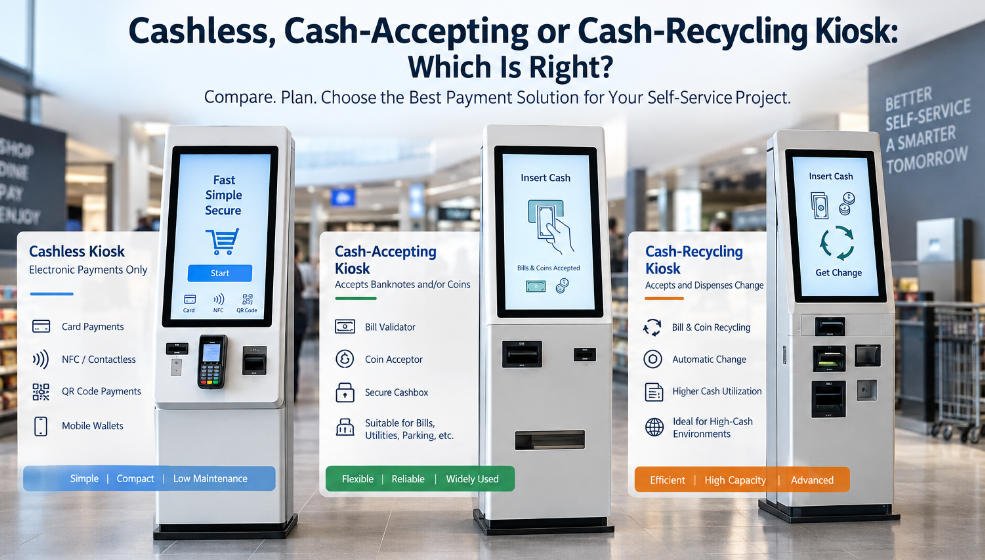
Cashless payment is one of the strongest kiosk adoption drivers. China’s mobile wallet ecosystem, Japan’s growing cashless ratio and India’s UPI network all reduce friction at the kiosk. Kiosks that support QR codes, NFC, cards, mobile wallets and local payment schemes will have stronger market acceptance.
3. Cloud-Based Remote Management
Large retailers, restaurant chains and transport operators need centralized kiosk monitoring. Cloud platforms allow operators to update content, monitor device health, detect errors, manage payments and analyze usage data remotely. This reduces downtime and improves operating efficiency.
4. Modular Hardware Design
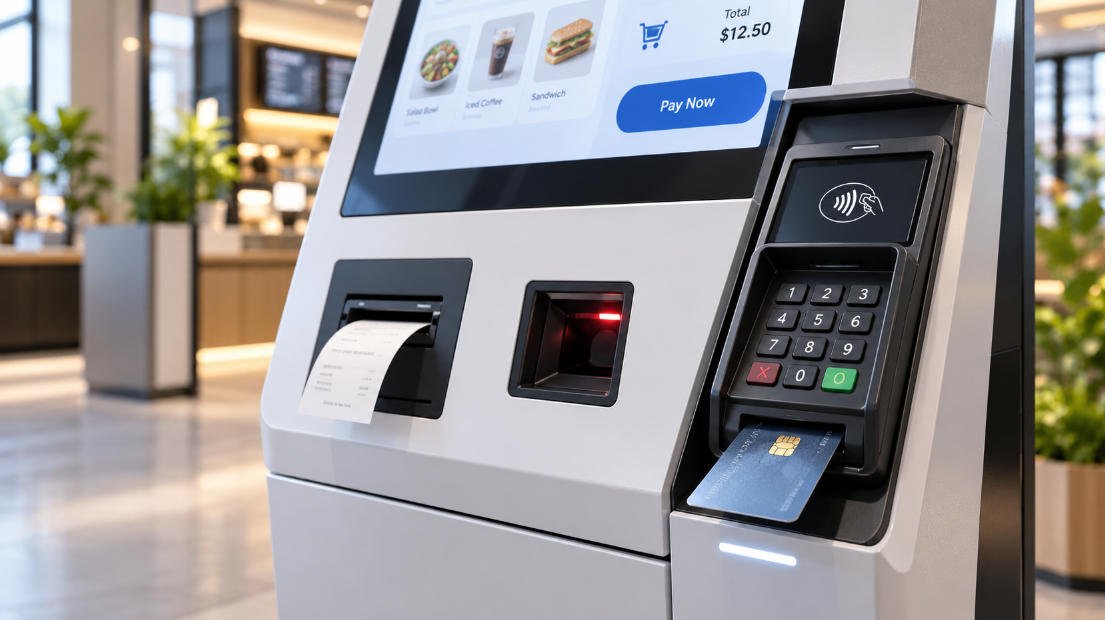
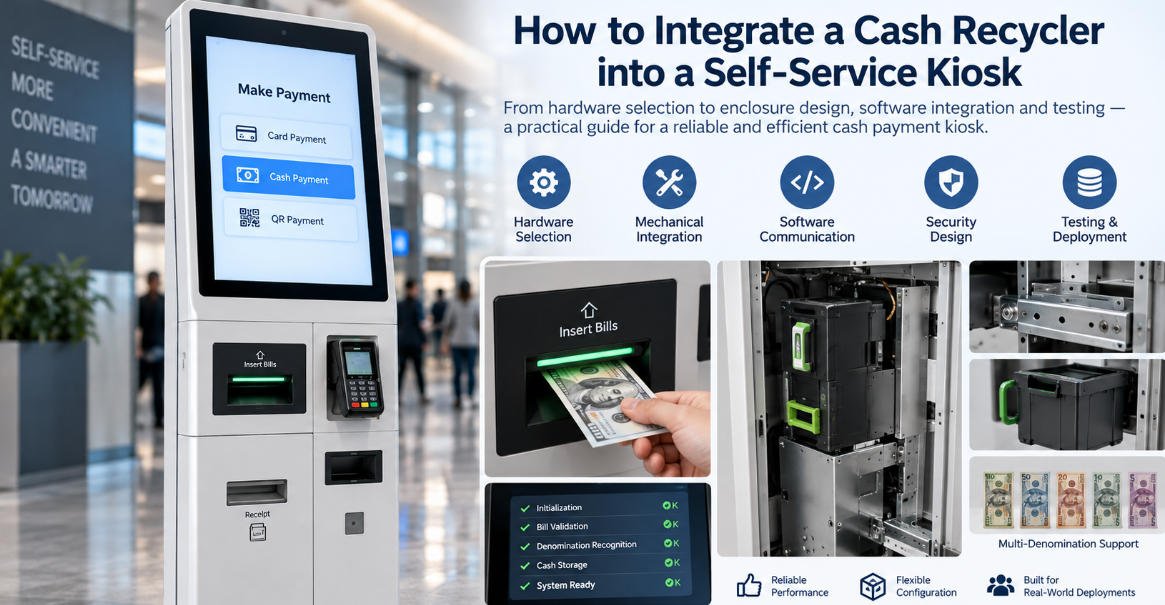
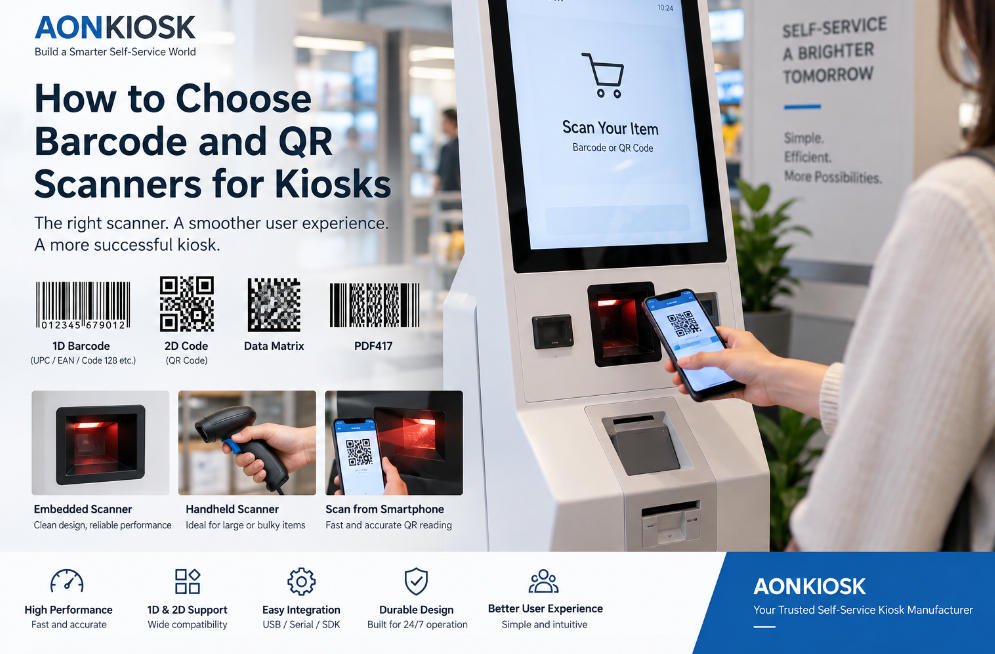
Different countries and industries need different configurations. A hospital kiosk may need ID scanning, card payment and printer modules. A QSR kiosk may need a large touchscreen, POS integration and receipt printer. A transportation kiosk may need rugged components, barcode scanners and outdoor protection. Modular design helps manufacturers serve multiple verticals with lower development cost.
5. Accessibility and Multilingual Interfaces
Japan’s aging population, India’s linguistic diversity and China’s tourism recovery all increase demand for accessible and multilingual kiosk interfaces. Larger fonts, audio guidance, wheelchair-friendly height, simple navigation and language switching are becoming essential design requirements.
Market Challenges
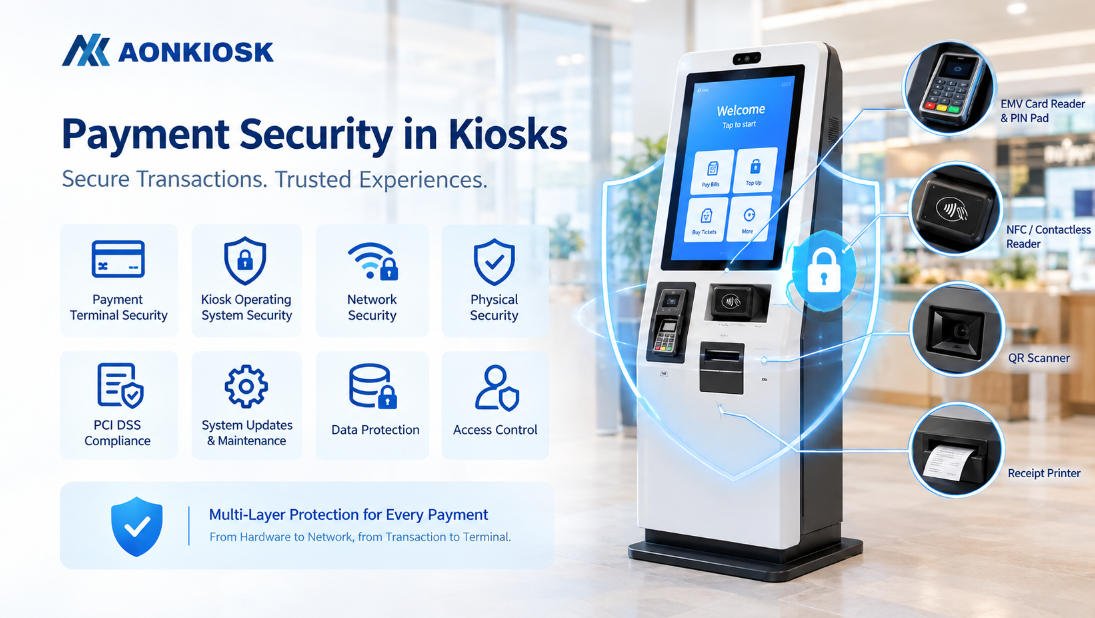
Despite strong growth, the Asia-Pacific kiosk market faces several challenges. Hardware cost remains a barrier for small businesses, especially in price-sensitive markets. Cybersecurity and payment compliance are also critical because kiosks handle personal and financial data. Maintenance is another concern: a kiosk that fails during peak hours can damage customer experience and reduce trust.
Localization is equally important. A kiosk built for China may not work well in Japan or India without adapting payment methods, interface language, user behavior, certification requirements and after-sales expectations. Manufacturers must avoid one-size-fits-all strategies.
Competitive Outlook
The Asia-Pacific market will reward companies that combine hardware reliability with software capability. In the past, kiosks were mainly hardware products. Today, buyers increasingly evaluate total solution value: operating system, payment integration, CMS, analytics, remote monitoring, security, industrial design, installation and lifecycle support.
China will likely lead in scale and speed. Japan will lead in quality-driven automation and retail efficiency. India will lead in digital public infrastructure and mass-market kiosk deployment. Together, these three countries will shape the next phase of Asia-Pacific self-service technology.
Conclusion
The Asia-Pacific self-service kiosk market is moving from optional automation to essential service infrastructure. China, Japan and India each represent a different growth model: China is mobile-payment-driven and scale-oriented; Japan is labor-efficiency-driven and quality-focused; India is digital-inclusion-driven and highly scalable.
For kiosk manufacturers, software developers and solution providers, the region offers significant opportunities from 2025 to 2030. The strongest growth will come from companies that can deliver secure, localized, payment-ready and remotely managed kiosk solutions for retail, healthcare, transportation, hospitality, banking and public services.
As consumers become more comfortable with self-service and businesses continue to face pressure to improve efficiency, self-service kiosks will play an increasingly important role in Asia-Pacific’s digital service economy.
References
Grand View Research – Global Self-Service Kiosk Market Report
Grand View Research – Asia-Pacific Self-Service Kiosk Market Outlook
Research and Markets – Self-Service Kiosk Market Forecasts
Statista – China Mobile Payment Users:
India Ministry of Finance / PIB – UPI Growth Data
Reuters – Japan Cashless Payment Ratio
Future Market Insights – Japan Self-Checkout Systems Market
Grand View Research – Self-Checkout Systems Market