





Bien que les termes kiosque et machine de libre-service soient souvent utilisés de manière interchangeable, ils ne décrivent pas le même type d'équipement.
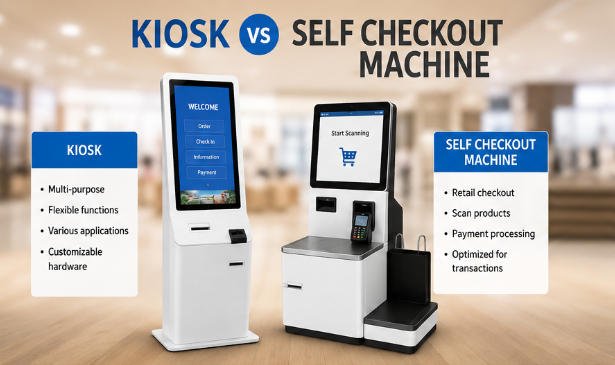
A machine de libre-service est un dispositif de vente spécialisé conçu spécifiquement pour le paiement par le client.
A kiosque libre-service est une plateforme matérielle plus large capable de prendre en charge de nombreuses applications différentes au-delà du paiement et du passage en caisse.
Comprendre cette distinction aide les intégrateurs de systèmes, les développeurs de logiciels, les détaillants et les partenaires OEM à sélectionner l'architecture matérielle appropriée pour leur déploiement.
Définition
Qu'est-ce qu'une borne libre-service ?
Un kiosque libre-service est un terminal informatique interactif qui permet aux utilisateurs d'effectuer des tâches prédéfinies sans l'assistance du personnel.
La fonctionnalité d'un kiosque est déterminée principalement par son logiciel et ses modules matériels intégrés.
Les applications typiques incluent :
- Commande en libre-service
- Enregistrement à l'hôtel
- L'enregistrement des visiteurs
- Émission de billets
- La gestion des files d'attente
- Consultation d’informations
- Paiement de factures
- Les services d'adhésion
- Impression de documents
Un kiosque est considéré comme une plateforme libre-service polyvalente.
Qu'est-ce qu'une machine de libre-service ?
Une machine de libre-service est un terminal de caisse de vente au détail conçu pour remplacer ou compléter les postes de caissiers traditionnels.
Son flux de travail logiciel se concentre exclusivement sur la réalisation de transactions de vente au détail.
Les fonctions typiques incluent :
- Scan de produits
- Gestion du panier
- Le traitement des paiements
- L’impression de reçus
- Confirmation d'achat
Contrairement aux kiosques polyvalents, les machines de libre-service sont optimisées pour les environnements de vente au détail où la rapidité, la précision des transactions et la prévention des pertes sont essentielles.
Comparaison fonctionnelle
| Fonction | Kiosque libre-service | Machine de libre-service |
|---|---|---|
| Enregistrement client | ✔ | — |
| Commande de repas | ✔ | — |
| Passage en caisse de produits | En option | ✔ |
| Scan de produits | En option | ✔ |
| Services d'adhésion | ✔ | Limité |
| Gestion des files d'attente | ✔ | — |
| Impression de billets | ✔ | — |
| Enregistrement à l'hôtel | ✔ | — |
| Paiement de vente au détail | En option | ✔ |
Architecture matérielle
Bien que les deux produits utilisent des ordinateurs industriels à écran tactile, leurs configurations périphériques diffèrent.
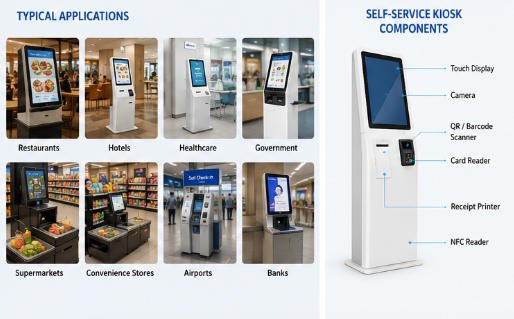
Composants typiques d'un kiosque libre-service
Un kiosque peut inclure :
- Écran tactile
- PC intégré
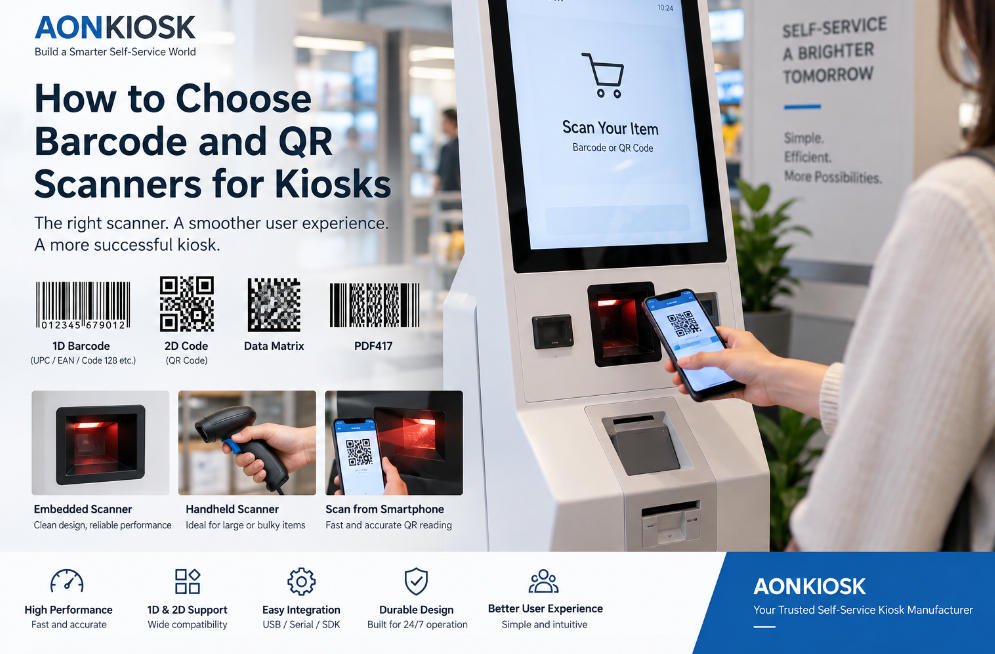
- Scanner QR
- Lecteur NFC
- Caméra
- Imprimante thermique
- Lecteur RFID
- Scanner de passeport
- Lecteur de carte d'identité
- Module d'empreinte digitale
- Caméra de reconnaissance faciale
- Distributeur de cartes
La sélection des composants dépend de l'application logicielle.
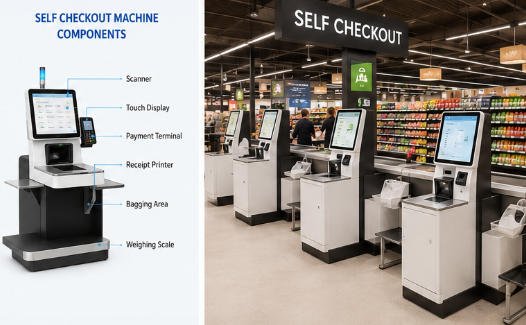
Composants typiques d'une machine de libre-service
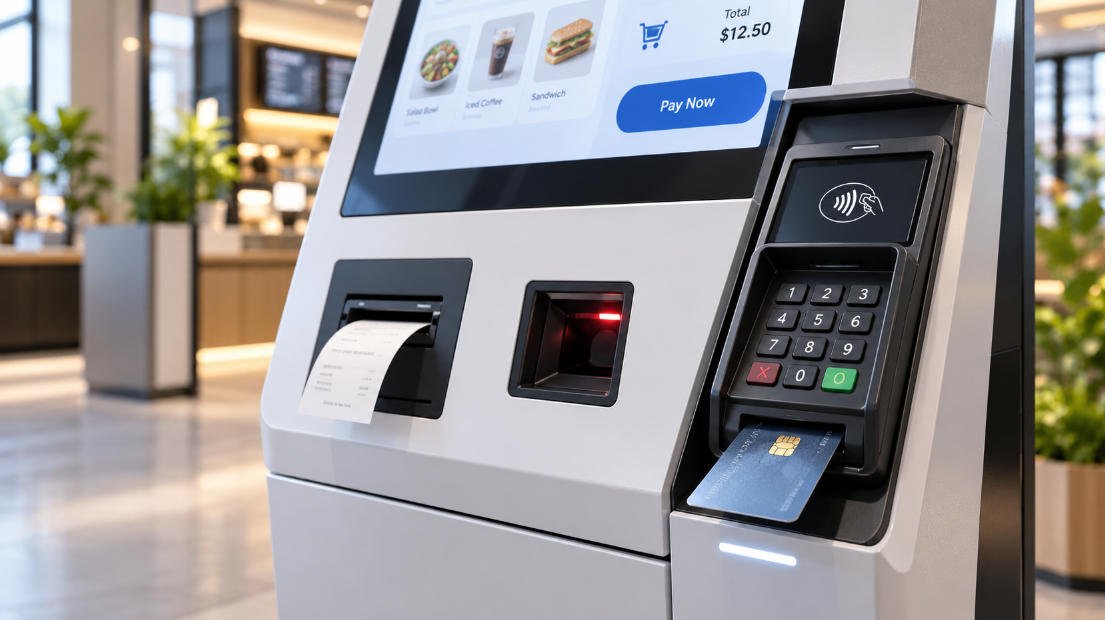
Les systèmes de caisse de vente au détail intègrent couramment :
- Scanner de codes-barres
- Écran client
- Terminal de paiement
- Imprimante de reçus
- Ordinateur POS
- Balance de pesée pour sacs
- Distributeur automatique de billets (en option)
- Distributeur de pièces de monnaie (en option)
- Caméra de sécurité
Ces dispositifs permettent un traitement efficace des transactions de vente au détail.
Différences logicielles
L’architecture logicielle constitue l’une des principales distinctions entre les deux systèmes.
Logiciel de borne libre-service
Se connecte généralement avec :
- ERP
- CRM
- Gestion des files d'attente
- PMS hôtelier
- SIH hospitalier
- Gestion des visiteurs
- Plateforme d’adhésion
- Système de billetterie
Le flux de travail varie selon l’application.
Logiciel de caisse libre-service
S’intègre généralement avec :
- PDV de vente au détail
- Gestion des stocks
- Base de données de tarification
- Moteur promotionnel
- Programme de fidélité
- Passerelle de paiement
- Système de prévention des pertes
Le flux de travail reste largement standardisé dans les environnements de vente au détail.
Scénarios de déploiement
Kiosque libre-service
Recommandé pour :
- Restaurants
- Hôtels
- Hôpitaux
- Bureaux gouvernementaux
- Aéroports
- Banques
- Établissements d’enseignement
- Centres d’accueil
Machine de libre-service
Recommandé pour :
- Supermarchés
- Supermarchés
- Magasins de proximité
- Pharmacies
- Chaînes de vente au détail
- Grands magasins
Un seul appareil peut-il remplir les deux fonctions ?
Oui.
De nombreuses plateformes de bornes modernes sont modulaires.
En intégrant des périphériques de vente au détail tels que :
- Scanner de codes-barres
- Terminal de paiement
- Balance
- Imprimante de reçus
une borne libre-service standard peut être configurée en machine de caisse libre-service.
La fonctionnalité finale dépend de :
- Logiciel installé
- Périphériques
- Flux de travail métier
Directives de sélection
Choisissez un kiosque libre-service lorsque votre application implique une interaction client au-delà de la caisse, comme l’inscription, la commande, l’enregistrement ou les services d’information.
Choisissez un machine de libre-service lorsque l’objectif principal est le traitement des transactions de vente au détail avec intégration de la numérisation des produits, du paiement et de la génération de reçus.