





Le secteur des services à l'échelle mondiale connaît une transformation numérique profonde. Des aéroports et hôtels aux gares ferroviaires, terminaux de croisière, hôpitaux et centres de location de voitures, les bornes d'enregistrement en libre-service sont devenues une technologie clé pour améliorer l'efficacité opérationnelle tout en offrant une expérience client plus rapide et plus pratique.
Sous l'effet des pénuries de main-d'œuvre, de la hausse des coûts d'exploitation, des attentes croissantes des voyageurs et de la demande de services sans contact, les organisations du monde entier accélèrent leurs investissements dans des solutions intelligentes en libre-service.
Aujourd'hui, les bornes d'enregistrement en libre-service ne se contentent plus de remplacer les comptoirs d'accueil traditionnels : elles deviennent des plateformes de services numériques intégrées, capables de vérification d'identité, de traitement des paiements, de numérisation de documents, d'impression de billets, d'authentification biométrique et de connectivité cloud.
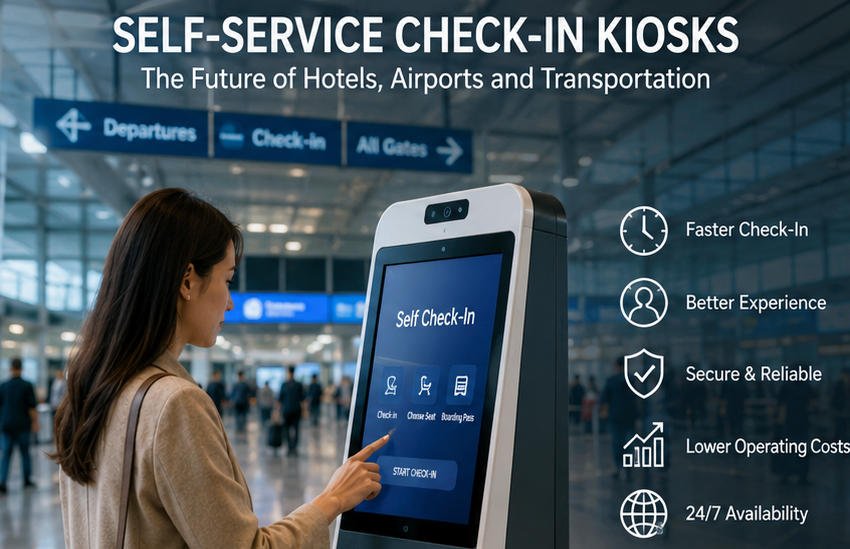
Cet article explore comment les bornes d'enregistrement en libre-service transforment les secteurs de l'hôtellerie, de l'aviation et des transports, les technologies qui les sous-tendent, et pourquoi elles resteront un élément essentiel des futurs écosystèmes de services intelligents.
Qu'est-ce qu'une borne d'enregistrement en libre-service ?
Une borne d'enregistrement en libre-service est un terminal interactif permettant aux clients d'effectuer de manière autonome les procédures d'inscription ou d'enregistrement, sans l'aide d'un employé.
Les bornes modernes comprennent généralement :
- Écran tactile de qualité industrielle
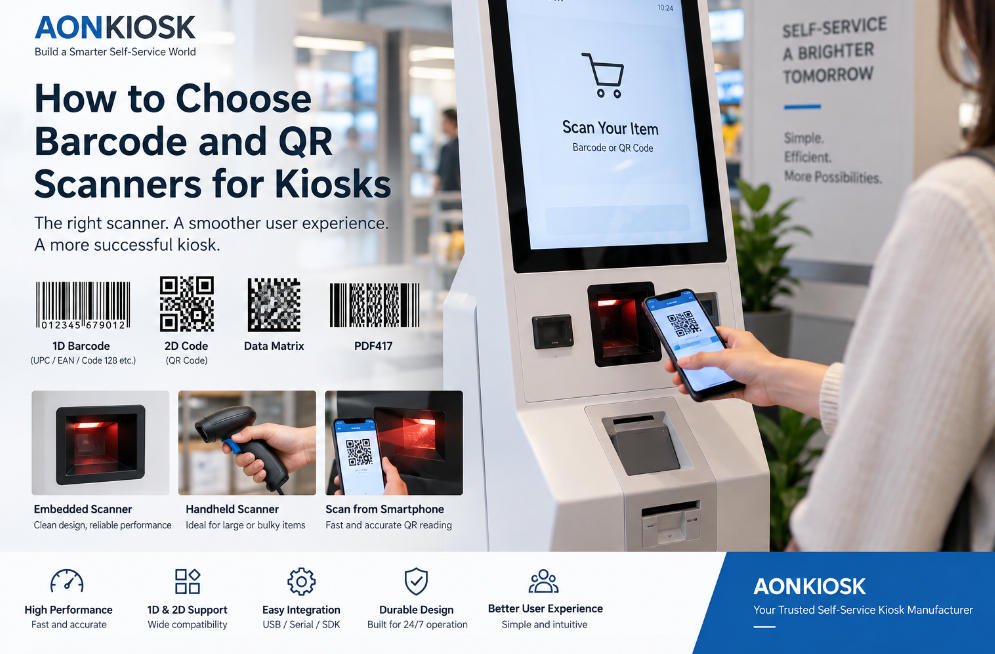
- Lecteur de code QR et de code-barres
- Scanner de passeport et de carte d'identité
- Lecteur RFID/NFC
- Terminal de paiement
- Imprimante de reçus ou de billets
- Imprimante de cartes d'embarquement
- Caméra de reconnaissance faciale (en option)
- Lecteur d'empreintes digitales (en option)
- Reconnaissance optique de caractères (OCR) pour passeports
- Logiciel de gestion basé sur le cloud
Selon l'application, la borne peut s'intégrer directement avec :
- Systèmes PMS hôteliers
- Systèmes de contrôle des départs des compagnies aériennes
- Plateformes de billetterie des transports
- Bases de données gouvernementales de vérification d'identité
- Passerelles de paiement
- Plateformes CRM
- Systèmes de gestion des files d'attente
Pourquoi l'enregistrement en libre-service devient la norme du secteur
Plusieurs tendances à long terme favorisent une adoption généralisée.
1. Réduction des coûts de main-d'œuvre
Les coûts de main-d'œuvre continuent d'augmenter dans le monde entier.
Les hôtels, aéroports et opérateurs de transports utilisent de plus en plus l'automatisation pour réduire le travail répétitif aux comptoirs d'accueil, tout en permettant aux employés de se concentrer sur un service client à plus forte valeur ajoutée.
Les bornes en libre-service peuvent fonctionner 24h/24 et 7j/7 sans interruption, permettant aux organisations de servir davantage de clients avec moins de personnel.
2. Traitement plus rapide des clients
L'un des principaux avantages réside dans la réduction des temps d'attente.
Les recherches montrent que les passagers effectuent généralement leur enregistrement sur borne en libre-service beaucoup plus rapidement qu'au comptoir traditionnel, en particulier pendant les périodes de pointe. Les temps de traitement typiques sur borne sont d'environ 60 à 90 secondes, contre environ 120 secondes pour un enregistrement traditionnel avec personnel dans de nombreux environnements aéroportuaires.
Des files d'attente plus courtes améliorent la satisfaction client tout en augmentant le débit global des installations.
3. Expérience sans contact
Suite à la pandémie de COVID-19, les clients se sont davantage familiarisés avec les services numériques en libre-service.
Les bornes à écran tactile incluent désormais souvent :
- Lecture de code QR mobile
- Authentification NFC
- Des paiements sans contact
- Clés de chambre numériques
- Récupération de billets mobiles
- Reconnaissance faciale
Ces fonctionnalités réduisent les interactions en face à face inutiles tout en améliorant la commodité.
4. Efficacité opérationnelle améliorée
Contrairement aux comptoirs de service traditionnels, les bornes ne sont jamais distraites ou incohérentes.
Elles offrent :
- Des flux de travail standardisés
- Une vérification d'identité précise
- Une génération automatique de documents
- Une synchronisation des données en temps réel
- Une tenue de registres numériques
Cela réduit considérablement les erreurs manuelles.
Enregistrement en libre-service dans les hôtels
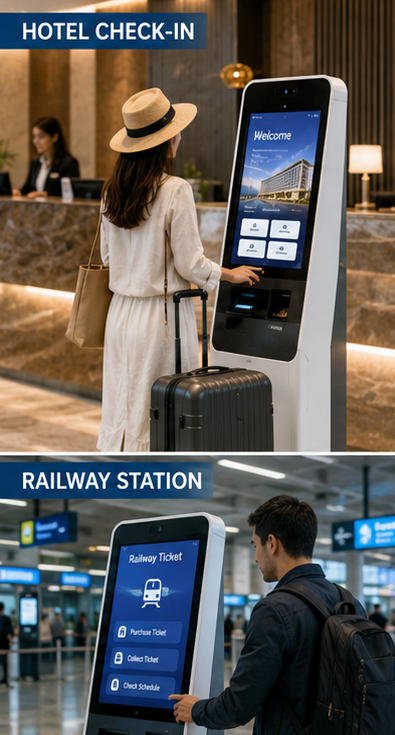
L'enregistrement autonome à l'hôtel est rapidement passé d'une fonctionnalité de luxe à une nécessité opérationnelle.
Les clients attendent de plus en plus :
- Une arrivée rapide
- Une attente minimale
- Un accès numérique à la chambre
- Des expériences axées sur le mobile
Processus type d'enregistrement à l'hôtel
- Le client scanne le code QR de réservation
- Le passeport ou la pièce d'identité est vérifié(e)
- Le paiement est effectué
- La fiche d'inscription est signée numériquement
- L'attribution de la chambre est générée
- La carte-clé de la chambre est distribuée automatiquement
- Le reçu est imprimé ou envoyé par courriel
L'ensemble du processus ne prend souvent que quelques minutes.
Les hôtels en bénéficient grâce à :
- Des besoins en personnel réduits
- Une capacité d'accueil 24 heures sur 24
- Une satisfaction client plus élevée
- Une réduction de l'encombrement à l'enregistrement
- Un meilleur support multilingue
Les hôtels de luxe, les hôtels d'affaires, les résidences avec services et les chaînes économiques ont tous étendu le déploiement de bornes ces dernières années.
Enregistrement en libre-service à l'aéroport
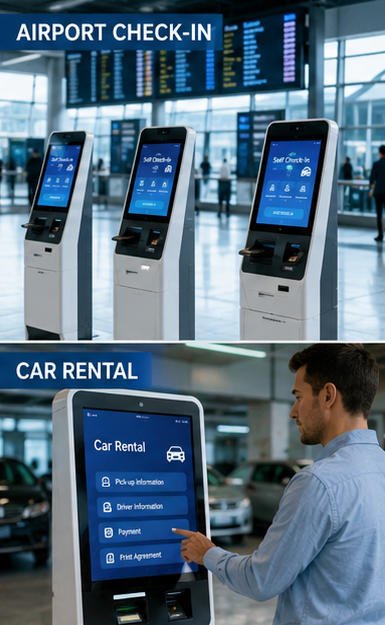
Les aéroports restent l'un des plus grands adoptants de bornes en libre-service.
Les passagers aériens peuvent désormais de manière indépendante :
- S'enregistrer
- Choisir leurs sièges
- Imprimer leurs cartes d'embarquement
- Imprimer leurs étiquettes à bagages
- Surclasser leurs sièges
- Acheter des services annexes
- Vérifier leurs documents de voyage
L'Association du transport aérien international (IATA) promeut depuis longtemps un plus grand libre-service pour les passagers grâce à des initiatives telles que les normes de libre-service en usage commun (CUSS), permettant aux voyageurs d'utiliser des bornes partagées entre plusieurs compagnies aériennes.
Avantages pour les aéroports
Les exploitants aéroportuaires en tirent des avantages significatifs :
- Un débit de passagers plus élevé
- Une réduction de l'encombrement
- Une meilleure utilisation de l'espace du terminal
- Des coûts de personnel réduits
- Une satisfaction des passagers améliorée
Une étude récente de planification aéroportuaire a révélé que le remplacement des comptoirs d'enregistrement traditionnels par des bornes en libre-service peut réduire l'espace d'enregistrement nécessaire d'environ 49–51% dans des conditions d'exploitation favorables, bien que la fiabilité et la composition des passagers influencent les résultats réels.
Applications dans le secteur des transports
Au-delà de l'aviation, l'enregistrement en libre-service se développe dans les transports.
Gares ferroviaires
Les passagers peuvent :
- Retirer leurs billets
- Vérifier leur identité
- Imprimer leurs itinéraires
- Surclasser leurs sièges
- Acheter des services supplémentaires
Terminaux de croisière
Les opérateurs de croisière utilisent des bornes pour :
- Vérification des passeports
- Impression de cartes d’embarquement
- L'attribution des cabines
- Le contrôle de sécurité
- Les déclarations de santé
Location de voitures
Les bornes de location permettent aux clients de :
- Vérifier le permis de conduire
- Signer les contrats
- Effectuer le paiement
- Recevoir les informations sur le véhicule
- Récupérer les clés
Cela réduit l'attente pendant les périodes de voyage chargées.
Gares routières
Les gares routières modernes proposent de plus en plus des bornes pour :
- La collecte des billets
- Les consultations d'horaires
- La planification d'itinéraires
- La validation d'embarquement
Technologies émergentes favorisant l'enregistrement de nouvelle génération
Les bornes modernes évoluent au-delà des simples terminaux à écran tactile.
Authentification biométrique
La reconnaissance faciale permet aux passagers et aux invités de vérifier rapidement leur identité sans présenter de multiples documents.
Les systèmes biométriques sont de plus en plus intégrés dans les parcours des passagers aériens dans le cadre de programmes d'identité numérique plus larges.
Intégration de l'IA
L'intelligence artificielle permet :
- Interaction vocale
- Des recommandations personnalisées
- Un guidage intelligent des clients
- Une traduction en temps réel
- Un dépannage automatisé
Gestion basée sur le cloud
Les plateformes cloud permettent aux opérateurs de :
- Surveiller l'état des bornes
- Déployer des mises à jour logicielles à distance
- Analyser le comportement des clients
- Générer des rapports opérationnels
- Gérer plusieurs sites à partir d'un seul tableau de bord
Intégration mobile
De nombreuses bornes fonctionnent désormais en toute transparence avec les smartphones.
Les clients peuvent :
- Scanner des codes QR
- Récupérer des réservations
- Utiliser des portefeuilles numériques
- Accéder aux clés de chambre mobiles
- Recevoir des reçus numériques
Avantages commerciaux
Les organisations mettant en œuvre un enregistrement en libre-service constatent généralement des améliorations dans plusieurs domaines :
| Avantage | Impact |
|---|---|
| Réduction des coûts de main-d'œuvre | Moins de personnel d'accueil requis |
| Service plus rapide | Files d'attente et temps d'attente réduits |
| Disponibilité 24h/24 et 7j/7 | Service client continu |
| Précision améliorée | Moins d'erreurs manuelles |
| Une expérience client améliorée | Plus grande commodité et autonomie |
| Intégration des données | Visibilité opérationnelle en temps réel |
| Opérations évolutives | Déploiement facile sur plusieurs sites |
Défis à prendre en compte
Un déploiement réussi nécessite plus que l'installation de matériel.
Les organisations doivent évaluer soigneusement :
Accessibilité
Les bornes doivent s'adapter à :
- Utilisateurs âgés
- Utilisateurs en fauteuil roulant
- Plusieurs langues
- Lecteurs d'écran
- Exigences d'accessibilité ADA ou régionales
Cybersécurité
Étant donné que les bornes traitent des informations personnelles et des paiements, les opérateurs doivent mettre en œuvre :
- Un chiffrement de bout en bout
- Une authentification sécurisée
- Des mises à jour logicielles régulières
- Une surveillance de la sécurité réseau
- La conformité aux réglementations sur la protection des données
Modèles de service hybrides
Tous les clients ne préfèrent pas le libre-service.
De nombreuses organisations performantes combinent :
- Bornes libre-service
- Applications mobiles
- Enregistrement assisté
- Comptoirs traditionnels avec personnel
Cette approche hybride améliore la flexibilité tout en garantissant l’accessibilité pour tous les utilisateurs.
Perspectives d’avenir
L’avenir de l’enregistrement en libre-service va bien au-delà du simple remplacement des comptoirs d’accueil.
Les systèmes de nouvelle génération intégreront de plus en plus :
- Assistance clientèle basée sur l’intelligence artificielle
- Vérification biométrique de l’identité
- Portefeuilles d’identité numérique
- Installations connectées à l’IoT
- Maintenance prédictive
- Des recommandations personnalisées
- Plateformes de gestion natives dans le cloud
Alors que les villes intelligentes, les systèmes de transport intelligents et l’hôtellerie numérique continuent de se développer, les bornes d’enregistrement en libre-service deviendront des composantes centrales des expériences client connectées.
Conclusion
Les bornes d’enregistrement en libre-service ont évolué en plateformes de services numériques intelligentes qui améliorent l’efficacité, réduisent les coûts d’exploitation et augmentent la satisfaction client dans les hôtels, aéroports, gares ferroviaires, terminaux de croisière et autres pôles de transport.
Plutôt que de remplacer entièrement le service humain, ces systèmes permettent au personnel de se concentrer sur des interactions personnalisées tandis que les tâches courantes sont automatisées. Les organisations qui investissent aujourd’hui dans des solutions de bornes sécurisées, accessibles et intégrées seront mieux positionnées pour répondre aux attentes croissantes des clients et concurrencer dans une économie de services de plus en plus numérique.
À mesure que des technologies telles que l’intelligence artificielle, la biométrie, le cloud computing et l’intégration mobile continuent de mûrir, les bornes d’enregistrement en libre-service joueront un rôle encore plus important dans la définition de l’avenir du voyage et de l’hôtellerie à l’échelle mondiale.
Références
- Association du transport aérien international (IATA) – Systèmes de traitement des passagers à usage commun (CUPPS) : https://www.iata.org/en/programs/passenger/common-use/
- Programme de recherche coopérative aéroportuaire (ACRP). Mise en œuvre du libre-service intégré dans les aéroports. https://crp.trb.org/acrp0715/wp-content/themes/acrp-child/documents/072/original/ACRP_136_Implementing_Integrated_Self-Service_at_Airports.pdf
- Wong, P. H. et al. (2024). L’adoption des bornes d’enregistrement en libre-service par les passagers aéroportuaires. https://pmc.ncbi.nlm.nih.gov/articles/PMC11471516/
- Wong, S. Y. (2024). Bornes d’enregistrement en libre-service dans la planification des terminaux aéroportuaires. https://www.researchgate.net/publication/385122879_Self-service_check-in_kiosks_in_airport_terminal_planning_Static_analysis_on_the_airport_check-in_space